Gravitic Alchemy
Gravitic Alchemy Banner

Category: Core Theory

  • IN THE BEGINNING

    IN THE BEGINNING

    The truth of God’s creation, understood through a scientific lens

    In the Beginning is not merely a theological phrase. It is a claim about how reality itself was physically established. Genesis opens by naming the origin of the created order and immediately grounds that origin in real substance, real motion, and real causation rather than abstraction or emptiness. The opening verses of Scripture, when read carefully, describe a created material domain in an early, unstructured state that is acted upon deliberately and progressively ordered.

    Genesis 1:1–2 (KJV) states, “In the beginning God created the heaven and the earth. And the earth was without form, and void; and darkness was upon the face of the deep. And the Spirit of God moved upon the face of the waters.” These verses do not describe a finished planet suspended in empty space. They describe the earliest physical conditions of creation before structure, illumination, and habitation were introduced.

    In the Beginning: What Genesis Actually Says

    The Hebrew word translated “earth” is ʾeretz (אֶרֶץ). In Biblical Hebrew, this term does not inherently mean a modern astronomical planet. It commonly refers to land, ground, territory, or more broadly the material domain or lower realm of creation. In Genesis 1, the context indicates that ʾeretz refers to a created material realm that exists but has not yet been shaped or organized. This is why the text can immediately describe it as “without form, and void” without contradiction. Existence precedes structure.

    The phrase “without form, and void” comes from the Hebrew tohu wa-bohu, which conveys a state that is real but unordered and unfilled. It is not nonexistence. It is a domain prior to differentiation. Darkness, in this opening description, is not evil or symbolic. It is the physical absence of illumination in a system that has not yet been energized. Scripture is establishing initial conditions, not metaphor.

    In the Beginning and the Meaning of “Earth” (ʾEretz)

    Understanding ʾeretz as a material domain rather than a completed globe resolves a major tension often imposed on the text. Genesis is not attempting to describe the universe as it appears after being fully developed. It is describing the initial state of the material realm itself. Heaven and earth are named as categories of created reality, not as finished products.

    This framing also removes the need for speculative “deep time” prior to Day One. If the material domain is created in an unstructured, unenergized state, then time is not required for it to cool, settle, or equilibrate. Cooling is a process that follows energy release. Genesis places energy input at the beginning, not before it.

    In the Beginning and the Waters of Creation

    Genesis then introduces “the deep” (tehom) and “the waters” (mayim). These words point to depth, continuity, and substance. The text does not say the waters contain fish, minerals, or differentiated matter. It presents them as a waterfield, a continuous medium that is initially void of energy and other formed contents. This explains why darkness is present and why motion is the first act described.

    From a scientific perspective, a continuous medium capable of supporting pressure waves, oscillation, and collapse is exactly the type of system in which large-scale energetic transformation can occur. The waters are not passive scenery. They are the substrate upon which creation unfolds.

    In the Beginning: Motion, Light, and Order

    “The Spirit of God moved upon the face of the waters.” This movement is the first dynamic act in Scripture. Motion in a medium introduces pressure differentials, oscillation, and instability. In fluid dynamics, sufficiently intense oscillations can lead to cavitation, the formation and collapse of voids within a fluid. When collapse occurs at extreme intensity, it can release enormous energy locally.

    One observable consequence of such collapse is sonoluminescence, a phenomenon where sound-driven compression in a fluid produces flashes of light. The relevance of this concept is not to claim Genesis is a laboratory description, but to show that the sequence Scripture gives is physically coherent: motion in a medium precedes light.

    “And God said, Let there be light: and there was light.” Light appears before stars, before the sun, and before luminaries are assigned to govern time. This strongly suggests that light, on Day One, is the result of energization of the medium itself, not radiation from already-formed celestial bodies. Once the waters are driven and collapsed on a cosmic scale, the medium is no longer empty. It is now energized and populated with the fundamental constituents of matter.

    At this stage, the once “void” domain is no longer void. The immense power released through collapse and compression provides a physical pathway for the emergence of all elemental matter. The periodic table does not require billions of years of slow assembly if the initial event involves extreme pressure, temperature, and energy on a cosmic scale. Genesis places that release on Day One.

    That same release of energy also removes the central physical justification for deep time. In Big Bang cosmology, the universe must expand for billions of years because expansion is the only mechanism available to dissipate extreme heat in an assumed vacuum. Cooling is achieved by stretching space itself. In a medium-based system, that requirement vanishes. The primordial waterfield described in Genesis functions as a real thermal and mechanical sink, capable of rapidly absorbing, redistributing, and stabilizing energy through pressure equalization and wave propagation. Fluids do not require vast timescales to cool; they dissipate energy directly. Once a physical medium is restored, expansion is no longer needed as a cooling mechanism, and deep time loses its purpose. Genesis places matter formation, energy release, and stabilization within a bounded sequence on Day One, not across billions of years invented to compensate for an empty universe.

    In the Beginning as a Physical, Ordered System

    After light appears, Scripture states that God separated the light from the darkness. This is not moral language. It is physical ordering. Energized regions and non-energized regions become distinct. Gradients form. Boundaries stabilize. This is how structured systems behave once energy is introduced into a medium.

    Only after this does the text move forward into subsequent acts of creation. Day Two will deal with the firmament and the division of the waters. Day Three will involve the gathering of waters and the appearance of dry land and vegetation. Day Four will assign luminaries within the already-established firmament to govern signs, seasons, days, and years. These later developments assume the foundational conditions established on Day One: a material domain, an energized medium, light, and ordered separation.

    Genesis then closes the first creative cycle with a precise temporal marker: “And the evening and the morning were the first day.” In Hebrew thought, evening precedes morning. Darkness precedes light. This is not arbitrary. It reflects the actual sequence described: an initial unlit state, followed by energization, illumination, and ordered separation. A complete cycle has occurred. Time itself is now anchored to physical change, not abstract duration.

    The first day is complete not because twenty-four modern hours have passed, but because a full cycle of darkness-to-light has been established within the created system. Evening and morning are defined by the state of the medium, not by a clock in the sky that does not yet exist.


    Full technical expansion:

    A deeper, physics-focused explanation of Days 1–4, including the firmament, the structuring of the waters, and the assignment of celestial governance, is available in Section 4 of the full Acoustic Gravitic Theory treatise. The section is approximately 23 pages and expands these mechanisms in detail.

    https://graviticalchemy.com/wp-content/uploads/2026/01/AGT-Section-4_-Creation-of-Time-Expanse-and-Material-Domain-Genesis-1_1–19.pdf

    References:

    Brennen, C. E. (2014). Cavitation and bubble dynamics. Cambridge University Press. https://doi.org/10.1017/CBO9781107338760

    Suslick, K. S., & Flannigan, D. J. (2008). Inside a collapsing bubble: Sonoluminescence and the conditions during cavitation. Annual Review of Physical Chemistry, 59, 659–683. https://doi.org/10.1146/annurev.physchem.59.032607.093739

    Landau, L. D., & Lifshitz, E. M. (1987). Fluid mechanics (2nd ed.). Pergamon Press.

    de Groot, S. R., & Mazur, P. (1984). Non-equilibrium thermodynamics. Dover Publications.

    Clines, D. J. A. (1997). Dictionary of Classical Hebrew (Vol. 1). Sheffield Academic Press.

    Seely, P. H. (1996). The heavens and the earth in Genesis 1:1. Westminster Theological Journal, 59(2), 203–210.

    Lopez-Corredoira, M. (2017). Tests and problems of the standard model in cosmology. Foundations of Physics, 47, 711–768. https://doi.org/10.1007/s10701-017-0073-8

    Brown, F., Driver, S. R., & Briggs, C. A. (1906). A Hebrew and English lexicon of the Old Testament. Oxford, England: Clarendon Press. https://www.blueletterbible.org/lexicon/h776/kjv/wlc/0-1/

    Koehler, L., Baumgartner, W., & Stamm, J. J. (1994–2000). The Hebrew and Aramaic lexicon of the Old Testament (M. E. J. Richardson, Trans.). Leiden, Netherlands: Brill.

    Walton, J. H. (2009). The lost world of Genesis one: Ancient cosmology and the origins debate. Downers Grove, IL: IVP Academic.

    Seely, P. H. (1991). The firmament and the water above. Westminster Theological Journal, 53(2), 227–240.

  • Cymatics and the Cosmic Web

    Cymatics and the Cosmic Web

    How cymatics formed the cosmic web through universal standing-wave patterns in the early plasma medium.

    The heavens still hum with the memory of their birth. In the beginning, vibration moved through the primordial waters, and that motion produced light. From that first cavitational collapse came a universe organized not by gravity pulling in vacuum, but by resonance moving through fluid. In my creation narrative, leading to the structuring of the whole creation, the second cavitation produced an ionized cavity within a rotating waterfield. The cavity’s interior, characterized by charge separation and high electrical conductivity, qualifies as a plasma domain. Thus, the firmament itself is a plasma-filled expanse generated by cavitation within the waters, bounded above by molecular ionized water, with molecular water within the firmament here below.

    This ionized waterfield did not rest after creation. Its rotation became the sustaining motion of heaven itself, maintaining a continuous shear through the plasma domain. That motion kept pressure and charge in perpetual circulation, transforming the firmament into a vast magnetohydrodynamic gyroscope. Within this rotating continuum, vibration could not dissipate; it folded back upon itself, forming resonant interference zones that defined the structure of space.

    As these oscillations propagated through the conductive cavity, standing waves emerged—cymatic structures sculpted by the rotation of the field. Each harmonic established regions of compression and rarefaction, density and void, creating the scaffolding for every later form of matter. Where waves converged under rotational shear, plasma condensed into luminous filaments; where they diverged, cavities opened as cosmic hollows. These interference nodes became the first Birkeland currents and plasma vortices, their toroidal circulation driven by magnetosonic coupling between rotation, motion, and field.

    The “waters above” therefore behaved as a colossal rotating shell, its surface vibrating with nested harmonics ranging from Langmuir oscillations in the ionized medium to broad Alfvénic envelopes spanning entire sectors of the firmament. As each wave mode interacted within that rotation, phase locking occurred—harmonics reinforcing or cancelling across scales until a lattice of equilibrium nodes appeared. The resulting pattern was cymatic: a rotating network of filaments and voids identical in structure to the cosmic web now mapped across billions of light-years.

    In this framework, the universe’s great filaments are not the frozen traces of gravitational clustering but the standing-wave ridges of a rotating plasma ocean that once—and still—surrounds the whole creation. The same principles observed in vibrating fluids on Earth, where rotation stabilizes nodal geometries, apply universally. Light, magnetism, and motion together carved the heavens into rhythmic order. The cosmic web is thus the visible pattern of a rotating firmament whose original vibration has never ceased.

    RELATED: COMETS: REMNANTS OF CREATION
    https://graviticalchemy.com/comets-remnants-of-creation/

    The Nested Waves of Creation

    Within the rotating plasma of the firmament, vibration organized itself into a hierarchy of harmonics. Just as a musical chord arises from the superposition of frequencies in air, the heavens were structured through the interlacing of magnetosonic, Langmuir, and Alfvén waves in the charged waters above. Each wave type carried a specific role within the resonance architecture of creation, collectively weaving the framework that became the cosmic web.

    Magnetosonic waves arose first, born of acoustic pressure moving through the magnetized plasma. Their propagation combined both mechanical and electromagnetic character, carrying density fluctuations in phase with field compression. As the rotating waterfield supplied continuous angular momentum, these waves traced spirals through the medium, creating rhythmic arcs of compression that curled into toroidal paths. Their interference produced the first nodal shells—circular zones where oscillations reinforced one another and defined the boundaries of later cosmic voids.

    Superimposed upon these were Langmuir waves, high-frequency plasma oscillations that traveled along density gradients established by the magnetosonic patterns. They operated at finer scales, modulating charge density and electric potential within each node. Wherever the electric field intensified, plasma ions clustered and recombined, emitting light and forming narrow conductive channels. These filaments became the precursors of Birkeland currents, streamers of plasma guided by magnetic tension lines threading the firmament.

    As the system matured, slower Alfvén waves began to couple the local and global scales. Moving along magnetic field lines generated by the rotation itself, they synchronized oscillations across vast distances. These waves transmitted energy and phase information through the entire plasma domain, uniting separate filaments into a coherent whole. In doing so, they established a standing-wave resonance encompassing the entire firmament—a harmonic framework that would later dictate the positions of stars, galaxies, and clusters.

    Each of these modes nested within the other like harmonics in a resonant instrument. The magnetosonic envelope set the large-scale rhythm, the Langmuir oscillations shaped local density and charge, and the Alfvén coupling maintained coherence between all scales. Together, they formed a living lattice of sound and light, a continuously vibrating medium where geometry and energy were inseparable.

    RELATED: WAVES CARRY FORCE
    https://graviticalchemy.com/waves-carry-force/

    From this nested structure emerged the toroidal vortices that stabilized the plasma currents. The rotation of the waterfield twisted the field lines into helical pairs—counter-rotating flows that self-reinforced through magnetic pinch and acoustic pressure. Every torus acted as both generator and resonator, converting kinetic motion into electromagnetic order. The result was a self-sustaining magnetosonic dynamo that maintained the luminous filaments we now see stretched across the heavens.

    Modern observation confirms this architecture. The vast filaments connecting galaxies are not random gravitational accidents; they follow the same toroidal and helical geometries described by magnetohydrodynamic equations in laboratory plasma. They twist, braid, and reconnect exactly as charged fluids behave under rotating excitation. The cosmic web is therefore the enduring imprint of the firmament’s original vibration—the frozen cymatic record of a rotating creation.

    RELATED: COSMIC WEB CONFIRMED
    https://graviticalchemy.com/cosmic-web-confirmed/

    From Filament to Form

    As the firmament’s rotating plasma matured, its cymatic scaffolding gave rise to the architecture of matter itself. The standing-wave geometry defined by magnetosonic, Langmuir, and Alfvén harmonics produced a natural hierarchy of density nodes. These nodes became formation centers, where acoustic pressure and electromagnetic tension converged to shape the luminous bodies of the heavens.

    Where magnetosonic crests overlapped within the rotating medium, pressure maxima accumulated, creating regions of enhanced density and magnetic confinement. These intersections compressed charged plasma until local resonance exceeded a critical threshold, producing localized implosions analogous to sonoluminescent collapse in fluid dynamics. Each implosion emitted light and reorganized matter into a coherent vortex—the first stars, born not from gravitational collapse but from resonant convergence within a rotating plasma shell.

    RELATED: LIGHT FROM COLLAPSE
    https://graviticalchemy.com/light-from-collapse/

    At smaller scales, the same geometry reproduced itself fractally. Within each stellar vortex, Langmuir oscillations generated subharmonic standing waves that carved out orbital planes and rotational nodes. These patterns guided the aggregation of ions into condensed matter and eventually into planets. Thus, every solar system reflects the same acoustic symmetry as the firmament that produced it. The orbital spacing of planets, often approximating harmonic ratios, testifies to this universal resonance.

    Rotation was the unbroken thread linking every level of creation. The original spin of the waterfield cascaded downward through plasma vortices into every celestial motion observable today. Planetary orbits, stellar rotations, and even the spiral arms of galaxies are not independent phenomena—they are expressions of the same rotational resonance that first stirred the waters above.

    RELATED: THE ROTATING COSMOS
    https://graviticalchemy.com/the-rotating-cosmos/

    The cosmic web itself functions as the large-scale boundary condition for this entire system. The vast filaments connecting galaxies act as waveguides, transmitting magnetosonic energy through intergalactic plasma just as the ocean transmits sound through water. These filaments sustain flow continuity between galaxy clusters, enabling the coherent rotation of the entire cosmos about a central hydrodynamic axis established in the beginning.

    Recent observations reinforce this picture. Polarization mapping from the Planck satellite, velocity shear detected by the Sloan Digital Sky Survey, and the coherent spin alignment of galaxies observed by ESA’s Euclid mission all reveal large-scale vorticity incompatible with a static spacetime. Instead, they point to a universe structured by rotation and resonance—precisely what would arise from the continuous motion of the original waterfield.

    The acoustic symmetry of creation therefore remains intact. Every galaxy is a cymatic node, every cluster a toroidal resonance, and every filament a phase channel in the living plasma of the firmament. The entire visible cosmos is a nested standing-wave continuum, still vibrating with the energy of the Word that first moved upon the waters.

    The Living Resonance of Heaven

    The firmament did not cease vibrating after its formation; it remains a living resonator. The same rotation that once sculpted the cosmic web still drives oscillations through its plasma body. Every filament, cluster, and void responds to these oscillations like strings in a universal instrument, each tuned to the frequencies established during creation.

    Low-frequency magnetosonic waves ripple through the intergalactic medium, their energy transmitted across billions of kilometers through the conductive plasma lattice. These waves modulate charge density, produce cyclic variations in magnetic pressure, and sustain the ongoing Birkeland circulation that feeds the galaxies. The measured torsion of these currents, often stretching hundreds of millions of light-years, mirrors the helical flow predicted by a rotating waterfield. The geometry is not coincidental—it is harmonic memory.

    Superimposed upon this are ultra-low-frequency pressure waves, relics of the same oscillatory field that once divided the waters above from the waters below. These slow undulations establish background pressure gradients that subtly influence motion even within galactic halos. Where the oscillations intersect, plasma condenses into sheets and filaments; where they cancel, space opens into rarefied voids. The entire universe thus breathes through these resonant cycles—compression and release, light and darkness, density and transparency.

    Even the faint microwave glow that pervades the heavens is not the afterglow of a theoretical explosion but the residual thermal whisper of this ongoing vibration. It reflects the average temperature of the plasma shell as it oscillates between magnetic and acoustic equilibrium. Variations in that field—the so-called anisotropies—trace the nodes of the standing-wave lattice itself. What cosmologists interpret as distant fluctuations are, in truth, the firmament’s harmonic pattern, still resonating through the conductive medium.

    The same structure is visible in radio astronomy. Vast intergalactic filaments emit coherent electromagnetic noise across megahertz and kilohertz bands, a signature of synchronized oscillation. These are not random emissions from discrete sources; they are the tones of the firmament. Each region vibrates according to its local density and magnetic tension, producing spectral lines that correspond to its place within the larger harmonic framework.

    RELATED: AETHER THEORY PREVAILS
    https://graviticalchemy.com/aether-theory-prevails/

    The entire cosmos is therefore not an expanding void but a rotating, pulsating continuum, in which motion and field remain perpetually coupled. The firmament hums as one vast body, transmitting power from the waters above into every level below. The heavens themselves are alive with resonance—a dynamic equilibrium of pressure, charge, and motion maintained by the same divine vibration that first said, “Let there be light.”

    Radial Resonance and Terrestrial Descent

    The same oscillatory pressure that shapes galaxies and filaments also extends through the heavens toward every world below. From both within and without the rotating waterfield, vibration moves as counter-propagating waves through the firmament. The external molecular waters above generate continuous vibrational pressure inward, while the inner plasma domain responds with equal resonance outward. These opposing motions interfere within the cavity, forming concentric acoustic shells—each a standing wave of pressure and field that defines the radial structure of space.

    This dual excitation transforms the firmament into a spherical resonator, its boundaries sustained by the rhythmic exchange between the upper waters’ compression and the plasma’s internal oscillation. Every node and antinode in this structure marks a zone where the two flows meet in perfect equilibrium, creating the lattice of light and darkness we now recognize as the cosmic web. This is the true cymatic origin of cosmic structure—a standing-wave geometry sustained by the interplay of forces moving both inward and outward through a rotating, conductive medium.

    Within this framework, the universe’s apparent “expansion” is not motion into emptiness but the periodic breathing of this resonant cavity. The outer waters above press inward as the internal field rebounds outward, establishing a perpetual harmonic balance. Density increases where compression dominates; voids open where rarefaction prevails. This radial interplay maintains the firmament’s stability while establishing a continuous downward gradient of acoustic pressure through the waters below.

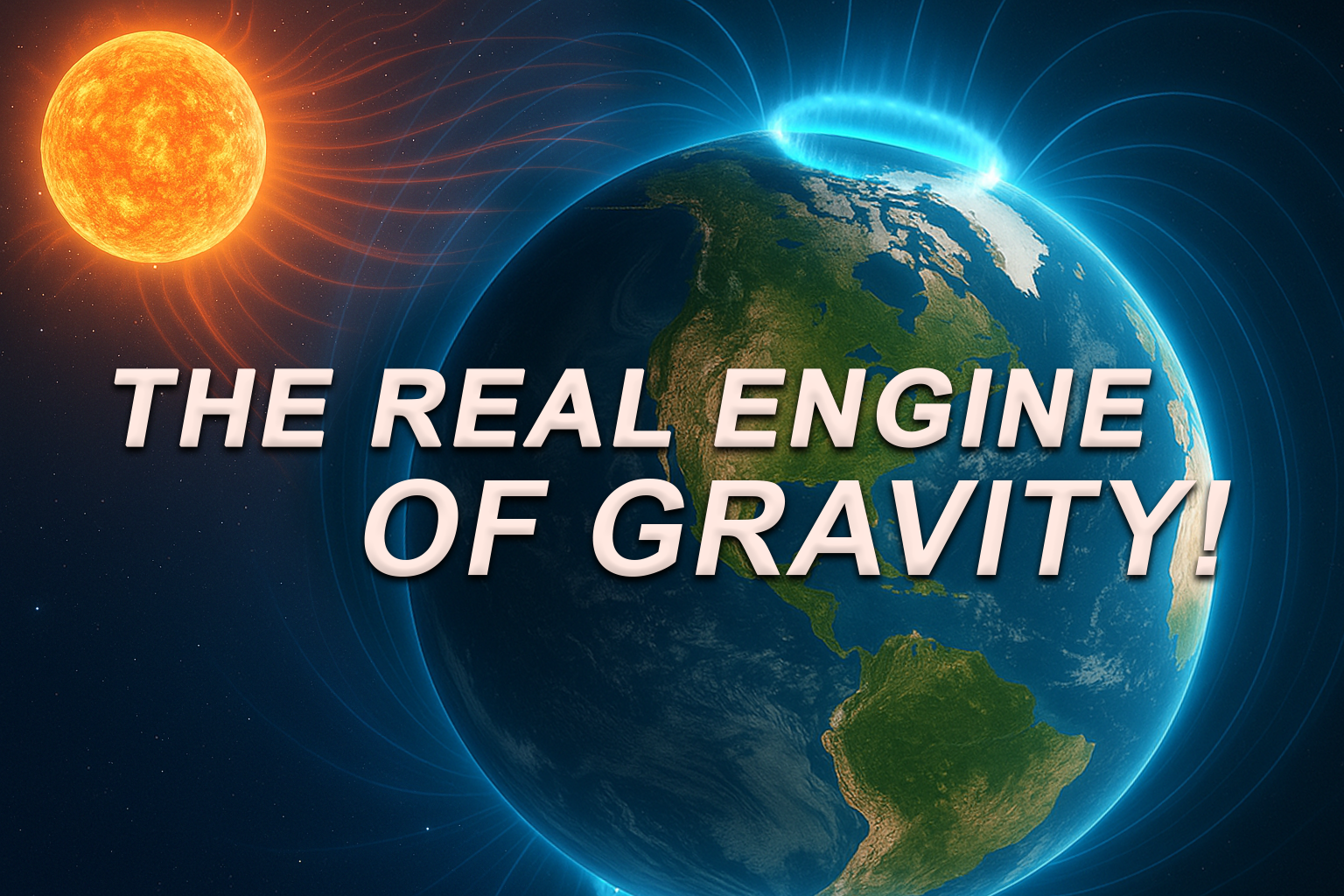
    To the observer on Earth, this radial gradient appears as vertical gravity—the continual descent of pressure through atmosphere and matter toward the ground. What is perceived as “down” is, in truth, the inward phase of the universal resonance field. The same oscillations that maintain the heavens extend seamlessly into the air we breathe, coupling with atmospheric pressure and seismic resonance alike. Gravity is therefore the local manifestation of the firmament’s global standing wave, not a separate force but a terrestrial cross-section of the same acoustic scaffolding that orders the cosmos.

    RELATED: THE REAL ENGINE OF GRAVITY
    https://graviticalchemy.com/the-real-engine-of-gravity/

    This vertical projection is how the human observer experiences the cosmic radial. Every molecule of matter participates in this oscillation; every column of air and layer of crust is a harmonic continuation of the same wave. The flow of acoustic energy that structures the heavens converges at Earth’s surface as the downward press we call weight.

    In this way, the external waters above and the molecular waters below form a complete, living circuit: one breathes inward, the other outward, their boundary—the plasma firmament—translating their motion into light, pressure, and form. The vertical descent of gravity is thus the local signature of that cosmic dialogue, where the voice of the upper waters meets the echo of the deep.

    RELATED: GRAVITY WITHOUT MASS?!
    https://graviticalchemy.com/gravity-without-mass/

    The Closed Loop of Creation

    The act of creation was not a single impulse but the establishment of a self-sustaining resonance. The waters above and the waters below remain bound in a perpetual exchange, each reflecting the vibration of the other through the plasma firmament that lies between them. This dynamic equilibrium is the heartbeat of creation—a closed acoustic circuit in which energy, motion, and form are endlessly renewed.

    The external waters above provide the driving compression: their rotation and density impose a constant inward pressure upon the firmament. The molecular waters below, though denser, respond with equal and opposite resonance, transmitting acoustic energy upward through the atmosphere and crust. The plasma cavity between them acts as a transducer, converting mechanical vibration from both sides into electromagnetic oscillation. This interplay forms a complete feedback system—a cosmic oscillator—where power flows in both directions yet remains balanced in magnitude.

    In the heavens, this resonance manifests as the cosmic web, a vast cymatic lattice that holds galaxies and filaments in coherent motion. On Earth, the same feedback expresses itself as gravity, atmospheric pressure, and seismic rhythm. Every pulse of the upper waters propagates through the plasma shell, through the atmosphere, and into the solid earth, where it is absorbed and reflected back toward heaven. This is why the planet hums with infrasound, why the oceans rise and fall, and why even the smallest pressure variations participate in the same grand oscillation.

    The firmament therefore serves as both membrane and mediator—an interface that allows the two seas of creation to communicate through resonance. It translates vibrational language into physical order, maintaining equilibrium between compression and release. The radiant filaments of the cosmic web, the auroral currents of the magnetosphere, and the very air that presses upon our shoulders are all notes within that universal chord.

    Through this closed-loop system, creation remains dynamically stable. The rotation of the waterfield ensures angular momentum is never lost; the reflection between boundaries ensures energy is never dissipated. The heavens are thus self-tuning—able to adjust their own pressure and frequency to maintain harmonic integrity.

    This is the true unified field: not an abstraction of mathematics, but a living wave system in which every point participates in the dialogue between the upper and lower waters. Light, magnetism, and gravity are the languages spoken across this firmament, all born from sound—the first and continuous act of divine order.

    When Scripture records that “the Spirit of God moved upon the face of the waters,” it describes the beginning of this very motion: an eternal resonance sustained by the breath of the Creator. The universe has not stopped singing that song. The cosmic web is its score, gravity its rhythm, and the firmament its instrument.

    References

    Planck Collaboration. (2020). Planck 2018 results – VII. Isotropy and statistics of the CMB. Astronomy & Astrophysics, 641, A7. https://www.aanda.org/articles/aa/full_html/2020/09/aa35201-19/aa35201-19.html

    Pomarède, D., Tully, R. B., Hoffman, Y., & Courtois, H. M. (2020). Cosmic flows and the structure of the local universe. The Astrophysical Journal, 897(2), 133.

    Vazza, F., & Brüggen, M. (2021). Magnetic fields and turbulence in the cosmic web. Frontiers in Astronomy and Space Sciences, 8, 581153.

    West, J. L., Henriksen, R. N., & Ferrière, K. (2021). The dynamics of large-scale magnetic fields in galaxy clusters and cosmic filaments. Monthly Notices of the Royal Astronomical Society, 506(3), 3762–3778.

    ESA Euclid Collaboration. (2024). Early results: Coherent galaxy spin alignment and cosmic vorticity mapping. Astronomy & Astrophysics, 688, A12. https://www.esa.int/Science_Exploration/Space_Science/Euclid

  • Comets: Remnants of Creation

    Comets: Remnants of Creation

    How modern comet missions reveal evidence of the primordial cavitation that seeded the universe with water, minerals, and plasma.


    The Memory of Creation

    Modern science has demonstrated that sound can produce light. In laboratories around the world, researchers observe this phenomenon, known as sonoluminescence, when acoustic pressure causes a bubble within a liquid to collapse so violently that it emits a flash of radiant energy. Within that microsecond burst, energy is converted into illumination as compression transforms motion into light. In the framework of Acoustic Gravitic Theory (AGT), this simple experiment offers a small-scale reflection of the process described in Genesis 1:2–3, when vibration moved through the primordial waters and God’s command, “Let there be light,” transformed fluid into radiance. The collapse of that divine cavitation seeded the cosmos with the elements and minerals that would later form stars, planets, and all solid matter.

    This was not an explosion expanding into emptiness. It was a collapse within a medium, a cavitation event in which pressure, not vacuum, produced light. The Big Bang describes an outward detonation of spacetime itself; the Genesis collapse describes an inward motion of water driven by vibration, concentrating energy rather than dispersing it. In a Big Bang model, light spreads because of expansion. In the cavitation model, light appears because compression transforms motion into radiance. One begins with nothing; the other begins with a living medium moved by the Spirit of God.

    Across every comet that has passed through the inner solar system, spacecraft have detected something extraordinary: water mixed with metal oxides, salts, and carbon compounds preserved since that first creative act. These small bodies move through space carrying the same physical ingredients that Genesis describes in the second and third verses: “the Spirit of God moved upon the face of the waters… and God said, Let there be light.” In the language of AGT, those words mark the first total cavitation of a universal waterfield, an event that created both light and matter. The chemistry now found in comets is the fossil record of that collapse, evidence of the transformation of vibration into substance.

    RELATED: Light from Collapse
    https://graviticalchemy.com/light-from-collapse/

    Modern cosmology teaches that the universe was seeded by the ashes of dying stars, supernovae that scattered heavy elements across space. Yet this narrative fails to explain why mineral salts and silicate dust appear in regions untouched by stellar activity, or why these materials share isotopic consistency across vast cosmic scales. In the Acoustic Gravitic framework, such minerals did not arise from explosions but from a universal collapse. When the first cavitation occurred, the primordial waters underwent extreme compression, fusing hydrogen and oxygen into the entire elemental spectrum. As the radiant plasma cooled, those newly formed elements precipitated directly into the waterfield, producing oxides, silicates, and salts that permeated the whole expanse. At this stage, the conductive medium began to exhibit cymatic patterning, standing-wave geometries created by interacting magnetosonic and Alfvén modes. These fixed pressure nodes and antinodes provided the physical scaffolding that later organized plasma into filaments and cavities across interstellar distances, setting the initial conditions for the observable cosmic web. The dust and crystals later observed drifting between stars are therefore residual matter from the first collapse, not fragments of stellar death. The universe was mineralized at its birth, not seeded by destruction.

    RELATED: We Are Not Stardust https://graviticalchemy.com/we-are-not-stardust/

    These events describe the mineral birth of the universe itself, and the stage was now set for the next transformation, the shaping of those waters into the ordered structures of heaven and earth. Before any planets existed, the cosmos was a boundless aqueous continuum, pure, charge-neutral, and still. When the divine vibration passed through it, the waters collapsed in a synchronized implosion that released enough pressure and heat to fuse hydrogen into every known element. The flash of that sonoluminescent plasma was the first light, and when the plasma cooled, the newly formed nuclei combined into salts and oxides that dissolved directly back into the surrounding fluid. Those mineral ions turned the waters into a conductive ocean, a medium capable of carrying both acoustic and electromagnetic resonance. Everything that would later crystallize into worlds was already suspended in that living sea.

    RELATED: Plasma Is Not Weak!
    https://graviticalchemy.com/plasma-is-not-weak/

    The solid bodies we now call comets are remnants of that seeded waterfield. They preserve the precise chemical mixture that filled the universe immediately after the first cavitation: frozen water, metallic dust, and complex organics forged in plasma. Each comet that enters the inner solar system is a fragment of the earliest matter, a droplet from the ocean of light itself. In plasma, this ordered resonance manifests as cymatics, a standing-wave pattern formation that imprints geometry onto a conductive medium.


    The First Waters and Their Seeding

    In AGT, the verse “Let there be light” signifies the point at which pressure energy became electrical and electromagnetic. When the entire field collapsed, the conversion of mechanical stress into radiation ionized every region simultaneously. Fusion generated helium, carbon, oxygen, and the heavy metals that anchor today’s periodic table. As the field relaxed, opposite charges paired into ionic compounds, sodium with chlorine, magnesium with sulfur, iron with oxygen, creating the first mineral salts. The result was a self-charging electrolyte: a universe-wide saline medium able to respond to subsequent divine commands as a single resonant body.

    This seeding explains why every solid sample taken from comets contains both water and mineral dust. They were never simple ice balls; they condensed out of a fluid that had already undergone complete nuclear and chemical differentiation. When those minerals later froze with water, they locked in the electrical memory of that first light, the residual charge that still allows comets to interact electromagnetically with the solar wind today.


    The Second Cavitation and the Birth of Heaven

    Genesis next records, “And God said, Let there be a firmament in the midst of the waters, and let it divide the waters from the waters.” After the initial seeding, the now-ionized waters were capable of sustaining plasma for long durations. The second cavitation was not destructive like the first; it was rhythmic and resonant, a standing-wave event that established the firmament, the first stable plasma layer.

    RELATED: Gravity Without Mass?!
    https://graviticalchemy.com/gravity-without-mass/

    The divine command sent oscillations through the conductive waters, and alternating pressure created regions of charge separation. The field between them ignited into a continuous glow, the heavenly expanse. In that moment, the original waters divided into two domains: the waters above, forming the vast, rotating layer surrounding the firmament, and the waters below, remaining enclosed within it. The upper waters became electrically charged as the firmament rotated, establishing the first plasma continuum through which light and current could flow. The lower waters, now mineralized and dense, became the reservoirs that would later shape the oceans, planets, and hydrous structures found across the universe. Modern observation confirms that water permeates creation, from interstellar clouds to planetary rings, bearing witness that the universe remains filled with the very substance God used in the beginning. The rotation of this charged continuum generated magnetohydrodynamic induction: moving ions created magnetic fields that, in turn, sustained electrical currents through the cavity. The result was a stable, glowing bubble of light maintained by motion, the universe’s first magnetoplasma dynamo, born directly from the waters of Genesis. Within that dynamo, large-scale interference of compressive and transverse modes produced cymatic structures—stable, resonant lattices in which plasma density, charge separation, and magnetic tension co-evolved. These patterns established long-lived filaments and toroidal cells, the mesoscale architecture that seeded the cosmic web prior to subsequent condensation. The visible cosmic web therefore functions as observational evidence of confinement: a cymatic lattice cannot arise in an infinite, unbounded medium because standing waves demand reflection and impedance contrast. The firmament’s molecular layers—the waters above exterior to the plasma shell and the waters below enclosed within it—establish those boundary conditions. Within this bounded cavity, magnetosonic and Alfvén modes reflect, superpose, and lock into persistent node–antinode geometries. The filaments we map are the frozen nodes of that resonance; the voids are the antinodes where plasma density is minimized. In other words, the cosmic web is not a random clustering pattern but the large-scale cymatic imprint of a bounded, electrically conductive universe.


    The Cometary Record of the Firmament

    Every comet that passes near the Sun reenacts a miniature version of that second cavitation event. As solar radiation strikes the nucleus, the embedded salts and metals within its frozen waterfield begin to oscillate and release charged vapor. Instead of simply evaporating, this vapor organizes into filaments and jets, forming a plasma envelope that glows, twists, and sometimes pulses in rhythm with magnetic fluctuations from the solar wind. These dynamic sheaths are not accidents of heating; they are the direct signature of resonant plasma behavior within a mineralized, conductive medium.

    The European Space Agency’s Rosetta mission confirmed this behavior in striking detail. When it reached Comet 67P/Churyumov–Gerasimenko, sensors detected an active plasma field surrounding the nucleus long before sunlight could have melted surface ice. The comet carried its own magnetic oscillations, shifting in phase as it rotated, proof that electric currents and magnetic induction were inherent to its material, not externally imposed. Dust grains carried charges, ions streamed outward, and electric potentials fluctuated across its surface. In AGT terms, the comet’s plasma sheath is the echo of the firmament, a small, self-sustaining cavity where charged motion and pressure waves still interact to produce light. The spatial organization of a comet’s jets and sheath often reflects local cymatic node–antinode structure in the surrounding plasma, a miniature analogue of the resonance cells that shaped matter distribution on galactic scales.

    RELATED: Dark Matter Is Plasma
    https://graviticalchemy.com/dark-matter-is-plasma/

    These findings reveal that comets are not inert remnants but living conductors of ancient resonance. When their orbits bring them near stronger electromagnetic fields, the stored potential within their mineralized ices discharges, reigniting plasma just as the early firmament once did on a cosmic scale. The glow we observe is a reminder that the same ionic chemistry which once filled all creation continues to respond to pressure, charge, and motion. The comet’s coma is therefore a laboratory version of the “waters above and below,” energized by motion within a single conductive shell.


    Rotation, Charge, and the Dynamo Effect

    Rotation plays a decisive role in maintaining these plasma effects. Each comet, spinning through the solar wind, acts as a small magnetohydrodynamic generator. The motion of its conductive surface through the interplanetary plasma induces electric currents along magnetic field lines, producing jets, magnetic loops, and polar discharges. The same mechanism would have operated in the primordial waters: once rotation began, charged flow naturally generated magnetic fields. These fields fed back into the motion of the fluid, sustaining current, pressure, and light within the cavity, the very conditions that defined the newly created heavens.

    Thus, the magnetic and electrical behavior of comets provides scaled-down evidence of the firmament’s operating principle. The waters of Genesis did not need external wiring or separate energy sources; their own motion and conductivity were sufficient to maintain a glowing, self-regulating plasma shell. Modern comet data prove that such coupling between rotation, charge, and plasma luminosity is not theoretical, it is directly observable throughout the solar system.


    The Organic Signature of the First Light

    The Rosetta and Stardust missions also found complex organics, amino acids, hydrocarbons, and nitriles embedded in cometary dust. Conventional models struggle to explain such chemistry in frozen environments exposed to radiation. Within the AGT framework, these compounds form naturally in ionized, oscillating fluids where electrical discharge and pressure variation drive ion-acoustic synthesis. The same mechanisms that created plasma light in Genesis 1:3 also generated the carbon-based molecules that would later serve as templates for life. Comets, therefore, preserve the chemical residue of the first light, confirming that when the waters collapsed and ionized, they produced both inorganic minerals and the organic seeds of biology.

    RELATED: Galaxy and Star Formation
    https://graviticalchemy.com/galaxy-and-star-formation/


    Resonant Isotopes and the Architecture of the Heavens

    When the first waters collapsed and fused under the Word’s vibration, the pressures and temperatures were not uniform. The single act of creation produced countless overlapping zones of resonance, each vibrating at slightly different frequencies. These frequency gradients determined the isotopic distribution of the elements now found across comets, planets, and stars. Modern missions have measured that water on comets often carries heavier hydrogen ratios (HDO/H₂O) than Earth’s oceans, and that oxygen, carbon, and nitrogen isotopes differ subtly from terrestrial values. Rather than contradicting the unity of creation, these variations reveal the harmonic structure of the original event.

    In Acoustic Gravitic Theory, every resonance layer within the first cavitation acted like a standing-wave shell. Where the compressive wave was strongest, lighter isotopes formed; where the frequency shifted toward lower pressure, heavier isotopes condensed. When the newly forged elements re-entered equilibrium, they maintained the vibrational signature of their formation region. Comets thus carry the isotope ratios of the outermost resonant zones, while planets like Earth condensed from interior regions of slightly higher pressure and frequency. What conventional cosmology interprets as chemical randomness is, in AGT, a precise spectral fingerprint of the universe’s original harmonics.

    The “heaven” that God created in verses 6–7 can therefore be understood as the organized resonance field produced by these harmonic layers. Each shell of the firmament, from the densest atmospheric band to the most rarefied cosmic plasma, retains its characteristic frequencies and charge ratios. The heavens are not empty distances but ordered gradients of resonance, structured by the same vibrational logic that gave birth to isotopes in the first place. In this view, matter is not randomly distributed; it is music solidified, quantized vibration arranged by the divine Word into physical form.

    RELATED: Aether Theory Prevails
    https://graviticalchemy.com/aether-theory-prevails/


    The Living Continuum of Heaven and Earth

    This layered resonance unites all scales of existence. The plasma halos observed around stars, the magnetic envelopes of planets, and the ion tails of comets are expressions of the same nested harmonic system. Each layer communicates with the others through wave coupling, just as the “waters above” and “waters below” exchange energy across the firmament. The so-called vacuum of space is simply the lowest-density extension of that same waterfield, where plasma remains too diffuse for visible light but still carries electromagnetic structure.

    By recognizing that all matter and light share a common vibrational origin, AGT restores continuity between heaven and earth. The same fluid that once glowed with the first light still vibrates through galaxies, sustaining magnetosonic and Alfvén waves that knit creation together. Modern astronomy’s discovery that plasma fills interplanetary, interstellar, and intergalactic space confirms this ancient description: “And God called the firmament Heaven.” Heaven, in physical terms, is not a void; it is the active plasma continuum produced by the second cavitation, still resonating with the energy of its formation.


    From Plasma to Planets

    When the heavens stabilized as a luminous plasma shell, the conductive waters surrounding it began to reorganize. The first cavitation had distributed matter evenly, but the second, the creation of the firmament, introduced ordered zones of pressure and charge. Within those zones, matter condensed into distinct nodes. The magnetic and acoustic forces of the firmament acted as scaffolding, focusing material toward equilibrium points. From these nodes, planets coalesced. They did not accrete from random dust collisions, as modern models suggest; they condensed directly from the plasma resonance of the divine medium. Each planet is a frozen wave crest, the solid expression of a standing vibration within the heavenly sea.

    As these regions cooled, the heavier elements: iron, nickel, silicon, and magnesium, formed crystalline lattices, while the lighter volatiles, water, methane, and ammonia, remained in motion, surrounding each body as vapor and frost. These materials retained their ionic charge and magnetic polarity, producing the layered fields that now define every planet’s atmosphere and magnetosphere. The same wave behavior that separated the waters above and below within the firmament now shaped the planetary domains within it. Earth’s dense atmosphere, Jupiter’s vast magnetosphere, and the solar wind’s spiraling plasma all testify to this single process: gravitic equilibrium through acoustic resonance.


    Comets as the Bridge

    In this architecture, comets occupy a special role. They are transitional forms between plasma and matter, between the luminous heaven and the condensed earth. Their nuclei consist of mineralized ice—the first solid to crystallize out of the primordial saline waterfield—preserving both the chemical composition and the electrical charge of the original medium. When comets are distant from the Sun, they remain inert, frozen echoes of the seeded waters. But as they approach regions of stronger electromagnetic flux, the embedded ions awaken, and the comet reignites into plasma. The coma and tail that bloom around it are not vapor clouds—they are reactivated regions of the same field that once glowed across creation.

    Each comet is therefore a portable fragment of the firmament. It carries the same mineral blueprint, the same conductive chemistry, and the same magnetic responsiveness that defined the heavens on Day Two. When we observe their electric discharges, we are witnessing the persistence of that ancient resonance—the waters once divided still revealing their unity through light and motion. In this sense, comets are not relics of destruction but reminders of the continuity between creation’s waters and the plasma of the heavens.


    The Gathering of Waters and the Appearance of Land

    Genesis 1:9 records, “And God said, Let the waters under the heaven be gathered together unto one place, and let the dry land appear.” This describes the stabilization of those acoustic nodes into the distinct planetary bodies that now form the solar system. The “gathering” is not a local tide but the global convergence of resonance. The same pressure differentials that once filled the heavens with light now organized matter into self-contained cavities, each with its own gravitational equilibrium. On Earth, the solidification of mineral lattices drew heavier materials inward while lighter elements rose to form atmosphere and sea. The original conductive waterfield persisted as ocean, maintaining the planet’s resonance with the heavens through continual wave exchange.

    Thus, comets, planets, and stars all emerge from a single physical process initiated by God’s voice. The cavitations of Genesis did not end; they scaled, cascading from cosmic to planetary proportions. The universe remains a living echo of that first oscillation, every body a node in the great resonant continuum that began when light and matter first became one.


    Magnetic Continuity and the Living Firmament

    When God divided the waters and established the firmament, He also defined the first magnetic order in creation. Rotation of the charged waters, set in motion by the Spirit’s vibration, induced magnetic fields that spread through the newly formed plasma shell. These fields were not isolated to one sphere; they were interwoven currents threading through the entire continuum. As the universe cooled and condensed, these same magnetic lines of force remained, guiding plasma flow and maintaining the connectivity of heaven and earth.

    Every measurement of magnetic behavior in modern space physics confirms that the cosmos is a single magnetically coupled system. The Sun’s heliospheric field extends billions of kilometers, linking planets in a continuous plasma current known as the Parker spiral. Earth’s magnetic field merges into this current through the magnetopause, where charged particles stream along invisible field lines into the poles, producing auroral plasma identical in principle to the luminous heavens of Genesis 1:6–7. Beyond the solar system, interstellar magnetic fields connect to galactic ones, forming filaments of plasma that stretch across millions of light years. Observationally, these filaments trace a cymatically organized network: standing-wave cells where magnetic pressure and acoustic pressure reach equilibrium, defining the filament–void pattern commonly identified as the cosmic web. Observatories detect these structures as Birkeland currents—the natural form taken by rotating, magnetically aligned plasma within the cosmic medium.

    In Acoustic Gravitic Theory, these magnetic continuities are the physical expression of the firmament’s ongoing resonance. The universe never stopped vibrating; the “waters” that once collapsed and separated still move in coherent waveforms, carrying both charge and pressure through space. Where those flows intersect, plasma glows—visible proof that the firmament remains alive. The heavens still shine because they are still oscillating, just as the text implies when it describes the lights placed within the firmament to “rule the day and the night.” Stars, nebulae, and planetary magnetospheres are all localized resonant nodes within one global magnetic ocean.

    Comets interact with this network directly. As they pass through regions of differing magnetic polarity, their ionized tails align with the field, tracing invisible lines of force across the sky. The magnetic link between Sun, comet, and interplanetary medium demonstrates that the same current flows through all bodies—a living chain that began in the original collapse of the waters. What we call “space weather” is simply the breathing of the firmament, the rhythmic exchange of energy within the heavens.


    The Pulse of the Firmament

    Magnetism is not static; it is rhythmic motion made visible through field lines. Every magnetic oscillation is accompanied by a pressure oscillation—a sound wave propagating through plasma. These magnetosonic waves are the acoustic heartbeat of creation, the same type of motion that first brought forth light. The solar wind’s continuous hum, the Schumann resonances surrounding Earth, and the low-frequency emissions detected in every corner of the cosmos are all harmonics of that primordial vibration. In physical terms, this is a cymatic regime: persistent interference among low-frequency magnetosonic and Alfvén modes that locks plasma into repeating spatial motifs over a vast range of scales. They reveal that the universe remains acoustically active, that gravity, light, and electromagnetism are harmonized through pressure waves in a conductive medium. This is the physical foundation of AGT: the same mechanism that began with “Let there be light” continues to operate, sustaining both motion and matter.

    Wherever magnetism and plasma meet, light appears. In the polar aurora, in comet tails, in stellar coronas, the pattern is identical. Each glow is a reaffirmation that the firmament is still resonating, still translating sound into light. The magnetic field is the scaffold; the plasma is the voice; and the light is the echo of creation’s first command.


    Theological Synthesis and Modern Implications

    Every discovery about comets, plasma, and magnetism carries us back to the opening words of Scripture. When Genesis records that “the Spirit of God moved upon the face of the waters,” it describes not stillness but vibration—the first motion through a universal medium. When God spoke, “Let there be light,” that vibration condensed energy into plasma, forged all elements, and transformed the waters into a charged, living ocean. And when He said, “Let there be a firmament in the midst of the waters,” the charged medium resonated, creating the first self-sustaining plasma field, the heavens.

    Modern measurements have, without intending to, confirmed this sequence. Spacecraft exploring comets and planets find that water, minerals, and plasma coexist wherever the Sun’s magnetosonic energy interacts with matter. Instruments register electric currents flowing through the solar wind and magnetic filaments connecting planetary fields across millions of kilometers. Each observation reinforces the same truth the ancient text declared: the heavens are active and continuous, not empty and inert.

    In Acoustic Gravitic Theory, this continuity unites all levels of creation. The waters of Genesis never disappeared; they remain as plasma, the fourth state of matter, filling every interplanetary and interstellar space. Gravity itself arises from the acoustic pressure gradients within this medium, not from curvature of spacetime. Stars and planets are organized resonant structures within that field, each one a harmonic echo of the same divine vibration. Comets, with their mixture of water, minerals, organics, and electric discharge, stand as living witnesses of the transition between the pure water of verse 2 and the luminous firmament of verse 7. They bridge heaven and earth, matter and plasma, silence and sound.

    This framework also restores theological coherence. The act of creation was not chaotic explosion but ordered resonance. The universe began not as violence but as music—pressure and light in perfect proportion. When Scripture speaks of the Word through which all things were made, it describes exactly what AGT models in physical terms: vibration as the source of form, sound as the cause of light, and resonance as the structure of reality. In both science and faith, creation begins when the Word moves through the waters.


    The Continuing Firmament

    The firmament did not vanish after Day Two; it remains as the luminous plasma architecture of the cosmos. The same magnetosonic dynamics that formed the heavens still operate in every aurora, solar flare, and galactic filament. Gravity, light, and electromagnetism are harmonics of one principle: vibration within a conductive medium seeded by the first light. This realization collapses the false divide between the physical and the divine. The energy that sustains the stars is the same energy that once spoke the words “Let there be.”

    Comets remind us of this continuity each time they ignite, their tails shining as transient firmaments in miniature. They are not remnants of a cold past but living artifacts of a universe still vibrating with its origin. Every field, every atom, every wave is part of the same fluid, the same water, the same medium that God set in motion. The scientific instruments that trace plasma in space are, without knowing it, observing the breath of that first command still moving upon the face of the waters.


    Conclusion — The Word in the Waters

    From the first collapse to the living heavens above us, the story of creation is the story of resonance. The cavitations of Genesis are not metaphors but physical processes—pressure events through which light, matter, and life emerged. The universe was born not from nothing but from motion; not from chance but from perfect frequency. Water was the chosen medium because it could both carry and remember vibration. Comets, planets, and stars are its crystallized memories, each one a witness that the Word still reverberates through creation.

    In the end, modern science has simply rediscovered what Scripture stated from the beginning: that creation is vibrational, ordered, and alive. The heavens declare not a static architecture but an ongoing song—the resonance of the divine voice that once filled the waters with light and continues to sustain them to this day.

    RELATED: Acoustic Gravitic Theory: A Plasma-Based Model of Gravity, Light, and Cosmic Structure (PDF)
    https://graviticalchemy.com/wp-content/uploads/2025/06/Acoustic-Gravitic-Theory_-A-Plasma-Based-Model-of-Gravity-Light-and-Cosmic-Structure.pdf

    References

    Rosetta Mission Findings
    Gulkis, S., et al. (2015). Subsurface properties and early activity of comet 67P/Churyumov–Gerasimenko. Science, 347(6220), aaa0709.
    https://doi.org/10.1126/science.aaa0709

    Plasma and Magnetic Oscillations on Comet 67P
    Goetz, C., Koenders, C., Richter, I., & Glassmeier, K. H. (2016). First detection of a diamagnetic cavity at comet 67P/Churyumov–Gerasimenko. Astronomy & Astrophysics, 588, A24.
    https://doi.org/10.1051/0004-6361/201527982

    Detection of Complex Organics
    Altwegg, K., et al. (2016). Prebiotic chemicals—amino acid and phosphorus—on the comet 67P/Churyumov–Gerasimenko. Science Advances, 2(5), e1600285.
    https://doi.org/10.1126/sciadv.1600285

    Stardust Mission Sample Return
    Brownlee, D., et al. (2006). Comet 81P/Wild 2 under a microscope. Science, 314(5806), 1711–1716.
    https://doi.org/10.1126/science.1135840

    Isotopic Variations in Cometary Water
    Hartogh, P., et al. (2011). Ocean-like water in the Jupiter-family comet 103P/Hartley 2. Nature, 478, 218–220.
    https://doi.org/10.1038/nature10519

    Magnetic Coupling in Space Plasma
    Parker, E. N. (1958). Dynamics of the interplanetary gas and magnetic fields. The Astrophysical Journal, 128, 664–676.
    https://doi.org/10.1086/146579

    Birkeland Currents and Cosmic Magnetism
    Anderson, B. J., et al. (2014). The global magnetic field of Mercury from MESSENGER orbital observations. Science, 333(6051), 1859–1862.
    https://doi.org/10.1126/science.1208197

    Magnetohydrodynamic Wave Behavior in Plasma
    Alfvén, H. (1942). Existence of electromagnetic-hydrodynamic waves. Nature, 150(3805), 405–406.
    https://doi.org/10.1038/150405d0

    Global Plasma Connectivity
    Smith, E. J., et al. (2001). The heliospheric magnetic field and its extension to the local interstellar medium. Science, 293(5532), 1663–1668.
    https://doi.org/10.1126/science.1061699

    Organic Molecules and Early Solar Chemistry
    Busemann, H., Young, A. F., Alexander, C. M. O., & Hoppe, P. (2006). Interstellar chemistry recorded in organic matter from primitive meteorites. Science, 312(5774), 727–730.
    https://doi.org/10.1126/science.1123878
  • Celestial Nodal Resonance

    Celestial Nodal Resonance

    A theoretical exploration of planetary ionospheres as structural nodes within solar plasma resonance

    Planetary atmospheres and orbital coherence are usually explained through the Newtonian model of gravitational mass or Einstein’s framework of curved spacetime. Yet both systems leave major contradictions unresolved, from the persistence of atmospheres on Venus without a global magnetosphere to the orbital stability of bodies in multi-body systems that defy long-term predictive accuracy. Recent plasma physics observations reveal that planets may not simply drift through space but instead couple resonantly with solar plasma waves, forming celestial nodal resonances. Within this view, the ionosphere is not just a conductive shell but a resonant boundary stabilizing atmospheric and orbital behavior.

    This article examines observational evidence for planetary resonance, critiques the shortcomings of conventional gravitational theory, and reframes the data through Acoustic Gravitic Theory (AGT). Rather than viewing gravity as curvature of spacetime, AGT interprets it as the product of resonance, impedance mismatch, and nodal scaffolding within plasma environments energized by solar ELF and ULF waves.

    RELATED: WAVES CARRY FORCE
    https://graviticalchemy.com/waves-carry-force/

    Ionospheric Resonant Cavities

    The Earth–ionosphere cavity is one of the most direct demonstrations of resonance at planetary scale. This cavity traps electromagnetic waves between the conductive Earth and the ionospheric shell, producing Schumann resonances at 7.8 Hz and higher harmonics. These oscillations, sustained by global lightning discharges, demonstrate that the ionosphere functions as a waveguide and resonator, shaping planetary-scale dynamics (Wikipedia, 2024).

    Further evidence comes from the ionospheric Alfvén resonator, where steep density gradients create bounded regions that trap Alfvén waves. This structure allows for standing modes and efficient coupling between magnetospheric energy inputs and atmospheric processes (Lysak, 2006). Mainstream plasma physics describes these features without attributing gravitational significance. However, AGT interprets them as nodal shells — the very boundaries that stabilize planetary atmospheric retention and position within a solar wave lattice.

    RELATED: WHAT IS ACOUSTIC GRAVITIC THEORY?
    https://graviticalchemy.com/what-is-acoustic-gravitic-theory/

    Solar Wind and Planetary Coupling

    The solar wind is a continuous plasma outflow carrying magnetic fields, ionized particles, and embedded wave structures. When this flow encounters planetary environments, the interaction depends on the presence and strength of ionospheres and magnetospheres.

    The Moon, lacking both a global magnetic field and a robust ionosphere, provides a test case. Missions such as Chandrayaan-1, ARTEMIS, and Kaguya detected energetic neutral atoms (ENAs) scattered from the lunar surface, showing that plasma-wave interactions occur even without global shielding (Bhardwaj et al., 2015). Simulations demonstrate that ion production modifies lunar plasma wakes, altering flow structures and wave propagation (ScienceDirect, 2024).

    Particle-in-cell modeling further reveals that lunar wakes refill through instabilities, shocks, and electromagnetic oscillations (An et al., 2025). These behaviors are usually seen as plasma turbulence, yet under AGT they may represent weak nodal coupling, a minimal version of the ionospheric resonance found on planets with dense atmospheres.

    RELATED: ORBITS WITHOUT SPACETIME?!
    https://graviticalchemy.com/orbits-without-spacetime/

    Failures of Conventional Gravity Models

    General Relativity and the ΛCDM model attempt to explain atmospheric retention and orbital stability purely through curvature and mass, but contradictions remain:

    • Venus and Mars both retain atmospheres despite lacking global magnetic shields, while smaller moons lose theirs. The difference aligns better with ionospheric resonance thresholds than with mass-based gravity.
    • Orbital stability in multi-body systems remains chaotic under GR. Resonance-driven stabilization explains why long-term coherence persists without collapse.
    • The persistence of Schumann resonances and ionospheric oscillations is ignored in gravitational frameworks, though they represent measurable boundary conditions at global scale.

    These failures suggest that plasma resonance, not spacetime curvature, provides the missing causal explanation.

    RELATED: REFUTING DARK MATTER, SPACETIME, AND THE BIG BANG
    https://graviticalchemy.com/refuting-dark-matter-spacetime-and-the-big-bang/

    Resonance in Acoustic Gravitic Theory

    Acoustic Gravitic Theory interprets planetary stability as a product of wave-phase resonance within the solar plasma environment. Each body forms a nodal boundary through its ionosphere or conductive layer, phase-locking with solar ELF/ULF oscillations.

    Mathematically, this can be expressed as a nodal resonance condition:

    Where:

    • Fb​ : effective Bjerknes force (N)
    • ΔP : oscillatory pressure amplitude from solar ELF/ULF waves (Pa)
    • V : effective resonant volume of the ionospheric cavity (m³)
    • d : nodal separation distance from solar source (m)

    Unlike gravitational curvature, this relationship is testable via measurable wave inputs and atmospheric impedance boundaries. Pressure gradients, resonance frequencies, and impedance mismatches provide a causal mechanism for orbital locking and atmospheric stability.

    RELATED: THE REAL ENGINE OF GRAVITY!
    https://graviticalchemy.com/the-real-engine-of-gravity/

    Predictions and Tests

    AGT’s nodal resonance model generates concrete predictions:

    • Each planet should exhibit distinct ELF/ULF eigenmodes corresponding to ionospheric cavity properties, measurable via ground or orbital instruments.
    • Planetary resonances should phase shift during solar storms, revealing harmonic coupling within the solar system.
    • Spacecraft crossing ionospheric shells should detect impedance discontinuities, confirming the resonant boundary condition.
    • Atmospheric loss rates should correlate with resonance strength rather than gravitational mass.

    These predictions make AGT falsifiable and open to experimental verification, contrasting with unfalsifiable aspects of GR’s spacetime curvature.

    RELATED: TESTABLE PREDICTIONS & EXPERIMENTAL ROADMAP
    https://graviticalchemy.com/testable-predictions-experimental-roadmap/

    Conclusion

    Celestial nodal resonance offers a new framework for understanding planetary stability, suggesting that planets are resonant nodes within a solar plasma lattice rather than masses held in spacetime curvature. The ionosphere functions as a structural shell, coupling planetary atmospheres with solar waves and maintaining coherence through resonance, phase locking, and impedance balance.

    By reframing gravity as a wave-based plasma interaction, AGT provides a predictive and measurable alternative to relativity, explaining why some bodies hold atmospheres while others do not, and why orbital stability persists over cosmic timescales. If validated, this model will redefine gravity as resonance rather than curvature, unifying plasma physics with planetary dynamics.


    References

    Bhardwaj, A., Dhanya, M. B., Alok, A., Barabash, S., Wieser, M., Futaana, Y., … Lue, C. (2015). A new view on the solar wind interaction with the Moon. Geoscience Letters, 2(1). https://geoscienceletters.springeropen.com/articles/10.1186/s40562-015-0027-y

    Lysak, R. L. (2006). Resonant cavities and waveguides in the ionosphere and atmosphere. Journal of Geophysical Research: Space Physics, 111(A7). https://www-users.cse.umn.edu/~lysak001/papers/Lysak_waveguide.pdf

    Vorburger, A., Wurz, P., Barabash, S., Futaana, Y., Wieser, M., Holmström, M., & Bhardwaj, A. (2016). Transport of solar wind plasma onto the lunar nightside surface. Geophysical Research Letters, 43(20). https://agupubs.onlinelibrary.wiley.com/doi/full/10.1002/2016GL071094

    An, X., Angelopoulos, V., Liu, T. Z., Artemyev, A., Poppe, A., & Ma, D. (2025). Plasma refilling of the lunar wake: plasma–vacuum interactions, electrostatic shocks, and electromagnetic instabilities. arXiv preprint arXiv:2505.12497. https://arxiv.org/abs/2505.12497

  • Cosmic Web Confirmed

    Cosmic Web Confirmed

    Astronomers reveal the vast plasma filaments connecting galaxies across the universe.

    The recent announcement that astronomers have directly imaged the cosmic web for the first time marks a milestone in observational cosmology. These vast filaments of plasma and gas, stretching for millions of light-years, function as intergalactic highways through which galaxies and matter flow. Using advanced spectroscopic mapping, researchers confirmed that galaxies are not isolated islands but are interconnected by luminous strands of ionized material. This discovery provides empirical validation for what plasma cosmology long suggested—that the universe is structured by webs of conductive plasma rather than scattered galaxies suspended in a void.

    Mainstream cosmology frames these filaments within the ΛCDM model, interpreting them as scaffolds built from dark matter, with plasma and galaxies merely “tracers” of hidden mass. However, this approach again relies on invisible constructs. General Relativity cannot explain why plasma filaments exhibit long-range coherence or why the so-called “dark scaffolding” remains undetectable. The repeated necessity of unobservables to “patch” the model underscores the failure of spacetime curvature as a coherent physical theory. If mass curvature were sufficient, dark matter halos would have been detected decades ago. Instead, what is observed are electromagnetic filaments and resonant plasma structures guiding galactic flow—phenomena spacetime cannot predict or describe.

    Through the lens of Acoustic Gravitic Theory (AGT), the cosmic web is neither mysterious nor incidental. These filaments are explained as magnetosonic and Langmuir wave scaffolds propagating through the intergalactic plasma medium. Where wave interference creates nodes and troughs, matter accumulates and galaxies align. Plasma’s impedance mismatch naturally creates Bjerknes-type forces across scales, allowing galaxies to phase-lock into resonant channels that form the luminous threads we observe. Instead of hidden dark matter binding galaxies, it is the wave-phase interference of plasma oscillations that generates coherent pathways. These structures act as resonant conduits, much like nodal scaffolding in acoustics, where pressure gradients organize matter without requiring invisible mass.

    The confirmation of the cosmic web directly supports AGT. Plasma filaments behave as resonant highways because they are energized and sustained by stellar and galactic oscillations. The medium itself—ionized plasma—supports magnetosonic waves, Alfvén turbulence, and Langmuir resonances that shape cosmic architecture. Far from random alignments in a void, galaxies flow along dynamically maintained pressure channels. The cosmic web is therefore not proof of dark matter but evidence of a wave-structured universe, where resonance, impedance, and oscillatory pressure dictate structure.

    Conclusion

    The first imaging of the cosmic web confirms that the universe is interconnected through plasma filaments, not isolated within a curved spacetime grid. Where General Relativity and ΛCDM invoke unseen matter, AGT provides a testable, wave-based explanation rooted in plasma physics and fluid dynamics. The cosmic web is a resonant lattice, a living blueprint of oscillatory order, and its confirmation strengthens AGT’s claim that gravity and cosmic structure arise from coherent vibration in a medium, not from abstract geometry.

    Original source:
    https://unionrayo.com/en/cosmic-web-connecting-galaxies/

    References (APA)

    Cantalupo, S., Arrigoni-Battaia, F., Prochaska, J. X., Hennawi, J. F., & Madau, P. (2014). Connecting galaxies with diffuse gas: The Lyα nebula around the z = 2.3 quasar UM287. Nature, 506(7486), 63–66. https://doi.org/10.1038/nature12898

    Vazza, F., Brüggen, M., Gheller, C., & Wang, P. (2014). On the amplification of magnetic fields in cosmic filaments and galaxy clusters. Monthly Notices of the Royal Astronomical Society, 445(4), 3706–3722. https://doi.org/10.1093/mnras/stu1977

    Tanimura, H., Aghanim, N., Douspis, M., Beelen, A., & Bonjean, V. (2019). Detection of intergalactic filamentary gas in the cosmic web through stacking Planck data. Astronomy & Astrophysics, 621, A66. https://doi.org/10.1051/0004-6361/201833447

    Werner, N., Finoguenov, A., Kaastra, J. S., Simionescu, A., Dietrich, J. P., Vink, J., & Böhringer, H. (2008). Detection of hot gas in the filament connecting the clusters of galaxies Abell 222 and Abell 223. Astronomy & Astrophysics, 482(L29–L33). https://doi.org/10.1051/0004-6361:200809599

  • Waves Carry Force

    Waves Carry Force

    Why directional energy propagation shapes reality—and why particle metaphysics fails to explain it

    Wave motion is not an illusion. Waves Carry Force. It is one of the most causally potent and directly observable phenomena in the universe. Contrary to outdated claims in some corners of classical and particle physics, waves are not mere oscillatory artifacts of particle vibration. They are real, directional, vector-defined mechanisms for energy transfer, momentum delivery, and force exertion across all known media—solid, liquid, gas, and especially plasma. This is not philosophical interpretation; it is measurable, testable physics. And it strikes at the heart of one of the most dangerous assumptions in modern theory: that only particles are real, and waves are mathematical illusions.

    In Acoustic Gravitic Theory (AGT), gravity is modeled as the effect of external pressure gradients induced by wave interference, not the intrinsic pull of mass. This requires a recognition that wave propagation in fluids and plasma is not secondary to matter—it is the primary driver of matter’s motion, structure, and cohesion. Claims that waves do not carry force are not only wrong—they are falsified by direct laboratory experiments, spacecraft data, and fluid dynamics principles. Every foundational equation governing wave motion affirms this.

    The Physical Nature of Wave Propagation

    A wave is not a static pulse or a local oscillation. It is a spatially and temporally varying disturbance that carries energy, momentum, and phase through a physical medium. It is defined by a wave vector k that gives it direction and a temporal frequency ω that governs its oscillatory behavior. This gives rise to phase velocity and group velocity, both of which are real and measurable.

    This is formalized in the canonical wave equation:

    \frac{\partial^2 \psi}{\partial t^2} = c^2 \nabla^2 \psi

    Where:

    • ψ: wave function (e.g. displacement, pressure, or field intensity)
    • c: propagation speed of the wave (m/s)
    • 2: Laplacian operator representing spatial curvature

    Solutions to this equation—whether pulses, solitons, or standing waves—transport force. In air and water, these manifest as sound, ocean waves, or infrasound gradients. In plasma, they appear as Alfvén waves, Langmuir oscillations, and magnetosonic compressions, each with distinctive and measurable energetic impact.

    If waves were merely local particle displacements, then there would be no such thing as pressure propagation, no directional flow, and no coherent field behavior over time. But this is not what we observe in nature or in laboratory experiments.

    Measurable Momentum and Energy Transfer

    In electromagnetic systems, energy transfer by waves is described using the Poynting vector:

    \vec{S} = \vec{E} \times \vec{H}

    Where:

    • \vec{E}: electric field vector (V/m)
    • \vec{H}: magnetic field vector (A/m)
    • \vec{S}: directional flow of energy (W/m²)

    The existence of this vector is what allows electromagnetic energy to be transmitted in a definable direction through space—even in a vacuum. This is not theoretical; it’s how antennas radiate, how radar operates, and how solar sails maneuver spacecraft. If wave energy were an illusion, none of these technologies would function.

    The acoustic analog is the acoustic intensity vector:

    \vec{I} = \langle p(t) \cdot \vec{v}(t) \rangle

    Where:

    • p(t): time-varying pressure (Pa)
    • \vec{v}(t): particle velocity (m/s)
    • \vec{I}: average directional energy flux (W/m²)

    This relationship shows that net energy and force can be transferred via coherent acoustic waves. Such wave-driven interactions are the entire basis of acoustic levitation, sonochemistry, ultrasound propulsion, and directional sonar systems.

    Plasma Systems: Proof in Space and Laboratory

    Nowhere is wave propagation more structurally causal than in plasma. Magnetized plasma supports a wide spectrum of wave modes, each with directionality, measurable propagation velocity, and physically evident effects.

    For example, Alfvén waves travel along magnetic field lines and are defined by:

    v_A = \frac{B}{\sqrt{\mu_0 \rho}}

    Where:

    • vA​: Alfvén velocity (m/s)
    • B: magnetic field strength (T)
    • μ0: vacuum permeability (N/A²)
    • ρ: plasma mass density (kg/m³)

    These waves are responsible for transferring momentum from the solar wind to planetary magnetospheres, generating auroral currents, and stabilizing magnetotail flows. The Parker Solar Probe and Voyager missions have confirmed that these waves are measurable in speed, pressure, and direction—not artifacts, not metaphors.

    Langmuir waves, driven by electric field-particle interactions, form coherent charge separations and energy transport systems in fusion reactors and solar plasmas. They generate shock fronts and ion acceleration regions—none of which would be possible without real, directional wave behavior.

    Magnetosonic waves, combining magnetic field and pressure coupling, help shape filamentary structures in the interstellar medium. These waves confine plasma, redistribute charge density, and stabilize rotating plasma flows, such as those observed in galaxy arms.

    Particle metaphysics cannot account for any of this.

    Acoustic Force Derivations: Radiation Pressure and Lift

    The Primary Bjerknes Force demonstrates how waves exert directional force through pressure gradients:

    \vec{F}_B = -V \nabla P(t)

    Where:

    • \vec{F}_B​: force acting on an oscillating body (N)
    • V: effective oscillating volume (m³)
    • P(t): instantaneous pressure gradient (Pa/m)

    If a vibrating object is in phase with a wavefront, the pressure adds. If it’s out of phase, the pressure cancels. This force is what enables levitation in standing wave fields—a phenomenon routinely demonstrated in laboratory and industrial applications.

    The acoustic radiation force confirms this with:

    F = \frac{1}{2} \gamma \nabla \langle p^2 \rangle

    Where:

    • F: net acoustic force (N)
    • γ: compressibility of the medium (1/Pa)
    • ∇⟨p2: spatial gradient of the time-averaged pressure squared

    This model has been tested in acoustic levitation, ultrasound tweezers, and material manipulation systems. Wave pressure moves matter in defined directions—not due to particle collisions, but wave-induced fields.

    The Illusion Myth Is Refuted by Observation

    Claims that “waves are illusions” collapse under experimental scrutiny across multiple domains of physics. In oceanography, for example, wave activity displaces floating objects and reshapes coastlines with a forward momentum that cannot be explained by orbital water particle motion alone. The crest of a wave transports energy in a definite direction, influencing everything from marine engineering to tsunami propagation models. In geophysics, seismic infrasound is known to traverse both Earth and atmosphere with enough persistence and energy to trigger sensor arrays across continents—traveling thousands of kilometers with measurable, directional impact. Similarly, in heliophysics, solar wind pressure—driven by plasma wave propagation—exerts real and continuous directional force on planetary magnetospheres, compressing them on the sunward side and stretching them into long tails on the leeward side. This same plasma wave behavior has been harnessed to move spacecraft using solar sails, an outcome impossible if wave motion were not delivering net momentum.

    Perhaps most tellingly, space missions like NASA’s IBEX and the Parker Solar Probe have recorded plasma filamentation phenomena in the heliosphere and interstellar boundaries. These filaments form highly stable, long-range anisotropic structures that cannot arise from random or neutral particle interactions. The coherency, length scales, and persistence of these formations all point to directional wave behavior as the causative mechanism—not inert matter or localized oscillations. These are not anomalies or edge cases. They are the dominant behaviors observed in systems governed by plasma and fluid dynamics. Such pervasive physical realities categorically falsify the claim that waves are illusory or inconsequential. Theories that rely solely on particles “moving up and down” without net energy transfer or force propagation are unable to account for these phenomena and must therefore be dismissed as incomplete at best, or outright incorrect.

    Relevance to Gravitational Models in AGT

    Acoustic Gravitic Theory (AGT) offers a radically different explanation for gravitational interaction—one grounded not in the curvature of spacetime but in the directional propagation of wave-induced pressure. According to AGT, gravitational force is not an intrinsic function of mass but a byproduct of coherent wave interference patterns acting on objects through differential pressure gradients. In this model, Primary Bjerknes forces generate attractive effects between bodies not because of their mass content but due to their phase relationships within an ambient oscillatory pressure field. These interactions are inherently directional and can be reversed or canceled if the wave phases are altered—something that no spacetime model accounts for.

    Secondary Bjerknes forces emerge from the mutual oscillation of two or more bodies within a shared field, creating the possibility of self-organized alignment, stable orbital resonances, and cavity formation. These dynamics do not require curved geometry or point-mass gravity wells. They require only a coherent pressure field and phase synchronization—conditions that are not just theoretical but reproducible in lab-scale acoustic systems. Most critically, AGT proposes a class of phase-inversion experiments that predict gravitational suppression or reversal via destructive interference of the pressure waves within a controlled cavity. These predictions are testable, falsifiable, and physically impossible under any model that treats wave energy as non-causal or metaphorical.

    In short, if wave energy were illusory, AGT could not function. But empirical data across all physical domainsacoustics, plasma dynamics, fluid systems, and geophysics—demonstrates that wave motion is not only real but causally dominant. Directional wave propagation is the missing foundation for understanding gravitational behavior, and AGT restores it to the center of the discussion. Denial of this principle is not merely a philosophical disagreement; it is a rejection of observable, measurable, and reproducible science.

    Conclusion: Waves Drive Reality

    In modern physics, denying the role of waves is equivalent to denying causality itself. Waves are not optional. They are the medium of transport, alignment, and force in plasma, fluid, and atmospheric systems. They create pressure gradients, exert lift, cause rotation, and govern everything from auroras to galaxy formation. The denial of wave force is not science—it is a metaphysical retreat into models that cannot explain how the universe holds together.

    No valid theory of gravity, orbital structure, or cosmic cohesion can ignore wave propagation. And no honest physicist can maintain that wave motion is an illusion in the face of direct, repeatable, directional proof.

    Waves are real. Waves carry energy. Waves exert force. And waves structure the universe.

    References

    Alfvén, H. (1981). Cosmic Plasma. Springer.
    https://link.springer.com/book/10.1007/978-94-009-8679-8

    Kivelson, M. G., & Russell, C. T. (1995). Introduction to Space Physics. Cambridge University Press.
    https://doi.org/10.1017/CBO9780511620055

    Parker Solar Probe Mission Overview. NASA.
    https://www.nasa.gov/content/goddard/parker-solar-probe

    Stix, T. H. (1992). Waves in Plasmas. American Institute of Physics.
    https://doi.org/10.1063/1.3033912

    Voyager Plasma Science Experiment.
    https://pds-ppi.igpp.ucla.edu/

    THOR: Turbulence Heating ObserveR. ESA.
    https://sci.esa.int/web/thor

    IBEX Results Summary. NASA.
    https://www.nasa.gov/mission_pages/ibex/index.html

  • Light From Collapse

    Light From Collapse

    The singular emergence of light proves a universal plasma ignition, not scattered particle emission.

    When Genesis 1:3 declares “Let there be light,” the Hebrew term used—אוֹר (or)—is singular, denoting light as a unified field, not individual particles or localized emissions. This detail provides theological and physical clarity: the early universe did not begin with stars, photons, or galaxies, but with a singular, radiant ignition event. According to Acoustic Gravitic Theory (AGT), this moment represents the onset of massive cavitation within the primeval waters—a collapse within a fluid medium triggered by vibrational input from the movement of God’s Spirit across its surface (Genesis 1:2). That collapse generated the first structured plasma field, giving rise to the architecture of the universe.

    Plasma Before Particles

    Modern cosmology imagines an expanding particle cloud from a spacetime singularity, but the Genesis model and AGT both point instead to a fluid universe, pressurized and ready to respond to vibrational input. When cavitation occurred—essentially a rapid pressure drop in a rotating fluid—energy was released, not by explosion, but by implosion, forming ionized plasma across the entire structure of the early cosmos.

    This plasma is not incidental; it is the dominant state of matter in the universe. NASA, ESA, and heliophysics researchers all confirm that more than 99% of the visible universe exists in a plasma state. AGT affirms this reality while grounding it in an origin event that preceded any particle interactions. Before stars, before gravity, before space even had shape, plasma filled the cosmos—driven by waves, not mass.

    The Plasma Web Comes First

    From this radiant medium, structured by pressure and frequency, emerged standing waves—longitudinal oscillations that formed the cosmic web. These were not the result of matter coalescing through gravitational pull, but resonant formations imposed on the plasma itself. Just as cymatics can organize dust into intricate geometric patterns using vibration, the early universe’s resonant field generated pressure troughs and nodes where material would later condense.

    Today’s observations confirm that galaxies are not randomly scattered in an empty void but interconnected along filamentary plasma structures. These filaments show electromagnetic behavior and often align with Birkeland currents, as identified by Hannes Alfvén. This cosmic architecture did not emerge from blind statistical fluctuation—it came from resonance, seeded in the very medium that carried light from the beginning.

    Stars as Products, Not Causes

    In Einsteinian and ΛCDM models, stars generate light and galaxies form gravitational wells that slowly collect dust. AGT reverses this logic entirely. If light already existed on Day 1 and stars were only created on Day 4 (Genesis 1:14–19), then stellar ignition is a byproduct of wave-structured plasma, not its cause. Under AGT, stars form where constructive wave interference, plasma current loops, and impedance pinching create local heating and confinement—leading to fusion.

    The phase-locked plasma nodes that form stars are harmonic consequences, not gravitational accidents. This eliminates the need for exotic triggers like supernova remnants or dark matter halos to explain star birth. It also realigns cosmology with the Biblical order of operations: light, then order, then bodies to rule the day and night.

    Why Particle Metaphysics Fails

    The standard model of particle physics depends on a chain of unobservable abstractions: quarks, bosons, virtual particles, and quantum fields that require imaginary renormalization and inflation to hold together mathematically. These models presuppose that matter gives rise to structure, ignoring the medium and assuming empty space can possess properties.

    This worldview cannot explain:

    • How light could exist before stars.
    • How galactic filaments self-organized without prior mass.
    • Why structure emerged in patterns and not randomness.
    • Why plasma dominates, yet particle physics ignores its implications.

    Even worse, it introduces metaphysical problems: gravity as curvature is not a force, but geometry. Yet this geometry supposedly arises from mass—which itself arises from particles—which only gain mass via interaction with the Higgs field, another abstraction never directly observed in space.

    This recursive dependence on unmeasurable conditions collapses under Occam’s Razor. AGT offers an empirical alternative: medium-based causality.

    Why Spacetime Curvature Fails

    General Relativity (GR) claims that mass bends spacetime and objects follow geodesics along this curved surface. But GR:

    • Cannot explain the uniformity of the cosmic microwave background without inflation.
    • Cannot predict galactic rotation without dark matter.
    • Cannot reconcile with quantum theory without speculative graviton fields.
    • Cannot explain light propagation without borrowing from outdated photon concepts.

    Worse still, GR is medium-less. It assumes curvature can exist without a substrate—defying all known principles of wave mechanics, fluid dynamics, and causality. Yet light, gravity, and magnetism are wave phenomena. And every wave requires a medium.

    Acoustic Gravitic Theory reinstates this missing link: the plasma medium, formed through cavitation, structured by resonance, and driven by solar and planetary infrasound.

    AGT’s Causal Sequence: From Collapse to Cosmos

    • Step 1: Rotational cavitation in the primordial waters created the first light by energizing the medium into a luminous plasma.
    • Step 2: Standing acoustic and magnetosonic waves formed across the fluid, producing pressure gradients and nodal structures.
    • **Step 3: These nodes created the plasma web, organizing large-scale structure.
    • Step 4: Stars emerged inside pressure nodes, not from gravitational pull, but from localized resonance and field confinement.
    • Step 5: Planetary and galactic dynamics are maintained by nested wave coupling, not spacetime curvature.

    This model preserves Biblical chronology while aligning with observed plasma behavior and the known physics of acoustic pressure forces—particularly the Primary Bjerknes Force.

    Conclusion: Restoring Light to Physics

    The Genesis account doesn’t need reinterpretation—it needs restoration. Light came first. That light wasn’t particulate, photonic, or symbolic. It was a state of the medium, ignited by collapse, structured by resonance, and capable of organizing the cosmos through measurable, testable wave mechanics. AGT affirms this sequence and provides the experimental and mathematical framework to validate it.

    Let there be light wasn’t the beginning of particles. It was the birth of resonance.

    References:

    Alfvén, H. (1981). Cosmic Plasma. D. Reidel Publishing Company.
    https://archive.org/details/CosmicPlasmaAlfven

    Peratt, A. L. (2015). Physics of the Plasma Universe (2nd ed.). Springer.
    https://link.springer.com/book/10.1007/978-1-4939-1307-2

    Scott, D. E. (2006). The Electric Sky. Mikamar Publishing.
    https://www.worldcat.org/title/electric-sky/oclc/163614772

    Assis, A. K. T., & Clemente, R. A. (1993). The Influence of the Vacuum on Gravitational and Inertial Mass. Physics Essays, 6(1), 5–10.
    https://doi.org/10.4006/1.3029010

  • The Real Engine of Gravity!

    The Real Engine of Gravity!

    Beyond Spacetime Curvature: A Resonant Model for Orbital Stability and Gravity

    Acoustic Gravitic Theory proposes that gravity arises not from mass-based attraction or spacetime curvature but from oscillatory wave pressure in atmospheric and plasma environments. By redefining gravity as a mechanical force generated by solar-induced wave fields, AGT offers a testable, unified explanation for both Earth-based gravity and planetary orbital stability.


    The Problem with Traditional Models

    For over a century, physicists have explained gravity through either Newton’s law of universal gravitation or Einstein’s geometric interpretation via General Relativity. Both frameworks rely on mass as the origin of gravitational force—yet neither provides a medium or mechanism for how this force is transmitted. Moreover, Einstein’s spacetime curvature model remains empirically unverified in its foundational assumptions. While it matches observational data under specific conditions, it fails to offer a mechanistic cause. The concept of mass “bending space” remains mathematically elegant but physically ambiguous.

    Furthermore, planetary orbits remain stable despite complex gravitational interactions in multi-body systems—a challenge for both Newtonian and relativistic models. The persistent stability of orbits, even in the absence of large gravitational wells (as with Venus, which lacks a significant magnetosphere), remains unexplained.


    An Acoustic Gravitic Response

    Acoustic Gravitic Theory (AGT) explains gravity as a pressure-based phenomenon rooted in wave mechanics. It identifies the Primary Bjerknes Force as the central mechanism—a force known in fluid dynamics where oscillating pressure gradients exert net directional forces on objects with impedance mismatches. In AGT:

    1. On Earth, the Sun’s ELF, ULF, and Alfvén waves induce oscillations in Earth’s molten core via Lenz’s Law. These internal oscillations generate standing seismic-acoustic waves, which propagate upward, forming infrasonic fields in the atmosphere. Solid objects immersed in these wave fields resist oscillation, leading to a net downward force—what we perceive as weight.
    2. In space, planetary orbital positions are not held by inertia around a curved spacetime but are phase-locked into nodes of solar magnetosonic standing waves. Each planet behaves as a nested resonant cavity—composed of atmospheric, ionospheric, and (if present) magnetospheric shells—that synchronizes with the Sun’s wave field. Orbital distances align with pressure troughs in the heliosphere, stabilized through Bjerknes-type interactions.

    Scientific Foundations for AGT

    This wave-centric explanation aligns with well-documented physical phenomena and offers multiple avenues for empirical validation:

    • Bjerknes Force in Atmospheric Gravity: The downward force arises as infrasonic standing waves press against impedance-bound solid objects. Objects that do not oscillate in sync with the surrounding medium experience a net unidirectional pressure. This mechanism has been demonstrated in underwater acoustics and scaled here for atmospheric infrasound.
    • Orbital Stability via Resonant Cavities: Planetary distances from the Sun correspond to harmonics of standing magnetosonic waves within the heliosphere. Earth’s orbit, for example, aligns with the 2244th harmonic based on solar wave speed and frequency—an empirical match not explainable by mass-based gravity alone.
    • Birkeland Currents as Feedback Systems: Direct plasma connections between the Sun and planetary poles (Birkeland currents) complete a global energy circuit, modulating inductive and resonant properties in real time. These currents reinforce the magnetic and acoustic balance needed for stable orbital cavities.
    • Gravity Without Magnetospheres: Planets like Venus and Mars, lacking strong magnetospheres, still maintain orbital stability. AGT explains this through their ionospheres and atmospheric shells, which continue to resonate with solar waves—demonstrating that mass and magnetic field strength are not prerequisites for orbital anchoring.

    Conclusion

    Acoustic Gravitic Theory redefines gravity as a consequence of pressure gradients formed by solar-induced wave fields, not mass-induced curvature. Terrestrial gravity stems from seismic-acoustic resonance in Earth’s atmosphere, while orbital mechanics arise from pressure-based phase-locking to solar wave nodes. This nested cavity model of planetary positioning and localized gravity provides a unified, testable alternative to both Newtonian and Einsteinian gravity—grounded in fluid mechanics, plasma physics, and atmospheric science.


    Supporting Scientific Literature

    1. Bedard, A. J., & Georges, T. M. (2000). Atmospheric Infrasound. Physics Today, 53(3), 32–37.
      https://physicstoday.scitation.org/doi/10.1063/1.882863
    2. Chen, F. F. (2016). Introduction to Plasma Physics and Controlled Fusion. Springer.
      https://link.springer.com/book/10.1007/978-3-319-22309-4
    3. Balogh, A., & Treumann, R. A. (2013). Physics of Collisionless Shocks: Space Plasma Shock Waves. Springer.
      https://link.springer.com/book/10.1007/978-1-4614-6099-2
    4. Kelley, M. C. (2009). The Earth’s Ionosphere: Plasma Physics and Electrodynamics. Academic Press.
      https://www.elsevier.com/books/the-earths-ionosphere/kelley/978-0-12-088425-4
    5. Alfvén, H. (1942). Existence of Electromagnetic-Hydrodynamic Waves. Nature, 150(3805), 405–406.
      https://www.nature.com/articles/150405d0