


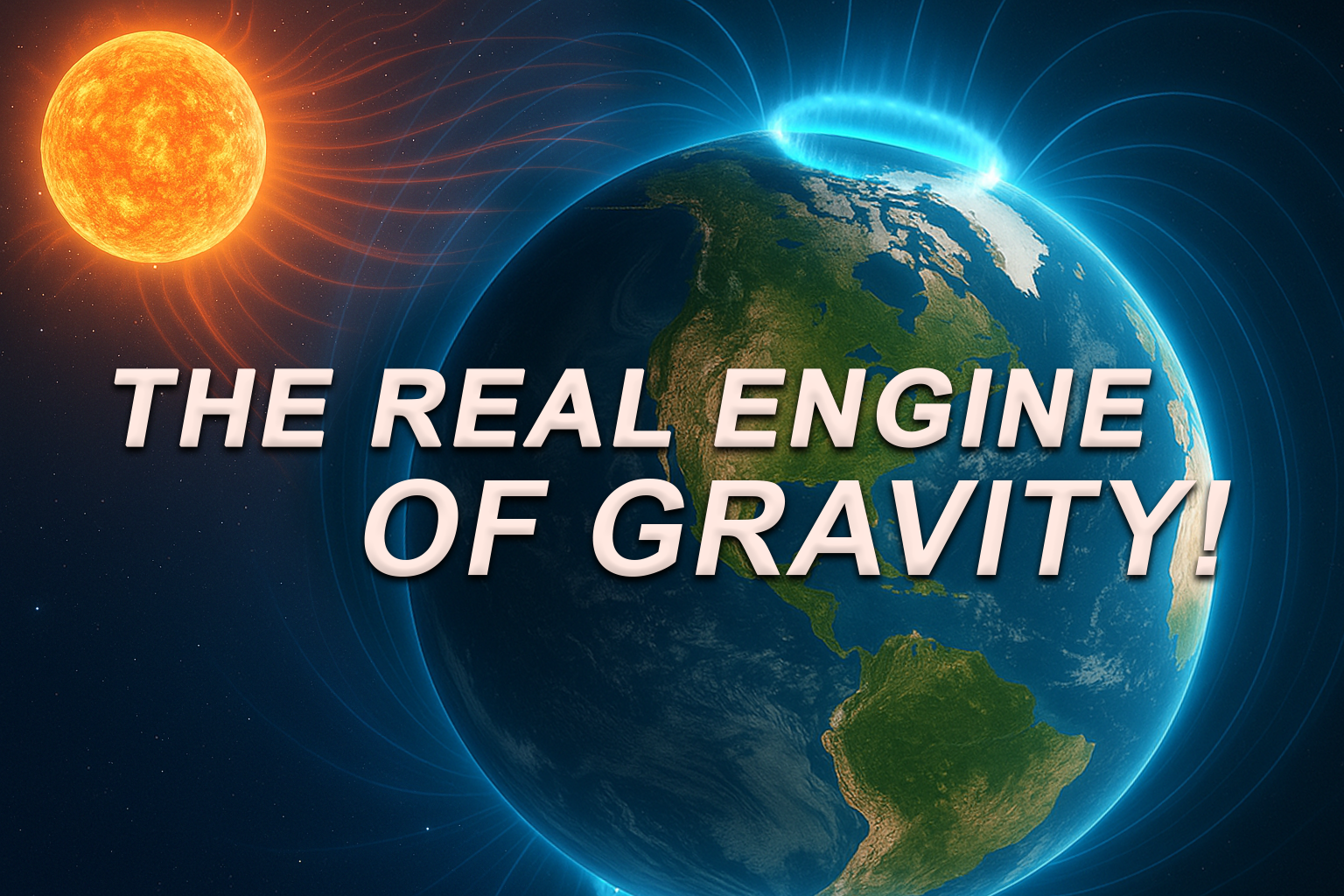
3 Wave-Pressure Mechanisms That Replace Mass-Based Force
The real engine of gravity isn’t mass. It isn’t spacetime curvature. It’s wave pressure acting through a physical medium, and the mechanism has a name, a mathematical formulation, and a documented laboratory record going back to the 19th century.
This is what Acoustic Gravitic Theory proposes. Not that gravity is mysterious or that it needs a new set of abstract parameters. But that it’s already been explained, by wave physics, and physics simply hasn’t made the connection yet. The Primary Bjerknes Force, originally formulated by Carl Anton Bjerknes at the University of Christiania through the 1860s and 1870s and extended by his son Vilhelm Bjerknes in his 1906 Columbia University lecture series “Fields of Force,” is the engine. The medium is the atmosphere and the solar plasma. The mechanism is real, testable, and already operating.
Let’s look at exactly how it works.
The Problem with Traditional Gravity Models
For well over a century, physicists have explained gravity through either Newton’s law of universal gravitation or Einstein’s geometric interpretation through General Relativity. Both frameworks treat mass as the origin of gravitational force. Neither provides a medium or a physical mechanism for how that force is transmitted.
Newton’s formulation is honest about this gap. He famously refused to speculate on the mechanism, “Hypotheses non fingo,” meaning he frames no hypotheses about what gravity actually is. He only described what it does mathematically. Einstein’s spacetime curvature model replaced Newton’s description with geometry, which is more mathematically elegant, but the fundamental question remains unanswered. What is the physical carrier? What actually pushes or pulls? Curved geometry is a description of a path, not an explanation of what bends the path or why.
Meanwhile, planetary orbits remain stable despite complex multi-body gravitational interactions that neither Newtonian nor relativistic models can solve analytically, a point Poincaré established definitively in his 1892 to 1899 treatise Les méthodes nouvelles de la mécanique céleste. The persistent stability of orbits across the full observed record of planetary motion, even for bodies like Venus that lack a significant magnetosphere, remains without a mechanistic explanation in the standard framework.
AGT answers the mechanism question directly.
RELATED: WHAT IS GRAVITY?
https://graviticalchemy.com/what-is-gravity/
Mechanism 1: The Primary Bjerknes Force in Earth’s Atmosphere
On Earth, the real engine of gravity operates through a vertical pressure gradient in the atmospheric column sustained by a composite acoustic energy system.
Secondary microseisms, generated by opposing ocean swell-train interactions and first characterized theoretically by Michael Longuet-Higgins at the University of Cambridge in his landmark 1950 paper in the Philosophical Transactions of the Royal Society, radiate continuous seismic power on the order of 10¹¹ to 10¹² watts globally into the crust at 0.1 to 0.3 Hz. Microbaroms generated by storm activity at the ocean surface deliver atmospheric infrasound reaching 0.05 pascals during major storms, monitored globally through the infrasound network of the Comprehensive Nuclear-Test-Ban Treaty Organization. Earth’s continuous seismic hum, established through the foundational 1998 paper of Naoki Suda, Kazunari Nawa, and Yoshio Fukao at the Earthquake Research Institute of the University of Tokyo, sustains the planet’s spheroidal normal modes from 0.309 millihertz through approximately 2 millihertz through infragravity wave loading of continental shelves.
Schumann resonances inside the Earth-ionosphere cavity, sustained by roughly 100 lightning discharges per second globally, contribute coherent electromagnetic standing waves at 7.83, 14.3, and 20.8 Hz. Solar ELF and ULF oscillations carried by Birkeland currents into the polar ionosphere penetrate Earth’s conductive outer core, inducing oscillatory feedback through Faraday’s Law and Lenz’s Law and organizing the phase coherence of the composite field.
The result is a vertically structured infrasonic standing wave field that produces a downward pressure gradient of approximately 12 Pa/m at the surface. This value matches the classical hydrostatic gradient of approximately 11.5 to 12 Pa/m from acoustic first principles, without any fitting to the observed gravitational acceleration. Solid bodies immersed in this field cannot oscillate in phase with the surrounding atmosphere because their internal impedance is several orders of magnitude higher than that of air. The asymmetric pressure across the body’s vertical extent produces a net downward force. That force is what we call weight. It’s the Primary Bjerknes Force applied to the terrestrial acoustic field, mechanical, deterministic, and continuous.
This isn’t speculation. Acoustic levitation experiments at the Daniele Foresti group at ETH Zurich demonstrated programmable suspension and three-dimensional manipulation of objects through dynamically reconfigured standing wave fields. The mechanism is identical. The cavity is just larger.
Mechanism 2: Orbital Phase-Locking via Solar Magnetosonic Waves
In space, the real engine of gravity operates through the same Bjerknes principle at heliospheric scale.
The Sun functions as a multi-frequency oscillator emitting magnetosonic waves, Alfvén waves first characterized by Hannes Alfvén in his 1942 Nature paper on electromagnetic-hydrodynamic waves, and ELF and ULF waves driven by solar rotation, coronal mass ejections, and magnetic reconnection events. These waves propagate outward through the heliospheric plasma and reflect inward from the heliopause, forming large-scale standing wave troughs at specific radial distances.
Planetary bodies don’t orbit at arbitrary distances. They phase-lock into these troughs. Each planet acts as a nested resonant cavity, composed of atmospheric, ionospheric, and where present, magnetospheric shells, whose impedance prevents in-phase oscillation with the surrounding plasma field. The resulting pressure asymmetry across the cavity boundary produces a restoring force directed toward the trough minimum. Orbital stability is the resonant equilibrium of an impedance-defined cavity in a documented standing wave structure.
Earth’s orbit, for example, aligns with the 2,244th harmonic of the solar oscillation frequency at the documented Alfvén wave speed across the inner heliosphere. That’s an empirical match that mass-based gravity doesn’t predict and can’t explain. It falls directly out of the wave-mechanical account.
The Lagrange points that Joseph-Louis Lagrange identified in his 1772 essay on the three-body problem, including the L4 and L5 positions occupied by the Trojan asteroid swarms 60 degrees ahead and behind Jupiter, are within AGT specific instances of phase-aligned trough positions in the nested wave architecture. They’re not precarious gravitational balancing acts. They’re wave nodes.
RELATED: ORBITAL MECHANICS
https://graviticalchemy.com/orbital-mechanics/
Mechanism 3: Birkeland Currents as Real-Time Feedback Infrastructure
The real engine of gravity doesn’t just establish an initial structure. It maintains it actively through a continuous electromagnetic feedback circuit.
Birkeland currents, the large-scale field-aligned electric current systems flowing along magnetic field lines between the Sun and planetary poles, complete a global energy circuit that modulates the resonant properties of the heliospheric wave field in real time. First proposed by Kristian Birkeland at the University of Christiania in the early 20th century and confirmed through satellite measurements by Adolph Ivar Fälthammar and colleagues in the 1970s, these currents carry vast electrical streams that continuously energize planetary cores and reinforce planetary magnetic fields through inductive coupling.
Alfvén waves propagate along magnetic flux tubes, transferring momentum and energy from solar activity outward through the entire system, as Alfvén detailed in his 1981 book Cosmic Plasma. This means the heliospheric standing wave structure isn’t a static snapshot frozen in place. It’s an actively maintained resonant cavity, continuously re-energized by the Solar Induction Dynamo. When solar activity fluctuates, the Birkeland current system adjusts. When the wave field shifts, planetary cavities track their trough positions through the same impedance-mediated feedback.
This is why the solar system maintains its stability across the full documented observational record. A purely gravitational system is conservative, energy is preserved but not replenished. Real planetary systems lose energy through tidal dissipation, radiation pressure, and other mechanisms. Something has to be doing the work of maintaining the structure, and that something is the active electromagnetic infrastructure of the Solar Induction Dynamo. Gravity, in AGT, isn’t a passive attraction. It’s an actively maintained pressure condition.
RELATED: WAVES CARRY FORCE
https://graviticalchemy.com/waves-carry-force/
Why Venus and Mars Still Work
One question comes up regularly: Venus lacks a significant global magnetosphere, and Mars has only a weak remnant field. If orbital stability depends on a planetary magnetosphere coupling to the solar wave field, how do these bodies maintain stable orbits?
The answer is ionospheric resonance. Both planets retain ionospheres, structured plasma layers in their upper atmospheres that continue to interact with the solar plasma medium and respond to passing magnetosonic waves. The impedance contrast between the ionospheric cavity and the surrounding solar plasma is sufficient to generate the Bjerknes-type restoring force that keeps the body locked to its trough position. Magnetospheric shells amplify the coupling, but they’re not required for it to operate.
Venus’s anomalous slow retrograde rotation, characterized through the Goldstone Solar System Radar observations of Roland Carpenter in 1962 and confirmed through the Soviet Venera missions from 1961 to 1984, fits directly into this account. Within AGT, Venus resides in a phase-inverted trough within the inner heliospheric standing wave structure, and its ionosphere is the coupling interface. The rotation isn’t a mystery requiring a special-case explanation. It’s a geometrically derivable outcome of the wave-phase relationship at Venus’s orbital position.
This extends the real engine of gravity to every body in the solar system with any kind of plasma interaction, which includes every significant body we’ve characterized.
Conclusion
The real engine of gravity is a pressure mechanism operating in a real physical medium, not a geometric metaphor stretching across empty space. On Earth, it’s the Primary Bjerknes Force applied to a vertically structured infrasonic standing wave field sustained by ocean-driven acoustics, solar electromagnetic input, and Schumann resonances. In the heliosphere, it’s the same Bjerknes principle applied to magnetosonic standing wave troughs maintained by the Solar Induction Dynamo through Birkeland currents and Alfvén waves.
This is a unified, testable, mechanistic account. It reproduces the observed gravitational acceleration at Earth’s surface from acoustic first principles without fitting parameters. It explains orbital spacing through documented wave harmonics. It accounts for anomalous planetary behavior through wave-phase geometry rather than special-case hypotheses. And it does all of this by appealing to physical processes that are already documented, already measured, and already operating.
The standard models describe what gravity does. AGT explains what gravity is.
The full mathematical derivation, including the complete dispersion model and energy budget, is available at graviticalchemy.com. To follow the development of AGT and join the community building this out, visit skool.graviticalchemy.com. To support the experimental validation program directly, visit buymeacoffee.com/graviticalchemy or merch.graviticalchemy.com.
Supporting Scientific Literature
Longuet-Higgins, M. S. (1950). A theory of the origin of microseisms. Philosophical Transactions of the Royal Society, 243(857), 1-35. https://royalsocietypublishing.org/doi/10.1098/rsta.1950.0012
Suda, N., Nawa, K., and Fukao, Y. (1998). Earth’s background free oscillations. Science, 279(5359), 2089-2091. https://www.science.org/doi/10.1126/science.279.5359.2089
Alfvén, H. (1942). Existence of electromagnetic-hydrodynamic waves. Nature, 150(3805), 405-406. https://www.nature.com/articles/150405d0
Alfvén, H. (1981). Cosmic Plasma. D. Reidel Publishing Company. https://link.springer.com/book/10.1007/978-94-009-8374-8
Bedard, A. J., and Georges, T. M. (2000). Atmospheric infrasound. Physics Today, 53(3), 32-37.
https://doi.org/10.1063/1.883019
Chen, F. F. (2016). Introduction to Plasma Physics and Controlled Fusion. Springer. https://link.springer.com/book/10.1007/978-3-319-22309-4
Kelley, M. C. (2009). The Earth’s Ionosphere: Plasma Physics and Electrodynamics. Academic Press. https://www.elsevier.com/books/the-earths-ionosphere/kelley/978-0-12-088425-4
Balogh, A., and Treumann, R. A. (2013). Physics of Collisionless Shocks: Space Plasma Shock Waves. Springer. https://link.springer.com/book/10.1007/978-1-4614-6099-2