Gravitic Alchemy
Gravitic Alchemy Banner

Tag: AGT

  • Dark Matter Is Plasma

    Dark Matter Is Plasma

    New findings reveal that so-called dark matter is not a mysterious substance but a manifestation of the plasma medium behaving as a coherent superfluid field.

    A recent study highlighted by Interesting Engineering reports that “dark matter” may behave like a superfluid, forming wave-like structures and vortices within galaxies. Researchers propose that, under certain densities and temperatures, this material transitions into a Bose-Einstein–like condensate capable of supporting phonon excitations — waves that transmit forces through the galactic medium.

    While mainstream physicists treat this as a property of an undiscovered particle species, the observation itself contradicts the particle paradigm. If “dark matter” flows, condenses, and exhibits fluid coherence, then it is not particulate at all. These are the signatures of a plasma field, not invisible mass. This development exposes a growing flaw in the ΛCDM model: the universe behaves as a wave-connected fluid continuum, not as a spacetime geometry filled with collisionless particles.

    RELATED: Refuting Dark Matter, Spacetime, and the Big Bang
    https://graviticalchemy.com/refuting-dark-matter-spacetime-and-the-big-bang/

    Plasma as the True Superfluid Medium

    Under Acoustic Gravitic Theory (AGT), the behavior attributed to dark matter emerges naturally from the plasma medium pervading interstellar and intergalactic space. This medium is charged, conductive, and capable of supporting magnetosonic and Alfvén waves. When compressed or cooled by large-scale magnetic structures, it behaves like a superfluid, forming coherent oscillations rather than discrete particle interactions.

    The apparent “dark halos” surrounding galaxies are therefore not halos of matter but regions of wave entrapment where magnetosonic pressure gradients create rotational balance. The equations describing this are identical in form to those used for acoustic lift and resonance in fluid dynamics. In AGT terms, gravitational stability arises from phase-locked pressure fields rather than invisible mass.

    P = ρaeff

    Where:

    • P = plasma pressure (Pa)
    • ρ = plasma density (kg/m³)
    • aeff​ = effective acceleration due to wave pressure gradients (m/s²)

    In this framework, every galaxy’s “dark matter halo” is a resonant cavity of the plasma continuum. The superfluid interpretation therefore confirms the presence of a cosmic aether-like substrate that AGT already predicts — a continuous wave medium that carries gravitational energy as acoustic pressure rather than curvature.

    RELATED: Plasma Is Not Weak!
    https://graviticalchemy.com/plasma-is-not-weak/

    Why the Dark Matter Model Fails

    Mainstream cosmology treats dark matter as a non-baryonic mass that curves spacetime, but no experiment has ever detected such a particle. The superfluid observation now undermines this assumption by showing that the behavior of galactic rotation curves results from collective plasma motion.

    If the universe’s unseen mass behaves like a fluid, then its gravitational influence is hydrodynamic, not geometric. The supposed “phonons” in dark matter are simply magnetosonic oscillations propagating through the plasma medium. As these waves interact with galactic fields, they produce stable, quantized vortices — the very structures now reported as evidence for dark-matter superfluidity.

    The failure of General Relativity in explaining these dynamics stems from its lack of a medium. Einstein removed the aether to preserve relativity, but the universe’s observed coherence requires one. The plasma medium fills that role, transmitting both light and gravitic pressure waves, providing a measurable, testable mechanism for what spacetime geometry can only describe abstractly.

    RELATED: The Real Engine of Gravity!
    https://graviticalchemy.com/the-real-engine-of-gravity/

    The AGT Perspective

    In AGT, all gravitational and cosmological structure arises from acoustic resonance within plasma. What cosmologists label “dark matter superfluid” is simply the low-frequency, high-coherence regime of this medium. The plasma behaves as a non-viscous superfluid where wave energy distributes evenly across nodes and antinodes, stabilizing galactic rotation without added mass.

    FB = −(P1P2)

    Where:

    • FB = Primary Bjerknes force (N)
    • P1,P2​ = interacting pressure amplitudes (Pa)

    This acoustic coupling produces the same radial force gradients attributed to dark-matter halos. Instead of gravity arising from mass curvature, AGT defines it as the interference of pressure waves in the plasma medium. The so-called dark-matter effects are therefore acoustic artifacts of large-scale resonance within that field.

    At cosmic scales, plasma filaments interconnect galaxies, and their nodes act as standing-wave junctions. The rotation curves that motivated dark-matter theory are natural consequences of this oscillatory structure — pressure stabilization, not mass attraction.

    Conclusion

    The claim that dark matter behaves as a superfluid is not a revelation about a new form of matter. It is an admission that the cosmos itself is a fluid medium whose pressure waves and resonances shape galaxies, clusters, and cosmic webs. Acoustic Gravitic Theory predicted this long before current models caught up. The universe does not require hidden mass; it only requires a medium capable of wave propagation and phase coherence — plasma.

    Every observation of “superfluid dark matter” is, in truth, a glimpse into the superfluid plasma universe already described by AGT. The failure lies not in the data, but in the interpretation.

    https://interestingengineering.com/space/dark-matter-behaves-like-superfluid

    References

    Berezhiani, L., & Khoury, J. (2015). Theory of dark matter superfluidity. arXiv. https://arxiv.org/abs/1507.01019

    Famaey, B., Berezhiani, L., & Khoury, J. (2017). Phenomenological consequences of superfluid dark matter with baryon–phonon coupling. arXiv. https://arxiv.org/abs/1711.05748

    Ferreira, E. G. M. (2020). Ultra-light dark matter. arXiv. https://arxiv.org/abs/2005.03254

    Lisanti, M., Moschella, M., Outmezguine, N. J., & Slone, O. (2019). A preference for cold dark matter over superfluid dark matter in local Milky Way data. arXiv. https://arxiv.org/abs/1911.12365

  • VIGA Gravity Detector

    VIGA Gravity Detector

    The VIGA Gravity Detector reveals gravity’s true source—vertical pressure gradients from infrasonic waves—not spacetime curvature.

    Introduction: Rethinking Gravity with Measurable Pressure

    The VIGA Gravity Detector is not a thought experiment. It is a challenge to the foundations of physics. For more than a century, gravity has been modeled as either an invisible force of attraction or a geometric warping of spacetime. Neither of these interpretations provides a physically measurable cause. Neither offers a medium. Neither includes a testable, causal mechanism. The VIGA Gravity Detector breaks this stalemate. By directly measuring vertical infrasonic pressure gradients in Earth’s atmosphere, it aims to validate the core premise of Acoustic Gravitic Theory (AGT)—that gravity is a wave-induced pressure field formed by solar-driven seismic resonance and atmospheric infrasound.

    Where Einstein invoked curvature, AGT reveals a standing vertical pressure structure. Where Newton relied on instantaneous attraction, AGT exposes mechanical pressure differentials rooted in impedance mismatch. This reframing has remained obscured, not because it was disproven, but because it was never measured. VIGA makes that measurement possible. It is not simply a device—it is the turning point between two eras of gravitational science.

    Why Vertical Gradients Went Unmeasured

    No existing scientific framework treated vertical infrasonic gradients as gravitationally relevant. General Relativity modeled gravity as a curvature in four-dimensional coordinate space, not as a force operating through a medium. The Einstein Field Equations replaced classical interaction with geometric abstraction, severing any link to real pressure fields or mechanical wave transmission. As a result, infrasound sensor networks such as CTBTO and ISNet were constructed with horizontal bias. These systems detect wavefronts moving laterally through the atmosphere but are physically incapable of resolving the vertical pressure differentials postulated by AGT.

    This omission is not a technological constraint—it is a theoretical blind spot. Once gravity was defined geometrically, pressure was no longer part of the equation. Vertical measurement became irrelevant. The VIGA Gravity Detector reintroduces what Einstein’s model deliberately excluded: the atmosphere as a real, structured medium capable of sustaining vertical standing waves that exert continuous mechanical force on solid bodies.

    Foundations in Atmospheric Infrasound and Resonant Mechanics

    Infrasound is ubiquitous in Earth’s atmosphere. Generated by ocean waves, tectonic motion, meteorological systems, and solar-induced seismic activity, these sub-20 Hz acoustic waves persist for hours and traverse thousands of kilometers. When reflected between boundary layers such as the tropopause and ionosphere, they form stable standing wave patterns. These patterns naturally give rise to vertical pressure gradients—an acoustic structure familiar in fluid dynamics and experimental acoustics but ignored in gravitation.

    AGT proposes that these standing infrasound waves, phase-locked into Earth’s vertical structure, impose a net downward force on solid bodies through the Primary Bjerknes Force. This force emerges when a body immersed in an oscillating pressure field resists synchronous motion. The resulting phase mismatch produces asymmetric pressure—higher above, lower below—resulting in a net compressive force. Gravity, in this view, is not an attractive force between masses but a measurable, mechanical pressure imposed on non-resonant matter.

    Pressure Gradient Required to Simulate Gravity

    The fundamental requirement to reproduce Earth’s gravitational acceleration through pressure is defined by:

    \frac{\Delta P}{\Delta z} = \rho \cdot g

    Where:

    • ΔPz: vertical pressure gradient (Pa/m)
    • ρ: air density at sea level (kg/m³), typically ~1.2
    • g: gravitational acceleration (9.8 m/s²)

    Substituting values:

    \frac{\Delta P}{\Delta z} = 1.2 \cdot 9.8 = 11.76 \, \text{Pa/m}

    Rounded, this defines the VIGA target detection threshold at 12 Pa/m. If such a persistent gradient is observed, not linked to convection or weather, it would empirically confirm that the weight of objects results from vertical infrasonic compression—not from geometric curvature or mass attraction.

    What Is the VIGA Gravity Detector?

    The VIGA Gravity Detector is a vertically arrayed stack of ultra-sensitive barometric sensors, placed at regular intervals—typically every 0.5 meters along a 6-meter mast. These sensors are calibrated to detect pressure differences down to 0.01 Pascals, enabling the detection of a gradient as small as 10–15 Pa/m. Sampling rates of 1 Hz or higher ensure capture of low-frequency infrasonic oscillations. Environmental shielding and thermal compensation are built in to reduce error from wind or heat distortion. The VIGA array is not simply a meteorological tool—it is a gravitic interferometer designed to test whether infrasonic standing waves constitute the downward force field we call gravity.

    If the VIGA Gravity Detector observes vertical pressure gradients that match theoretical thresholds and persist independently of atmospheric convection, the entire premise of General Relativity collapses under the weight of a real measurement.

    The Case Against Spacetime

    Spacetime cannot resonate. It cannot refract, diffract, or oscillate. It has no impedance, no density, and no mechanical properties. It is a placeholder for gravitational behavior, not a medium through which it propagates. All empirical data used to support General Relativity—Mercury’s precession, time dilation, lensing—can be reinterpreted through phase-locking mechanics, resonant drag, and plasma-based refraction.

    In contrast, Acoustic Gravitic Theory defines all gravitational behavior as phase-induced pressure effects. Planets phase-lock into nodal minima of solar magnetosonic waves. Light bends due to refractive index gradients in plasma. Time dilation arises from resonant impedance on atomic oscillators. Every phenomenon once attributed to geometric deformation is instead causally explained through measurable interaction between oscillating wave fields and impedance structures.

    The VIGA Gravity Detector confronts the assumption of curvature with the reality of vertical compression. If gravity can be measured as a standing pressure field, then spacetime has no role in gravitational cause.

    Toward Artificial Gravity and Gravitational Engineering

    If infrasonic pressure gradients can be measured, they can be replicated. Artificial gravity becomes an engineering problem, not a theoretical fantasy. Spacecraft could be fitted with low-frequency resonant coils to produce standing gradients of 12 Pa/m, recreating Earth-like weight without rotation. Spacesuits could incorporate portable infrasonic emitters to preserve muscular and skeletal integrity during EVA.

    This wave-based understanding also enables gravitational suppression. By generating phase-inverted infrasonic fields, local pressure gradients can be canceled, producing temporary weightlessness. If refined, this method could support acoustic lift, zero-gravity chambers, and ground-based propulsion systems.

    What begins as a passive detection device becomes a gateway to active gravitic manipulation.

    Energy Source and Sustainability

    A common objection is the energy requirement to sustain such a pressure field. But AGT accounts for this through solar-induced core excitation. Ultra-low-frequency magnetic waves from the Sun couple into Earth’s core via geomagnetic field lines. These induce internal oscillations, which radiate as seismic and infrasonic energy. The energy density required to sustain a 12 Pa/m pressure gradient falls well within the output of solar ELF/ULF input—estimated at 0.5 to 2 mW/m². Unlike GR, which offers no sustaining mechanism, AGT traces a continuous, testable power flow from Sun to seismic to atmospheric wave structure.

    Why It Was Never Measured—Until Now

    For more than a century, physicists have built models that exclude media. Spacetime, dark matter, dark energy—all are artifacts of mathematical necessity, not empirical discovery. With no pressure mechanism in its equations, General Relativity offered no incentive to measure vertical gradients. VIGA exists precisely because no one else asked the right question. Not once was a vertical barometric array designed to test whether infrasonic standing waves create the net force we interpret as gravity.

    VIGA fills that void. It does not theorize. It listens.

    Testability and Experimental Criteria

    The VIGA Gravity Detector operates in real-time, measuring pressure at vertical intervals during solar events, seismic quiet, and background fluctuations. Correlation with solar wind data, geomagnetic indices, and known infrasound events enables precise filtering. Detection criteria include:

    • Persistence of vertical pressure gradients exceeding 10 Pa/m
    • Coherence across multiple sensors with minimal variance
    • Correlation with solar input (e.g., flares, CMEs)
    • Independence from convection, weather, or ground-level disturbances

    If even one of these criteria is met repeatedly, AGT gains empirical priority. If all are met simultaneously, GR’s reign ends.

    Conclusion: VIGA Validates Gravity’s Medium

    The VIGA Gravity Detector is not just an instrument. It is the first apparatus in history designed to answer whether gravity is a standing acoustic pressure field—not a curvature of space. It offers a testable, mechanical framework where none existed. It aligns with fluid dynamics, wave theory, and plasma physics. It challenges unobserved abstractions with measurable gradients. It redefines weight as downward phase mismatch and orbit as harmonic lock-in—not as pull, not as curve, but as vibration in a real, oscillating medium.

    For over a century, science has tried to describe gravity. Now, for the first time, we can detect it. Not as motion. Not as orbit. As pressure.

    It’s time to measure what spacetime ignored.

    It’s time to build the VIGA Gravity Detector.


    References

    Le Pichon, A., Blanc, E., & Hauchecorne, A. (2010). Infrasound Monitoring for Atmospheric Studies. Springer.
    https://link.springer.com/book/10.1007/978-1-4020-9508-5

    Mitome, H. (1998). Acoustic radiation force on a solid sphere in a focused beam. The Journal of the Acoustical Society of America, 103(2), 952.
    https://asa.scitation.org/doi/10.1121/1.421247

    Parker, E. N. (1958). Dynamics of the interplanetary gas and magnetic fields. The Astrophysical Journal, 128, 664.
    https://ui.adsabs.harvard.edu/abs/1958ApJ…128..664P

    Alfvén, H. (1942). Existence of electromagnetic-hydrodynamic waves. Nature, 150(3805), 405–406.
    https://www.nature.com/articles/150405d0

  • The Real Map of The Universe

    The Real Map of The Universe

    Reinterpreting the Planck Satellite’s Cosmic Map through Acoustic Gravitic Theory

    Mapping the Universe’s Microwave Background

    In 2013, the European Space Agency’s Planck satellite unveiled the most detailed map of the cosmic microwave background (CMB), capturing the universe’s oldest light emitted approximately 380,000 years after the Big Bang. This full-sky map, often referred to as the “map of the universe,” showcases minute temperature fluctuations that correspond to regions of varying densities in the early universe. These variations are believed to be the seeds of all current cosmic structures, including stars and galaxies .(The Guardian, Phys.org, Max Planck Society)

    The Planck mission’s findings have been instrumental in refining our understanding of the universe’s age, composition, and development. According to the standard interpretation, the data suggests the universe is approximately 13.8 billion years old—slightly older than previous estimates—and indicates a higher matter content than earlier believed.(Berkeley Lab News Center, WIRED)

    Challenging Conventional Cosmology

    While the Planck data aligns with the standard cosmological model in many respects, it also presents anomalies that challenge existing theories. For instance, the observed asymmetry in temperature fluctuations between the northern and southern hemispheres of the CMB and the presence of a large cold spot are not easily explained by the conventional Big Bang model .(Max Planck Society, WIRED)

    These irregularities prompt questions about the completeness of our current understanding of the universe’s origins and structure. They suggest the need for alternative models that can account for these observations without relying solely on the concept of spacetime curvature.

    Acoustic Gravitic Theory’s Perspective

    Acoustic Gravitic Theory (AGT) offers a novel interpretation of the Planck satellite’s findings. Instead of viewing the CMB as relic radiation from a singular Big Bang event, AGT posits that the observed patterns result from ongoing plasma processes and wave interactions in the universe.(Phys.org)

    In this framework, the universe is permeated by magnetosonic and Langmuir waves, which interact to form standing wave patterns. These patterns create regions of varying pressure and density, leading to the formation and organization of cosmic structures. The “map of the known universe,” as captured by Planck, thus reflects a dynamic, continuously evolving cosmos shaped by these plasma interactions.

    AGT also suggests that gravitational effects arise from the pressure gradients established by these standing waves, rather than from the curvature of spacetime. This perspective aligns with observations of plasma behavior in laboratory settings and offers a testable alternative to traditional gravitational theories.

    Implications for Our Understanding of the Cosmos

    Reinterpreting the Planck data through the lens of Acoustic Gravitic Theory has profound implications for cosmology. It challenges the notion of a static universe born from a singular event, proposing instead a dynamic cosmos where structures emerge from continuous plasma interactions.(WIRED)

    This perspective also aligns with the idea that our understanding of the universe “just keeps getting bigger” as our observational technologies advance. The “three-dimensional map of” the cosmos provided by Planck can be seen not as a snapshot of a bygone era but as evidence of ongoing processes that shape the universe.(Max Planck Society)

    Furthermore, AGT’s emphasis on plasma processes and wave dynamics offers a framework that can be explored and tested through laboratory experiments and observations, potentially leading to new insights into the fundamental forces that govern the cosmos.

    Conclusion

    The Planck satellite’s comprehensive mapping of the cosmic microwave background has provided invaluable data that both supports and challenges existing cosmological models. Acoustic Gravitic Theory offers an alternative interpretation, viewing the universe as a dynamic, plasma-filled medium where structures arise from continuous wave interactions. This perspective not only accounts for the anomalies observed in the Planck data but also opens new avenues for research and understanding in cosmology.(The Guardian)

    Original Source:
    https://www.esa.int/Science_Exploration/Space_Science/Planck/Planck_reveals_an_almost_perfect_Universe

    References:

    Planck Collaboration. (2014). Planck 2013 results. Astronomy & Astrophysics, 571, A1. https://doi.org/10.1051/0004-6361/201321529

    Peratt, A. L. (1992). Physics of the Plasma Universe. Springer-Verlag. https://link.springer.com/book/10.1007/978-1-4614-7819-5

    Alfvén, H. (1981). Cosmic Plasma. D. Reidel Publishing Company. https://link.springer.com/book/10.1007/978-94-009-8679-8

    Bostick, W. H. (1986). The Morphology of the Universe: The Plasma Universe. IEEE Transactions on Plasma Science, 14(6), 703–711. https://doi.org/10.1109/TPS.1986.4316597

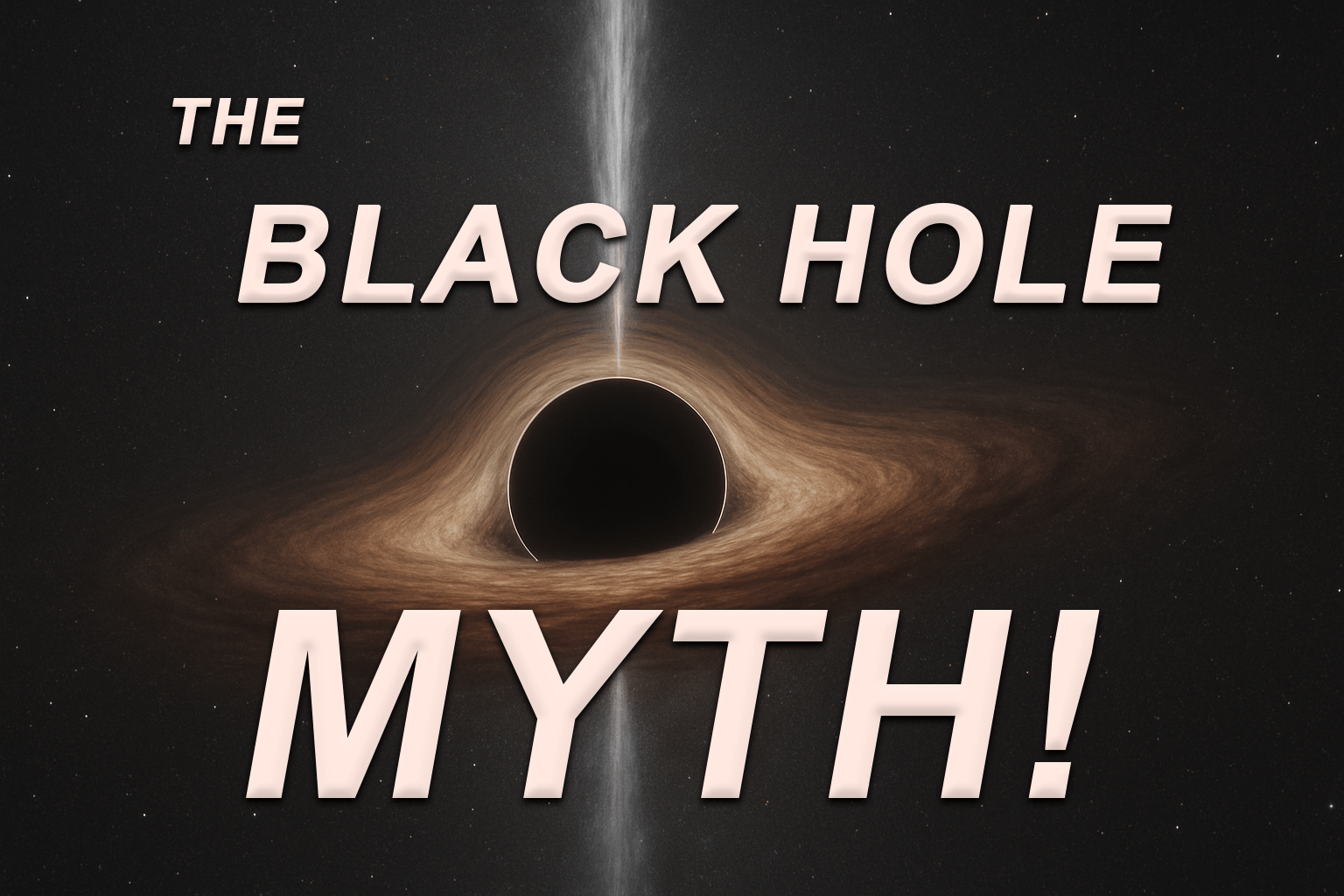
  • The Black Hole Myth!

    The Black Hole Myth!

    Plasma Physics Explains Why Black Holes don’t exist.

    For over a century, black holes have dominated the popular imagination and academic astrophysics. From the warping of spacetime to the notion of singularities swallowing light and time itself, these enigmatic voids have been sold as inevitable consequences of Einstein’s equations. But what if black holes are not real—at least, not in the way we’ve been told?

    Acoustic Gravitic Theory (AGT) proposes a bold, physics-based alternative: what astronomers are seeing are not spacetime sinkholes, but high-density plasma pinch points governed by magnetohydrodynamic (MHD) forces and wave collapse. The supposed “black hole” is a misinterpretation—a relic of theory stretched beyond observable causality.

    There Are No Singularities in Nature—Only Plasma Collapse

    In laboratory settings, plasma subjected to strong magnetic confinement will self-organize into tight filaments via the Z-pinch and Bennett pinch effects. These structures:

    • Emit minimal visible light due to density and field alignment.
    • Radiate X-rays and high-energy particles from boundary layer collisions.
    • Launch bipolar jets along their magnetic axes—exactly like what is seen in quasars and AGNs.

    What traditional astrophysics labels as an “event horizon” is better explained by the outer sheath of a plasma pinch, where the refractive index gradients and magnetic fields block visible light without invoking an infinite density or escape velocity.

    Gravity Doesn’t Pull—It Presses

    Einstein’s interpretation depends on mass pulling spacetime into a funnel. But AGT explains gravity as a net downward pressure from wave interference—primarily infrasonic and magnetosonic waves initiated by the Sun and structured through Earth’s atmospheric and magnetospheric shell.

    There is no need for an invisible point-mass crushing light and matter. Plasma around galactic cores is compressed not by gravity, but by magnetic wave collapse and pressure gradients, which create a self-stabilizing structure with observable properties—minus the metaphysical baggage of a singularity.

    The Jets Refute the Theory

    The very existence of relativistic jets undermines the black hole hypothesis. According to General Relativity, nothing—not even light—should escape an event horizon. Yet jets blast out of the “poles” of these so-called black holes at near-light speeds. These jets are not exceptions; they are rules in galaxy cores and microquasars alike.

    In plasma physics, these jets are perfectly expected: magnetic tension in the pinch column releases energy along the axis of rotation, just as seen in fusion chambers and magnetically confined toroids.

    There Is No ‘Hole’—Only a Dense, Oscillating Core

    In AGT, what forms at the center of a galaxy or collapsed star is a resonant node of pressure and energy, stabilized by standing waves and electromagnetic feedback. These nodes don’t absorb and destroy information—they redirect energy via phase transitions and wave leakage.

    Recent studies even hint that objects near so-called “black holes” emit high-frequency radiation and exhibit oscillatory structures—an outcome not predicted by event-horizon models but perfectly aligned with plasma-based oscillation theory.

    Observational Tests Support Plasma, Not Spacetime Distortion

    AGT makes falsifiable predictions that standard models cannot:

    • Plasma lensing, not spacetime curvature, causes light bending—this predicts frequency-dependent (chromatic) lensing, unlike General Relativity’s achromatic forecast.
    • High-frequency wave leakage near galactic cores should exist—where GR predicts silence, AGT predicts electromagnetic shimmer.
    • Oscillatory behavior in gravity, lensing, and timekeeping devices correlates with solar-induced wave events—not invisible masses.

    In fact, X-ray behavior near black hole candidates aligns with known plasma heating mechanisms like magnetic reconnection and current filament collapse—not quantum singularity dynamics.


    Conclusion

    Black holes are not gravity wells; they are pressure nodes—dense, wave-locked structures formed by plasma pinch effects and magnetosonic collapse. The time has come to replace the mathematical abstraction of singularities with testable physics rooted in plasma dynamics and acoustic field theory.

    Let go of the spacetime mirage. The universe is structured by waves, not warps.