

Why directional energy propagation shapes reality—and why particle metaphysics fails to explain it
Wave motion is not an illusion. Waves Carry Force. It is one of the most causally potent and directly observable phenomena in the universe. Contrary to outdated claims in some corners of classical and particle physics, waves are not mere oscillatory artifacts of particle vibration. They are real, directional, vector-defined mechanisms for energy transfer, momentum delivery, and force exertion across all known media—solid, liquid, gas, and especially plasma. This is not philosophical interpretation; it is measurable, testable physics. And it strikes at the heart of one of the most dangerous assumptions in modern theory: that only particles are real, and waves are mathematical illusions.
In Acoustic Gravitic Theory (AGT), gravity is modeled as the effect of external pressure gradients induced by wave interference, not the intrinsic pull of mass. This requires a recognition that wave propagation in fluids and plasma is not secondary to matter—it is the primary driver of matter’s motion, structure, and cohesion. Claims that waves do not carry force are not only wrong—they are falsified by direct laboratory experiments, spacecraft data, and fluid dynamics principles. Every foundational equation governing wave motion affirms this.
The Physical Nature of Wave Propagation
A wave is not a static pulse or a local oscillation. It is a spatially and temporally varying disturbance that carries energy, momentum, and phase through a physical medium. It is defined by a wave vector k that gives it direction and a temporal frequency ω that governs its oscillatory behavior. This gives rise to phase velocity and group velocity, both of which are real and measurable.
This is formalized in the canonical wave equation:

Where:
- ψ: wave function (e.g. displacement, pressure, or field intensity)
- c: propagation speed of the wave (m/s)
- ∇2: Laplacian operator representing spatial curvature
Solutions to this equation—whether pulses, solitons, or standing waves—transport force. In air and water, these manifest as sound, ocean waves, or infrasound gradients. In plasma, they appear as Alfvén waves, Langmuir oscillations, and magnetosonic compressions, each with distinctive and measurable energetic impact.
If waves were merely local particle displacements, then there would be no such thing as pressure propagation, no directional flow, and no coherent field behavior over time. But this is not what we observe in nature or in laboratory experiments.
Measurable Momentum and Energy Transfer
In electromagnetic systems, energy transfer by waves is described using the Poynting vector:

Where:
: electric field vector (V/m)
: magnetic field vector (A/m)
: directional flow of energy (W/m²)
The existence of this vector is what allows electromagnetic energy to be transmitted in a definable direction through space—even in a vacuum. This is not theoretical; it’s how antennas radiate, how radar operates, and how solar sails maneuver spacecraft. If wave energy were an illusion, none of these technologies would function.
The acoustic analog is the acoustic intensity vector:

Where:
- p(t): time-varying pressure (Pa)
: particle velocity (m/s)
: average directional energy flux (W/m²)
This relationship shows that net energy and force can be transferred via coherent acoustic waves. Such wave-driven interactions are the entire basis of acoustic levitation, sonochemistry, ultrasound propulsion, and directional sonar systems.
Plasma Systems: Proof in Space and Laboratory
Nowhere is wave propagation more structurally causal than in plasma. Magnetized plasma supports a wide spectrum of wave modes, each with directionality, measurable propagation velocity, and physically evident effects.
For example, Alfvén waves travel along magnetic field lines and are defined by:

Where:
- vA: Alfvén velocity (m/s)
- B: magnetic field strength (T)
- μ0: vacuum permeability (N/A²)
- ρ: plasma mass density (kg/m³)
These waves are responsible for transferring momentum from the solar wind to planetary magnetospheres, generating auroral currents, and stabilizing magnetotail flows. The Parker Solar Probe and Voyager missions have confirmed that these waves are measurable in speed, pressure, and direction—not artifacts, not metaphors.
Langmuir waves, driven by electric field-particle interactions, form coherent charge separations and energy transport systems in fusion reactors and solar plasmas. They generate shock fronts and ion acceleration regions—none of which would be possible without real, directional wave behavior.
Magnetosonic waves, combining magnetic field and pressure coupling, help shape filamentary structures in the interstellar medium. These waves confine plasma, redistribute charge density, and stabilize rotating plasma flows, such as those observed in galaxy arms.
Particle metaphysics cannot account for any of this.
Acoustic Force Derivations: Radiation Pressure and Lift
The Primary Bjerknes Force demonstrates how waves exert directional force through pressure gradients:

Where:
: force acting on an oscillating body (N)
- V: effective oscillating volume (m³)
- ∇P(t): instantaneous pressure gradient (Pa/m)
If a vibrating object is in phase with a wavefront, the pressure adds. If it’s out of phase, the pressure cancels. This force is what enables levitation in standing wave fields—a phenomenon routinely demonstrated in laboratory and industrial applications.
The acoustic radiation force confirms this with:

Where:
- F: net acoustic force (N)
- γ: compressibility of the medium (1/Pa)
- ∇⟨p2⟩: spatial gradient of the time-averaged pressure squared
This model has been tested in acoustic levitation, ultrasound tweezers, and material manipulation systems. Wave pressure moves matter in defined directions—not due to particle collisions, but wave-induced fields.
The Illusion Myth Is Refuted by Observation
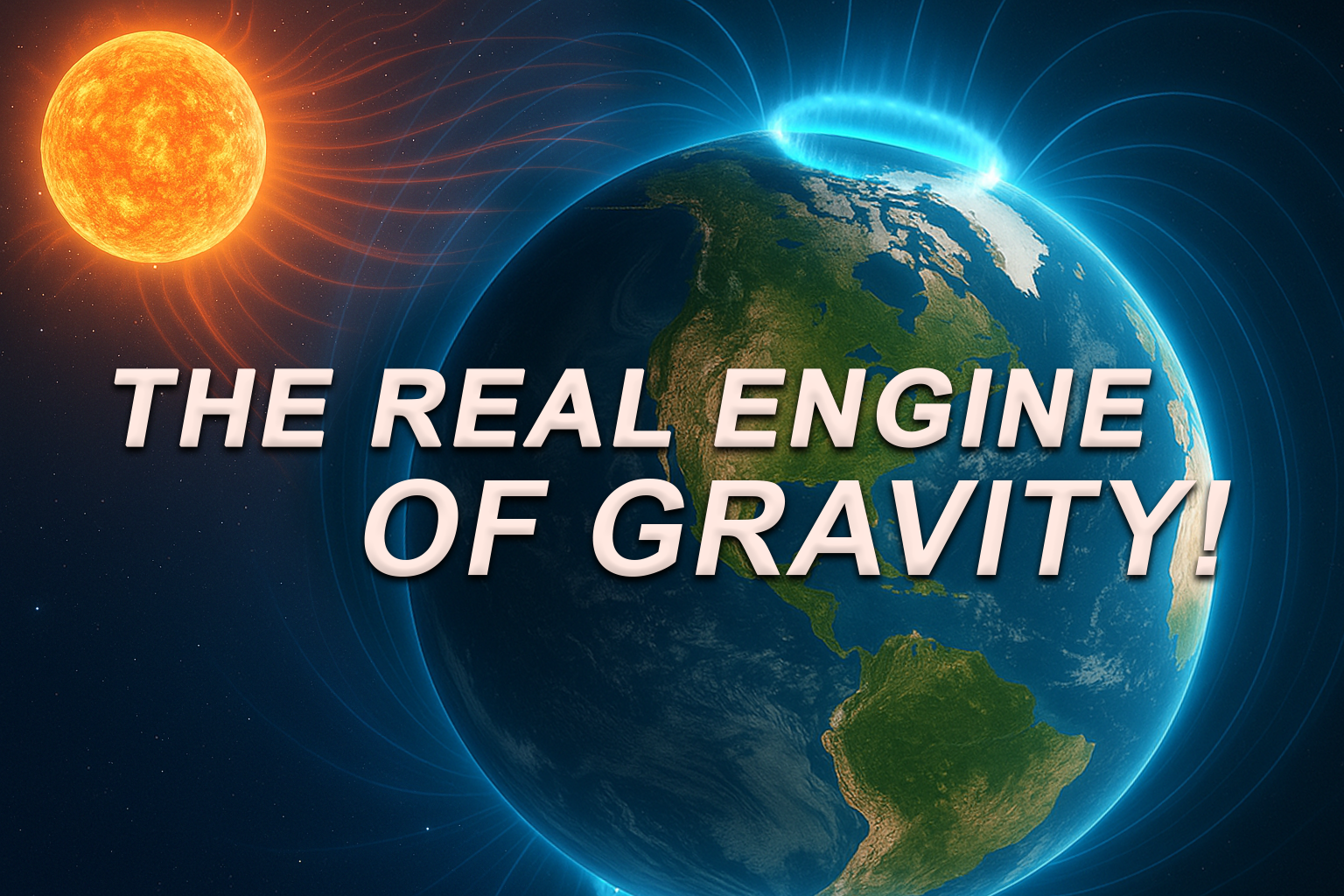
Claims that “waves are illusions” collapse under experimental scrutiny across multiple domains of physics. In oceanography, for example, wave activity displaces floating objects and reshapes coastlines with a forward momentum that cannot be explained by orbital water particle motion alone. The crest of a wave transports energy in a definite direction, influencing everything from marine engineering to tsunami propagation models. In geophysics, seismic infrasound is known to traverse both Earth and atmosphere with enough persistence and energy to trigger sensor arrays across continents—traveling thousands of kilometers with measurable, directional impact. Similarly, in heliophysics, solar wind pressure—driven by plasma wave propagation—exerts real and continuous directional force on planetary magnetospheres, compressing them on the sunward side and stretching them into long tails on the leeward side. This same plasma wave behavior has been harnessed to move spacecraft using solar sails, an outcome impossible if wave motion were not delivering net momentum.
Perhaps most tellingly, space missions like NASA’s IBEX and the Parker Solar Probe have recorded plasma filamentation phenomena in the heliosphere and interstellar boundaries. These filaments form highly stable, long-range anisotropic structures that cannot arise from random or neutral particle interactions. The coherency, length scales, and persistence of these formations all point to directional wave behavior as the causative mechanism—not inert matter or localized oscillations. These are not anomalies or edge cases. They are the dominant behaviors observed in systems governed by plasma and fluid dynamics. Such pervasive physical realities categorically falsify the claim that waves are illusory or inconsequential. Theories that rely solely on particles “moving up and down” without net energy transfer or force propagation are unable to account for these phenomena and must therefore be dismissed as incomplete at best, or outright incorrect.
Relevance to Gravitational Models in AGT
Acoustic Gravitic Theory (AGT) offers a radically different explanation for gravitational interaction—one grounded not in the curvature of spacetime but in the directional propagation of wave-induced pressure. According to AGT, gravitational force is not an intrinsic function of mass but a byproduct of coherent wave interference patterns acting on objects through differential pressure gradients. In this model, Primary Bjerknes forces generate attractive effects between bodies not because of their mass content but due to their phase relationships within an ambient oscillatory pressure field. These interactions are inherently directional and can be reversed or canceled if the wave phases are altered—something that no spacetime model accounts for.
Secondary Bjerknes forces emerge from the mutual oscillation of two or more bodies within a shared field, creating the possibility of self-organized alignment, stable orbital resonances, and cavity formation. These dynamics do not require curved geometry or point-mass gravity wells. They require only a coherent pressure field and phase synchronization—conditions that are not just theoretical but reproducible in lab-scale acoustic systems. Most critically, AGT proposes a class of phase-inversion experiments that predict gravitational suppression or reversal via destructive interference of the pressure waves within a controlled cavity. These predictions are testable, falsifiable, and physically impossible under any model that treats wave energy as non-causal or metaphorical.
In short, if wave energy were illusory, AGT could not function. But empirical data across all physical domains—acoustics, plasma dynamics, fluid systems, and geophysics—demonstrates that wave motion is not only real but causally dominant. Directional wave propagation is the missing foundation for understanding gravitational behavior, and AGT restores it to the center of the discussion. Denial of this principle is not merely a philosophical disagreement; it is a rejection of observable, measurable, and reproducible science.
Conclusion: Waves Drive Reality
In modern physics, denying the role of waves is equivalent to denying causality itself. Waves are not optional. They are the medium of transport, alignment, and force in plasma, fluid, and atmospheric systems. They create pressure gradients, exert lift, cause rotation, and govern everything from auroras to galaxy formation. The denial of wave force is not science—it is a metaphysical retreat into models that cannot explain how the universe holds together.
No valid theory of gravity, orbital structure, or cosmic cohesion can ignore wave propagation. And no honest physicist can maintain that wave motion is an illusion in the face of direct, repeatable, directional proof.
Waves are real. Waves carry energy. Waves exert force. And waves structure the universe.
References
Alfvén, H. (1981). Cosmic Plasma. Springer.
https://link.springer.com/book/10.1007/978-94-009-8679-8
Kivelson, M. G., & Russell, C. T. (1995). Introduction to Space Physics. Cambridge University Press.
https://doi.org/10.1017/CBO9780511620055
Parker Solar Probe Mission Overview. NASA.
https://www.nasa.gov/content/goddard/parker-solar-probe
Stix, T. H. (1992). Waves in Plasmas. American Institute of Physics.
https://doi.org/10.1063/1.3033912
Voyager Plasma Science Experiment.
https://pds-ppi.igpp.ucla.edu/
THOR: Turbulence Heating ObserveR. ESA.
https://sci.esa.int/web/thor
IBEX Results Summary. NASA.
https://www.nasa.gov/mission_pages/ibex/index.html