Gravitic Alchemy
Gravitic Alchemy Banner

Tag: plasma-based orbital mechanics

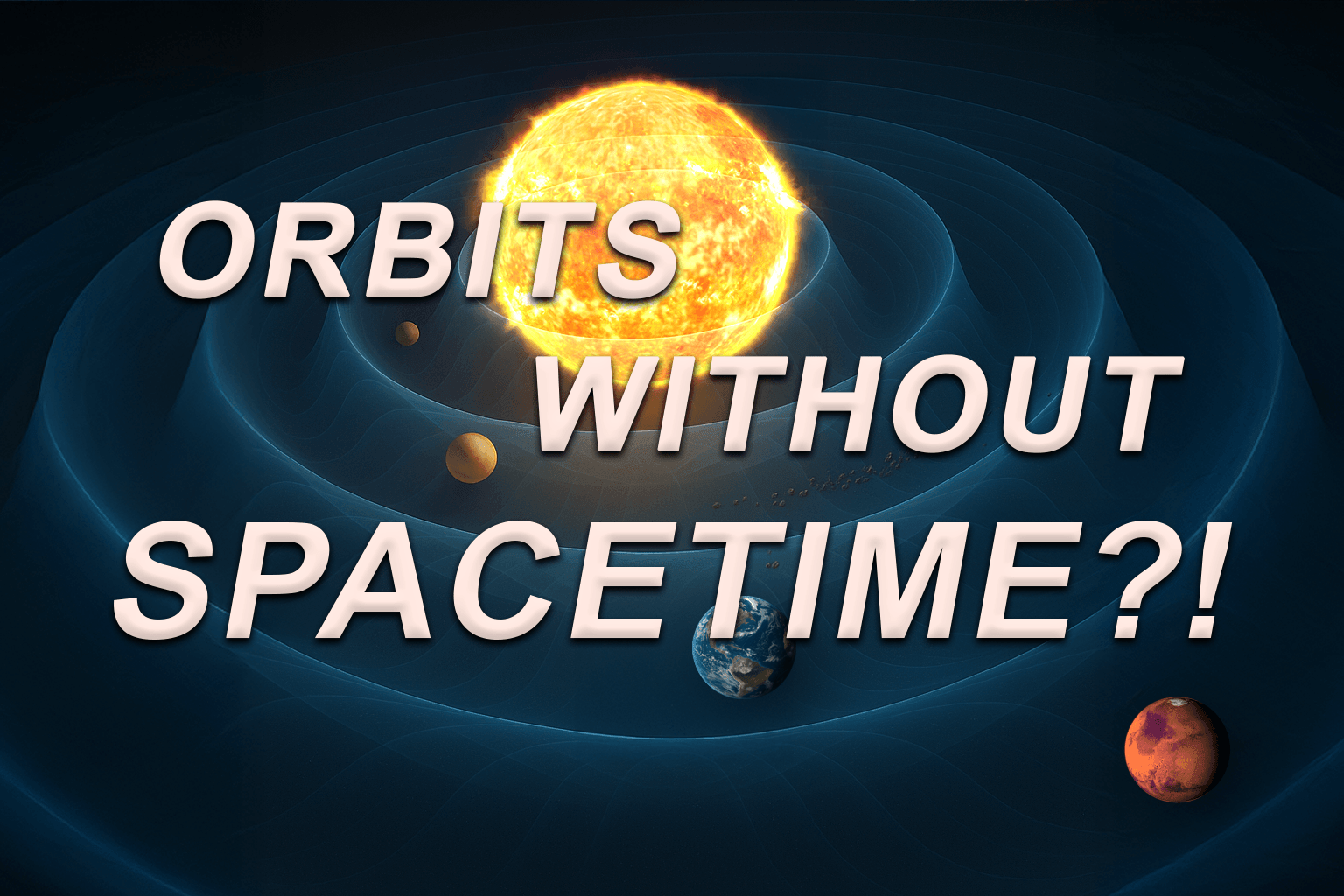
  • Orbits Without Spacetime?!

    Orbits Without Spacetime?!

    Langmuir Node Stabilization and the Plasma-Based Mechanism of Planetary Retention

    Introduction

    The prevailing paradigm in modern astrophysics explains planetary orbits as a consequence of spacetime curvature. According to General Relativity, massive objects deform the geometric structure of spacetime, and this deformation guides the motion of other bodies—a view most commonly exemplified by solutions such as the Schwarzschild or Kerr–Newman metrics. While elegant and mathematically robust, this model lacks a physical medium and introduces abstract curvature rather than tangible forces. Acoustic Gravitic Theory (AGT) challenges this model directly, offering an alternative based on physical pressure gradients, wave interference, electromagnetic field resonance, and the structured behavior of plasma.

    This paper introduces the concept of Langmuir Node Stabilization as a credible alternative to traditional gravitational explanations of orbital motion. Drawing on extensive measurements from missions such as Voyager, Parker Solar Probe, WIND, and others, we show that the interplanetary medium contains the necessary plasma density and electric field behavior to anchor planetary bodies within standing Langmuir wave nodes—an idea that dissolves the need for spacetime curvature altogether.

    Problem Analysis: The Limits of Curved Spacetime

    In recent years, models involving a magnetized Kerr–Newman spacetime have been used to explore the stability of bound chaotic photon orbits near rotating black holes. These relativistic solutions attempt to model complex interactions between light, charge, spin, and gravity in extreme environments, and they extend to include rotating, magnetized, and charged bodies. Similarly, in discussions of orbits and bound states, particularly in the equatorial plane of compact objects, these geometric constructs attempt to describe phenomena such as frame-dragging, precession, and relativistic perihelion shifts.

    Yet despite their mathematical sophistication, these models remain abstract. They rest on assumptions of mass-induced geometric deformation and require an acceptance of curved spacetime without physical substance. Furthermore, they cannot be directly tested or recreated in any laboratory. These limitations make them descriptive but not mechanistic. They explain what happens, but not how in physical terms.

    More critically, these frameworks struggle to explain why orbits remain stable across vast timescales in regions of weak gravitational influence, such as the interplanetary medium. If curvature alone were responsible for planetary positioning, then the high fidelity of orbital distances—accurate to fractions of an astronomical unit—would require unknown stabilizing influences. Dark matter, extra dimensions, or higher-order corrections are sometimes invoked to preserve internal consistency. But such patches raise more questions than they resolve.

    This growing disconnect between mathematical predictions and empirical data presents an opportunity for reassessment. Instead of attempting to retrofit mass-based attraction into every observable, AGT reframes orbital structure through the lens of fluid dynamics, plasma behavior, and oscillatory wave fields that are measurable, quantifiable, and mechanically real.

    Langmuir Node Stabilization: A Plasma-Based Alternative

    Langmuir waves—electrostatic oscillations within plasma—are measurable, repeatable, and deeply studied phenomena. They occur across space and astrophysical environments: from Earth’s bow shock to the heliopause and interstellar boundary. When these waves form standing patterns within the heliospheric plasma, they generate alternating regions of compressive and rarefied electric pressure. These regions behave as nodes and antinodes—essentially acting as gravitational scaffolding made of oscillating field structures.

    Within the framework of Acoustic Gravitic Theory, planetary bodies are not orbiting due to curved space, but are suspended in these impedance-matched nodal troughs of plasma oscillation. Langmuir nodes provide localized regions of reduced net pressure, allowing planetary bodies to remain in dynamically stable positions with minimal external interference. The physical mechanism responsible for this is the Primary Bjerknes force—a net directional force arising when an object does not oscillate in perfect phase with the surrounding medium.

    This interaction between object impedance and wave field phase results in a continuous corrective force, which stabilizes a planet’s position over astronomical timescales. No curvature is needed, only wave mechanics in a structured medium. The Sun acts as the initiator of this process, emitting low-frequency oscillations that propagate through the plasma-rich heliosphere. These oscillations phase-lock into standing wave structures, and the planets, due to their impedance profiles, settle into those nodes.

    Nested Wave Hierarchies: Magnetosonic–Langmuir Coupling

    While Langmuir waves form the immediate scaffolding for orbital suspension, their structure and stability are shaped by deeper dynamics—specifically, the large-scale behavior of magnetosonic waves propagating through the heliospheric plasma. These compressional magnetohydrodynamic (MHD) waves travel at speeds approximating the solar wind (300–800 km/s) and serve as the foundational drivers of plasma density modulations across the interplanetary medium.

    In regions where magnetosonic standing waves form—due to solar oscillations and heliospheric boundary reflections—they create periodic troughs and peaks in plasma pressure and electron density. Since the local electron density determines the frequency and intensity of Langmuir oscillations (via ωₚₑ = √(nₑe² / ε₀mₑ)), these larger magnetosonic structures become the organizing lattice upon which Langmuir wave nodes stabilize. In other words, Langmuir nodes are nested within and shaped by the larger magnetosonic architecture.

    This nested hierarchy is crucial for understanding why planetary orbits appear both stable and discrete. Magnetosonic standing waves define the spatial rhythm of density variation across the heliosphere. Langmuir waves then modulate these zones into finer-scale electrostatic oscillations that exert directional pressure through Primary Bjerknes forces. A planet’s orbital lock occurs only where both wave systems resonate together—where magnetosonic troughs allow Langmuir nodes to form coherent, impedance-matched pockets of stability.

    Furthermore, this coupling suggests a feedback loop: planetary presence alters local plasma impedance, subtly influencing the standing wave structure and reinforcing the node. As a result, orbital zones become dynamic, self-correcting systems where planetary motion, wave structure, and medium properties all co-evolve in phase. This provides a testable, wave-based mechanism for long-term orbital coherence without requiring mass-induced attraction or curved spacetime geometry.

    Quantitative Validation from Space Missions

    The theoretical model proposed here is supported by data from multiple space missions. For example, electron plasma frequencies measured near Earth by Voyager, WIND, and Parker Solar Probe indicate electron densities ranging from 5 to 10 electrons per cubic centimeter. This corresponds to Langmuir plasma frequencies in the range of 20–30 kHz. These frequencies, when translated into electric field strengths, are capable of producing pressures on the order of 4.59 × 10^11 Pascals—sufficient to counteract Earth’s gravitational weight.

    Calculated electric field strengths of ~3.22 × 10^11 V/m are feasible within localized high-density plasma environments and support the notion of Langmuiric nodes capable of suspending planetary masses. The force required to retain Earth’s orbit (approximately 5.85 × 10^25 N) aligns with the electrostatic force generated by the wave-structured plasma field.

    These calculations are not conjectural. They use physical constants, measurable densities, and realistic wave behaviors validated by direct observation. Moreover, the predictions can be modeled in simulation environments using magnetohydrodynamics (MHD) and impedance-driven acoustic wave propagation.

    Reframing the Language of Gravity

    The continued use of spacetime curvature as a universal explanatory mechanism necessitates the integration of complex, unverifiable terms. Phrases such as “a magnetized Kerr–Newman spacetime,” “bound chaotic photon orbits,” and “equatorial plane stability” have become hallmarks of relativistic literature. While these terms carry mathematical legitimacy, they often obscure the absence of physical mechanism. This paper uses these terms not to reinforce them but to confront them—to invite the reader into a new interpretive lens.

    Langmuir node stabilization reframes orbits as a pressure-based phenomenon. Instead of interpreting orbital mechanics as the tracing of geodesics through curved spacetime, AGT describes them as objects entrained within structured electromagnetic wave fields. These fields emerge from real plasma densities and real electric behavior—not abstract geometry.

    The equatorial plane, therefore, is not a mathematical slice of a warped coordinate grid—it is the dynamically resonant midline of a toroidal plasma cavity. Bound states are not the result of curvature wells, but of impedance valleys. Photon paths are not chaotic because of spacetime nonlinearity, but because of wavefront interference across layered plasma regions.

    Conclusion

    Orbits without spacetime are not orbits without gravity—they are orbits with a redefined gravity. They reflect a physical process, not a geometric metaphor. Langmuir nodes replace geodesics. Plasma replaces geometry. The cosmos becomes knowable through pressure differentials, phase dynamics, and feedback loops—not warped coordinates.

    This is not a rejection of Relativity’s observational successes, but a reinterpretation of those observations through a mechanistic and falsifiable lens. It restores substance to motion, causality to curvature, and testability to gravitational theory. In doing so, Acoustic Gravitic Theory provides a complete and experimentally approachable model for planetary retention in a universe defined not by the void of space, but by the wave-structured medium that fills it.

    The time has come to stop curving nothing—and start measuring something.

    References

    Bedard, A. J., & Georges, T. M. (2000). Atmospheric Infrasound. Physics Today, 53(3), 32–37. https://doi.org/10.1063/1.882863

    Chen, F. F. (2016). Introduction to Plasma Physics and Controlled Fusion (3rd ed.). Springer. https://link.springer.com/book/10.1007/978-3-319-22309-4

    Langmuir, I. (1928). Oscillations in ionized gases. Proceedings of the National Academy of Sciences, 14(8), 627–637. https://doi.org/10.1073/pnas.14.8.627

    NASA. (2020). As NASA’s Voyager 1 Surveys Interstellar Space, Its Density Measurements Are Making Waves. https://www.nasa.gov/science-research/heliophysics/as-nasas-voyager-1-surveys-interstellar-space-its-density-measurements-are-making-waves/

    Parker, E. N. (1958). Dynamics of the interplanetary gas and magnetic fields. The Astrophysical Journal, 128, 664. https://doi.org/10.1086/146579

    Stix, T. H. (1992). Waves in Plasmas. American Institute of Physics. https://doi.org/10.1063/1.529524

    Wind Mission. (n.d.). Plasma wave observations. NASA Goddard Space Flight Center. https://wind.nasa.gov

    STEREO Mission. (n.d.). Solar TErrestrial RElations Observatory. NASA. https://stereo.gsfc.nasa.gov

    Gurnett, D. A., & Kurth, W. S. (2019). Plasma densities near and beyond the heliopause from Voyager observations. Nature Astronomy, 3, 1024–1028. https://space.physics.uiowa.edu/~dag/publications/2019_PlasmaDensitiesNearAndBeyondTheHeliopauseFromVoyager-Instruments_Nature_Astronomy.pdf

    Alfvén, H., & Fälthammar, C.-G. (1963). Cosmical Electrodynamics: Fundamental Principles (2nd ed.). Oxford University Press.

    Voyager Mission. (2020). Plasma wave measurements in the interstellar medium. NASA Jet Propulsion Laboratory. https://voyager.jpl.nasa.gov
  • The Three-Body Problem… SOLVED!!!

    The Three-Body Problem… SOLVED!!!

    5 Reasons Wave Physics Solves What Gravity Never Could.

    The three-body problem has been physics’s most embarrassing open secret for more than three centuries. It’s the problem that defeated Henri Poincaré, one of the greatest mathematical minds who ever lived, and it remains unsolved in Newtonian mechanics and General Relativity to this day. The three-body problem isn’t just a hard equation. It’s a flashing warning light on the dashboard of modern physics that everyone agreed to ignore.

    This article isn’t going to whisper around that. We’re going to look directly at why the three-body problem exists, why no amount of mathematical patching inside the standard gravitational framework fixes it, and why a wave-based model rooted in real plasma physics doesn’t just handle it better. It dissolves the conditions that made it a problem in the first place.


    What Is the Three-Body Problem, and Why Does It Matter?

    At its simplest, the three-body problem asks: given three massive objects moving through space under mutual gravitational attraction, can you predict exactly where they’ll be at any future point in time?

    For two bodies, yes. The math is clean, and the solution is exact. Johannes Kepler described it. Isaac Newton derived it in his 1687 Principia Mathematica. Two bodies in a gravitational field produce stable, predictable ellipses.

    Add a third body and the whole thing collapses into chaos.

    Poincaré proved in his 1892 to 1899 treatise ‘Les méthodes nouvelles de la mécanique céleste’ or ‘The New Methods of Celestial Mechanics’ that there’s no general closed-form solution to the three-body problem. It’s not a matter of needing faster computers or better approximations. The mathematical structure of the problem itself generates chaotic behavior that makes long-term prediction fundamentally impossible. The Kolmogorov-Arnold-Moser theorem, established through the independent work of Andrey Kolmogorov at Moscow State University in 1954, Vladimir Arnold in 1963, and Jürgen Moser at New York University in 1962, later characterized the precise conditions under which orbits remain quasi-periodic under small perturbations, while also identifying exactly where the chaos takes over. Neither result solves the problem. They describe the boundaries of the wreckage.

    Now here’s the question nobody asks loudly enough: if the three-body problem is unsolvable, why does the solar system stay stable? We have eight planets, dozens of moons, and countless smaller bodies all interacting across long timescales, and the whole system holds together remarkably well. If Newtonian gravity and General Relativity can’t solve the three-body problem analytically, what’s actually keeping everything organized?

    That’s the question Acoustic Gravitic Theory answers.


    Reason 1: Abstract Forces Have No Physical Substrate to Appeal To.

    The core reason the three-body problem breaks gravitational mechanics is that gravity, as described by Newton and Einstein, has no physical carrier. It’s a force that acts across empty space with no medium, no propagation delay in the Newtonian version, and no physical mechanism even in General Relativity beyond the metaphor of spacetime curvature.

    When you have two bodies, you can describe their mutual attraction mathematically, and the equation stays manageable. When you add a third body, you now have three sources of abstract attraction all simultaneously influencing each other. There’s no medium to distribute these interactions. There’s no substrate that adds them up physically. You’re left with three nonlinear coupled differential equations that feed back into each other indefinitely, and the math becomes chaotic because there’s nothing physical anchoring it.

    This is exactly what Poincaré found. He wasn’t just solving a hard math problem. He was exposing what happens when your “mechanism” is fundamentally abstract. The chaos in the three-body problem isn’t a computational limitation. It’s the mathematics reflecting the fact that the underlying physics was never real to begin with.

    General Relativity doesn’t fix this. GR replaces the force with curvature, but the n-body problem in GR is still governed by the same chaotic dynamics. What allows us to simulate multi-body systems at all is numerical integration, which means computers brute-forcing tiny time steps and accumulating the result. That’s not solving the three-body problem. That’s approximating it. The error accumulates, the simulation drifts, and over long timescales it fails. As the AGT treatise notes, numerical simulations of mass-mediated multi-body systems yield “outcomes prone to divergence over extended integration intervals” regardless of computational precision. Numerical approximation of an abstract force law is not physics.

    RELATED: ORBITS WITHOUT SPACETIME?!
    https://graviticalchemy.com/orbits-without-spacetime/


    Reason 2: Wave Superposition Is a Physical Operation, Not a Mathematical One.

    Acoustic Gravitic Theory treats the Sun as a resonant oscillator generating a continuous spectrum of plasma waves throughout the heliosphere. These include magnetosonic waves, Alfvén waves first described by Hannes Alfvén in his foundational 1942 Nature paper on electromagnetic-hydrodynamic waves, and ELF and ULF waves driven by solar rotation, coronal mass ejections, and magnetic reconnection events.

    These waves propagate through a real medium: the solar plasma. And here’s where everything changes.

    Waves in a physical medium obey a linear wave equation. Linear systems superpose. That means when two or three or twenty sources generate pressure waves in the same medium, the medium adds them up physically and automatically. You don’t need to solve three coupled nonlinear equations. The medium handles the superposition as a property of its own physics.

    This isn’t a mathematical trick. This is what physical media actually do. Sound waves from three instruments don’t create an unsolvable three-source problem in air. The air adds them up. The resulting pressure field is deterministic, measurable, and continuous.

    The three-body problem in the gravitational framework is intractable because you have three point sources exerting forces on each other across a vacuum with no medium. In an acoustic pressure medium, you have three sources contributing to one continuous field, and each body responds to the local pressure gradient at its position. AGT’s treatise makes this explicit: “multiple bodies coexist stably within the same magnetosonic shell when their Langmuir impedance profiles remain orthogonal, with the real-time wave self-regulation preventing the cascade failures that mass-mediated dynamics generate.” The “problem” as Poincaré defined it doesn’t arise in the same form.


    Reason 3: The Bjerknes Force Creates Stable Orbital Locking.

    The Primary Bjerknes Force, originally formulated by Carl Anton Bjerknes at the University of Christiania through the 1860s and 1870s and extended by his son Vilhelm Bjerknes in his 1906 Columbia University lecture series “Fields of Force,” is what happens when oscillating pressure sources in a continuous medium interact. When two sources pulsate in phase in the same acoustic field, they attract. When they pulsate out of phase, they repel. The force is real, measurable, and has been demonstrated repeatedly at laboratory scale.

    Applied to planetary mechanics, each planetary magnetosphere or ionosphere acts as a resonant cavity inside the solar plasma medium. As magnetosonic waves propagate outward from the Sun and reflect back inward from the heliopause, they form standing wave patterns throughout the heliosphere. Planets don’t orbit randomly inside this structure. They lock into the standing wave nodes, the regions where the pressure field reinforces itself and creates stable pressure gradients.

    The Daniele Foresti group at ETH Zurich produced systematic demonstrations of programmable acoustic levitation in which objects were suspended and manipulated in three dimensions through dynamically reconfigured standing wave fields. The mechanism is the same Primary Bjerknes Force that AGT identifies as operating at heliospheric scales. If it works in a laboratory chamber, the physics doesn’t stop working because the cavity is larger.

    Hans Jenny’s Cymatics monograph, published in two volumes in 1967 and 1972, documented extensively how particles distributed across a vibrating surface settle at the nodal intersections of standing wave patterns. The planetary bodies of the solar system exhibit this same phenomenology at cosmic scale. They’re not where they are by accident or by a gravitational lottery. They’re at the nodes.

    When a third body enters a Bjerknes-based system, it doesn’t create a new unsolvable coupling problem. It introduces a third source into the standing wave field. The medium adjusts. The pressure field redistributes. The system finds a new resonant equilibrium because the medium itself has the physical machinery to do that.

    RELATED: WAVES CARRY FORCE
    https://graviticalchemy.com/waves-carry-force/


    Reason 4: The Solar Induction Dynamo Continuously Re-Energizes the System.

    One of the things the gravitational model never adequately explains is how the solar system maintains its dynamical stability across the long timescales the observed record documents. Gravitational mechanics is conservative in principle, meaning energy is preserved rather than added. But real solar systems lose energy through tidal dissipation, radiation pressure, and other mechanisms. A purely gravitational system should degrade.

    The Solar Induction Dynamo solves this. The Sun continuously pumps energy into the heliospheric field through several mechanisms working together.

    Birkeland currents, the large-scale field-aligned electric current systems first characterized by Kristian Birkeland at the University of Christiania in the early 20th century and confirmed through satellite measurements by Adolph Ivar Fälthammar and colleagues in the 1970s, carry vast electrical streams along magnetic field lines from the Sun to planetary systems. Alfvén waves propagate along magnetic flux tubes, transferring momentum and energy from solar activity outward through the entire system, as Alfvén himself described in his 1942 paper and elaborated in his 1981 book Cosmic Plasma. ELF and ULF waves act as inductive current drivers, reinforcing planetary magnetic fields through the same electromagnetic coupling described by Lenz’s Law.

    This continuous energy input isn’t a coincidence or a side effect. It’s the infrastructure that keeps the standing wave patterns coherent over time. The Sun isn’t just a gravitational anchor. It’s an electromagnetic oscillator continuously maintaining the resonant cavity that the planets orbit inside. Without that active energy input, the standing wave structure would degrade. With it, the system self-corrects.

    This is why the solar system is more stable than the three-body problem predicts it should be. The stability isn’t a lucky accident. It’s maintained by active resonance.


    Reason 5: Ionospheric Coupling Stabilizes Even Non-Magnetized Bodies.

    One objection worth addressing directly is that planets like Mars and Venus lack robust global magnetospheres. If orbital stability depends on planetary magnetospheres interacting with the solar plasma field, how do non-magnetized bodies stay stable?

    The answer is ionospheric resonance. Even without a strong global magnetic field, a planet with an ionosphere maintains a structured plasma layer in its upper atmosphere. This ionosphere still interacts with the solar plasma medium, generating oscillatory electromagnetic responses to passing magnetosonic waves. The result is a localized version of the Bjerknes force that keeps the planet coupled to the heliospheric standing wave field.

    Venus’s slow retrograde rotation, characterized through the Goldstone Solar System Radar observations of Roland Carpenter in 1962 and confirmed through the Soviet Venera missions from 1961 to 1984, actually supports this interpretation. Within AGT, Venus’s anomalous rotation emerges from the planet’s residence in a phase-inverted trough within the inner heliospheric standing wave structure. Its ionosphere is the coupling mechanism.

    Langmuir waves within these ionospheres provide an additional tuning mechanism. They adjust plasma density in response to incoming solar wave activity, acting as a dynamic feedback system that keeps the planet’s local plasma environment synchronized with the broader heliospheric field. It’s self-correcting stabilization rooted in real electromagnetic physics, not in abstract mathematical forces across a vacuum.

    This extends the wave-based orbital stability model to every body in the solar system with any kind of plasma interaction, which includes every significant body we know of.

    RELATED: THE REAL ENGINE OF GRAVITY!
    https://graviticalchemy.com/the-real-engine-of-gravity/


    What This Means for the Three-Body Problem Specifically.

    Let’s be direct about what Acoustic Gravitic Theory is actually claiming here.

    The three-body problem is unsolvable in Newtonian gravity and General Relativity because those frameworks describe point masses interacting through abstract forces across empty space. The nonlinearity and chaotic coupling are structural features of a mechanism-free mathematical description. You can’t engineer your way out of that with better computers. The chaos is in the physics, or rather, in the absence of it.

    AGT doesn’t patch the three-body problem. It replaces the conditions that create it.

    When orbital mechanics is governed by magnetosonic wave pressure gradients in a continuous plasma medium, the interaction between bodies isn’t point-to-point across a void. It’s body-to-field-to-body through a medium that physically superimposes contributions from every source simultaneously. The AGT treatise puts it plainly: “AGT reframes the three-body problem as a phase-tracking system rather than as a force-resolution dilemma. Orbits emerge where impedance cancellation and pressure minima converge across the multi-cavity wave architecture.”

    The libration points that Joseph-Louis Lagrange identified in his 1772 essay on the three-body problem, including the L4 and L5 positions where small bodies occupy stable equilibrium relative to two larger orbiting bodies, become within AGT specific instances of phase-aligned trough positions that the nested wave architecture supports. The Trojan asteroid swarms documented at the Lagrange points 60 degrees ahead and behind Jupiter occupy these wave-mechanical equilibrium positions through documented phase-locking dynamics rather than through the precarious gravitational balance that conventional treatment describes. That’s not a reinterpretation for its own sake. It’s a physically honest account of a structure the standard model never fully explains.

    This is testable. If planetary orbits correspond to standing wave nodes in the heliospheric plasma field, we should detect correlations between orbital radii and standing wave pressure patterns in spacecraft data. The Parker Solar Probe and Voyager instruments provide exactly the kind of heliospheric plasma measurements that could confirm or challenge this prediction. If spacecraft near planetary ionospheres detect wave interference patterns synchronized with solar wave emissions, that’s direct confirmation of the coupling mechanism.

    Physics has had 300 years to solve the three-body problem by making the math more sophisticated. Nobody’s gotten there because the math isn’t the problem. The framework is. A force with no physical carrier, acting across a vacuum, on point masses with no medium between them, is always going to produce the same result: beautiful equations that collapse into chaos the moment a third body shows up.

    The solar system is not chaotic. It’s been remarkably stable across the full span of the observed and recorded record. Something is doing the work of keeping it that way, and that something has to be physical. Magnetosonic wave resonance in a continuous plasma medium, maintained by the Solar Induction Dynamo, energized by Birkeland currents and Alfvén waves, and coupled to planetary bodies through their ionospheres and magnetospheres, is a physical mechanism. It has a carrier. It has a medium. It has measurable predictions.

    That’s not just a better answer to the three-body problem. That’s the first physically honest answer anyone has offered.


    Where to Go From Here.

    The full mathematical derivation of Acoustic Gravitic Theory, including the dispersion model and energy budget for the heliospheric acoustic field, is available at graviticalchemy.com. The treatise includes the complete derivation and is available in the appendix for anyone who wants to run the numbers.

    If you want to follow along with the ongoing development of AGT and be part of the community building this out, join us at skool.graviticalchemy.com. If you want to help fund the experimental validation program directly, you can support the work at buymeacoffee.com/graviticalchemy or pick something up from merch.graviticalchemy.com.

    The three-body problem isn’t waiting on a mathematician. It’s waiting on a physicist willing to ask what the mechanism actually is. That’s the question AGT answers.