Gravitic Alchemy
Gravitic Alchemy Banner

Tag: plasma cosmology

  • Dark Energy Is Acoustics

    Dark Energy Is Acoustics

    How low frequency pressure waves in a rotating plasma medium sustain cosmic structure and eliminate the need for dark energy

    The cosmic web spans billions of light years and displays a precise lattice of filaments, nodes, and voids. This structure has remained coherent since the earliest observable epochs. Any model of the universe must therefore explain why the web does not dissolve, why its geometry remains sharp, and why its boundaries remain stable. Acoustic Gravitic Theory resolves this by identifying the sustaining mechanism described in Genesis: the rotation of the primordial waterfield. A rotating conductive medium naturally produces continuous long wavelength oscillations that propagate through the firmament and maintain its architecture.

    In this interpretation, what modern cosmology calls “dark energy” is not a substance or a repulsive effect. It is the large scale result of low frequency acoustic, magnetosonic, Langmuir, and Alfvénic waves traveling through the intergalactic plasma. These oscillations reinforce the cosmic lattice and create the slow outward adjustment of node spacing that is misinterpreted as acceleration. The structure is therefore not maintained by spacetime expansion but by continuous vibrational input in a rotating medium.

    RELATED: Cosmic Web Confirmed
    https://graviticalchemy.com/cosmic-web-confirmed/

    Reinterpreting Dark Energy as Acoustic Expansion

    Modern cosmology links galactic redshift with an accelerating expansion of space, assuming that increasing distance corresponds to galaxies being carried apart by a stretching geometric environment. This interpretation depends on the idea that spacetime itself can expand and act on matter despite having no measurable physical properties. Acoustic Gravitic Theory approaches the same observations differently by focusing on the behavior of waves in an actual material medium. In a universe where structure is supported by a physical substance rather than abstract geometry, redshift no longer needs to be explained through the motion of galaxies or the stretching of space.

    From an AGT standpoint, the separation between large-scale structures is shaped by low-frequency modes moving through the plasma firmament. These modes continually reshape the spacing of the cosmic lattice as energy travels outward from the rotating waterfield. Instead of implying that galaxies are fleeing one another, the observed redshift reflects how light interacts with an active medium. As oscillations travel through the firmament, they modulate both the density and the electromagnetic environment that photons encounter, producing a measurable shift without requiring recessional velocity or metric expansion.

    RELATED: Space Time Illusion
    https://graviticalchemy.com/space-time-illusion/

    In this view, dark energy is unnecessary because the phenomenon it was created to explain can be accounted for through standard wave behavior. When a medium carries persistent long-wavelength oscillations, the positions of nodes in that medium adjust in response to ongoing energy input. This outward adjustment is a property of resonance, not a sign of a new cosmic force. Laboratory plasma devices, acoustic chambers, and controlled MHD experiments all demonstrate that a driven system will reorganize its interior structure as energy continues to enter it. The universe behaves according to the same principle.

    Supernova measurements and baryon acoustic oscillation data align with this interpretation. Both record the way matter arranges itself within the pressure field of the firmament, not the rate at which galaxies move apart. As the pressure field evolves, the distribution of matter tracks those changes, producing signals that appear to indicate expansion when viewed through a vacuum-based framework. Under AGT, these observations are the natural consequences of a medium energized by the second cavitation event. The firmament transmits waves, the waves produce pressure contrasts, and those contrasts determine the structure we observe.

    A plasma medium adjusts continually when supplied with fresh input. The cosmic web operates as a large resonant cavity influenced by the waterfield’s rotation, and its gradual restructuring reflects that ongoing interaction. The trend that cosmologists interpret as acceleration is better understood as the behavior of a driven system still moving toward equilibrium. Rather than indicating a mysterious energy source or a breakdown of physical law, the observed pattern signals that the medium has not yet reached its steady-state configuration. The dynamics remain causal, predictable, and tied directly to the properties of the firmament.

    Observational Evidence for Acoustic Expansion

    The observations often presented as proof of metric expansion can be interpreted through the behavior of waves in a physical medium rather than through the stretching of space. A universe built on a plasma firmament responds directly to oscillatory input, and the resulting interactions between light and the medium account for the same measurements without requiring geometric expansion. The firmament created during the second cavitation event is capable of shaping optical and structural data across cosmic distances because its density, charge distribution, and magnetic character vary in response to the rotation of the waterfield.

    The first category of evidence is cosmological redshift. Under ΛCDM, redshift is tied to recession velocity and then to expanding geometry, even though the model provides no medium through which light must travel. In AGT, redshift follows naturally from how photons behave when they pass through a plasma environment. Interactions with large-scale magnetosonic activity, gradients in electron density, and the dispersive properties of the medium alter the energy profile of light in predictable ways. Laboratory plasma experiments demonstrate these effects directly, showing that measurable redshift can occur without any change in the distance between objects.

    RELATED: Plasma Is Not Weak
    https://graviticalchemy.com/plasma-is-not-weak/

    A second line of evidence involves baryon acoustic oscillations. BAO measurements are usually treated as remnants from an early-universe event, preserved only because space supposedly expanded around them. In a medium-based model, these signals represent active processes rather than ancient echoes. If the firmament still carries long-wavelength modes generated by the rotating waterfield, then the BAO pattern is a current resonance built into the plasma itself. Instead of being fixed in place billions of years ago, it reflects the present distribution of oscillatory energy in a driven cavity.

    A third observational category addresses the persistence and definition of cosmic voids. Under a purely gravitational and expanding-space framework, voids should gradually lose coherence as their boundaries relax and surrounding regions diffuse. Observations show the opposite: voids remain sharply defined with consistent spacing. AGT explains this as the natural consequence of antinodes in a standing-wave environment. Continuous oscillatory input maintains the pressure conditions that keep matter from accumulating in these regions, reinforcing the shape and stability of voids without relying on expansion or exotic forces.

    Together, these observations point toward the presence of a medium rather than an expanding metric. When the firmament is treated as a plasma cavity shaped by cavitation and energized by rotation, the behavior of both matter and light follows established wave principles. Redshift emerges from propagation effects, voids remain stable through pressure contrasts, and BAO reflects ongoing resonance. None of these require a stretching spacetime. Each fits more naturally within a wave-driven universe where structure and observation arise from direct physical interaction with the medium.

    Supernova Light-Curve Stretching Without Time Dilation

    In the standard cosmological model, supernova light-curve stretching is treated as direct evidence that time flows differently across the universe. The conclusion depends on the assumption that spacetime expands and that redshift marks recessional motion. If those premises are set aside, the observation itself becomes simpler: distant supernova signals appear broadened when they arrive. Acoustic Gravitic Theory explains this broadening through the interaction between light and a structured plasma environment, not through changes in the nature of time.

    As light from a supernova moves through the firmament, it passes through regions where plasma density, charge concentration, and magnetic configuration vary in response to large-scale wave activity. These variations influence the propagation of the signal, altering its temporal profile. Well-documented plasma phenomena—such as dispersive delays in radio bursts and the modulation seen in ionized environments—demonstrate that electromagnetic pulses can be reshaped by the medium they traverse. In the cosmic setting, long-wavelength magnetosonic and Alfvénic modes introduce large-scale structure into the firmament, and these structures affect the pulse as it moves across interstellar and intergalactic distances.

    The degree of broadening is consistent with differences between high-pressure environments such as Earth’s atmosphere and the extremely low pressures present in intergalactic regions. In a near-vacuum plasma with micro-pascal pressures, dispersion and phase modulation dominate the behavior of traveling signals. The extended light curve that observers detect is therefore a record of how the pulse interacted with varying plasma conditions along its path. The stretching is a physical consequence of wave-mediated propagation, not evidence that time itself behaves differently at large distances.

    Under AGT, there is no requirement for clocks to slow down or for temporal rates to change as a function of redshift. Time remains constant, while the medium is responsible for modifying the signal. The plasma cavity formed by the second cavitation event provides a real environment through which light must pass, and this environment carries oscillations generated by the rotating waterfield. These oscillations continually reshape local plasma structure, influencing how electromagnetic pulses travel. Supernova light curves lengthen because the firmament is dynamic, not because time alters its pace.

    Recognizing this removes the need for one of ΛCDM’s foundational assumptions. When light-curve stretching is understood as a propagation effect within a wave-bearing medium, the argument for metric expansion weakens. The observation becomes part of a broader pattern in which the universe exhibits the characteristics of a driven acoustic system. The medium determines the behavior of signals, the rotation provides the driving input, and the resulting modulation explains the observed broadening without invoking expanding spacetime.

    Acoustic Behavior in a Driven Plasma Cavity

    A plasma cavity energized by a rotating source develops a resonant pattern that reorganizes itself as additional energy enters the system. This is a well-established behavior in controlled plasma environments, where sustained input leads to evolving wave distributions and shifting internal structure. The firmament operates according to the same principles. The rotation of the waterfield acts as the continuous driver, and the oscillations it generates move through the plasma domain, shaping its large-scale arrangement without the need for any geometric change in space itself.

    Within a driven cavity, wave activity redistributes energy throughout the medium, gradually altering the positions of standing-wave features. This shift in node placement reflects the dynamic balance between input and propagation. Matter responds to these changes because pressure fields govern its distribution. Observers who interpret these adjustments as signs of metric expansion are misattributing a wave-mediated effect to a geometric one. The universe does not rely on stretching space to account for the observed behavior; the physics of an energized medium already provides the necessary mechanisms.

    The firmament responds continuously to the rotational energy supplied by the waterfield, supporting a spectrum of long-wavelength modes that reshape its interior. Magnetosonic, Alfvénic, Langmuir, and ion acoustic waves each influence different aspects of the structure, from filament formation to void boundary maintenance. Their combined activity produces the large-scale resonant configuration identified as the cosmic web. The gradual outward motion perceived as expansion is simply the evolution of this resonant system toward equilibrium, a natural outcome of sustained oscillatory input.

    In this framework, the cosmic structure remains dynamic because the driving source has never ceased. The waterfield’s rotation ensures that the firmament continues to adjust, refine, and reinforce its standing-wave lattice. Rather than signaling an expanding spacetime, the observed trends reflect the standard behavior of a driven plasma cavity still settling into its long-term resonant state. The universe maintains coherence through acoustic processes, not geometric transformation.

    Eliminating Dark Energy and Restoring Physical Causality

    The idea of dark energy arose because the Big Bang framework had no physical mechanism to explain why distant galaxies show higher redshift than gravity alone would predict. Once cosmology committed to a universe defined by empty space rather than a medium, the interpretation defaulted to stretching spacetime. When redshift patterns appeared to increase with distance, a repulsive influence was added to maintain the model. Dark energy therefore serves as a corrective term, not a directly observed phenomenon, and functions primarily to uphold a system that excludes a real physical substrate.

    Acoustic Gravitic Theory removes the need for this corrective term by restoring the medium that Big Bang cosmology discards. Genesis describes the waters present before the formation of the firmament, and AGT identifies this waterfield as the original conductive body whose rotation drove the second cavitation event. The resulting plasma cavity—the firmament—provides a real environment through which waves propagate. Once both the medium and the rotational driver are recognized, the effects attributed to dark energy become straightforward consequences of wave behavior, not evidence for an unseen force.

    RELATED: Waves Carry Force
    https://graviticalchemy.com/waves-carry-force/

    Physical causality requires that interactions arise from real forces acting within a medium, not from geometric abstractions. In a wave-bearing environment, pressure fields, density variations, and magnetic structure influence the movement of matter and the behavior of light. Long wavelength oscillations in a plasma naturally produce the large-scale organization seen in filaments, voids, and cluster boundaries. Redshift, in this context, reflects the cumulative interaction of light with the firmament rather than recession velocity. The apparent acceleration emerges from the evolution of a driven resonant system, not from a field pushing galaxies apart.

    Reintroducing the medium restores a coherent causal chain. AGT grounds cosmic dynamics in established principles of fluid mechanics and magnetohydrodynamics. Waves originate from the rotating waterfield, propagate through the plasma firmament, and imprint structure across the universe. Every observation used to justify dark energy—including redshift distribution, BAO spacing, and void clarity—aligns naturally with the behavior of a medium responding to continuous oscillatory input. No repulsive field is necessary because the system operates through pressure and resonance, not metric expansion.

    Dark energy is therefore unnecessary. The physical processes responsible for the observed phenomena already exist within the firmament itself. The plasma medium sets the conditions for wave propagation, and the rotation of the waterfield ensures an uninterrupted supply of energy. As long as this rotation continues, the cosmic structure remains organized and predictable according to acoustic principles. The explanatory model becomes simpler, more consistent, and more aligned with both observed plasma behavior and the Genesis creation account.

    The Acoustic Lattice of the Universe

    The universe’s large-scale structure arises from continuous oscillations moving through the plasma firmament established during the second cavitation event. These oscillations channel rotational energy from the waterfield outward, generating long-wavelength modes that organize matter across cosmic distances. Magnetosonic, Alfvénic, Langmuir, and ion acoustic waves collectively shape the framework of filaments, clusters, and voids. The resulting geometry is not the consequence of gravitational collapse but the natural standing-wave pattern of an energized plasma medium.

    Within this pattern, matter settles into regions where the pressure field reaches long-term stability. Acoustic systems consistently draw material toward nodes, while antinodes remain depleted. This creates voids with sharply defined boundaries and filaments that trace regions of sustained pressure minima. The wavelength of the driving oscillations determines the scale of the lattice, and this wavelength is governed by the rotational motion of the waterfield. Because that rotation has remained active since creation, the lattice continues to update and reinforce its structure, providing ongoing coherence without invoking an expanding geometry.

    This wave-based architecture removes the need for dark energy. The phenomena commonly attributed to a repulsive field follow directly from the behavior of a resonant acoustic system. Redshift reflects how light interacts with the medium. BAO signatures indicate present-day resonance rather than frozen remnants of an early universe. Void stability results from persistent pressure gradients, not weakened gravitational influence. The cosmic web behaves as a driven structure because it is one—the product of a physical medium, a continuous rotational driver, and the oscillations that bind them.


    Conclusion

    Dark energy arose as a corrective term for a cosmology built on empty space. Without a medium to carry forces or sustain structure, Big Bang theory required an additional mechanism to justify why distant galaxies show greater redshift than gravity alone predicts. Restoring the firmament as the plasma domain formed by cavitation in the rotating waterfield removes this need entirely. Once a real medium and a real driver are acknowledged, the phenomena attributed to accelerated expansion become natural expressions of wave activity. Redshift patterns, filament spacing, void boundaries, and overall cosmic geometry follow directly from the dynamics of an energized acoustic lattice.

    Acoustic Gravitic Theory presents a universe governed by physical interaction rather than abstract geometry. Continuous oscillations generated by the primordial waterfield maintain structure across all scales. The firmament carries these oscillations, shaping matter and guiding energy in predictable ways. Coherence persists because the medium is present and the rotation has never ceased. The cosmic web retains its form because the acoustic processes that produced it remain active. The universe does not expand. It resonates.

    REFERENCES

    Alfvén, H. (1986). Double layers and circuits in astrophysics. IEEE Transactions on Plasma Science, 14(6), 779–793. A full-text copy of Alfvén’s lecture is available via NASA’s Technical Reports Server (NTRS). The PDF provides the full article, including the table of contents and the introduction.
    https://ntrs.nasa.gov/api/citations/19870005703/downloads/19870005703.pdf

    Bellan, P. M. (2006). Fundamentals of plasma physics. Cambridge University Press. A preview of Bellan’s textbook is accessible through Google Books. It includes bibliographic details and describes the scope of the book.
    https://www.google.com/books/edition/Fundamentals_of_Plasma_Physics/XcreBwAAQBAJ

    Kivelson, M. G., & Russell, C. T. (Eds.). (1995). Introduction to space physics. Cambridge University Press. NASA’s Astrophysics Data System (ADS) provides an abstract summarising the textbook’s scope, noting that it covers solar wind, magnetospheres, plasma waves and auroral processes. https://ui.adsabs.harvard.edu/abs/1995isp..book…..K/abstract

    Perrone, D., Alexandrova, O., Mangeney, A., Maksimovic, M., Lacombe, C., Rakoto, V., Kasper, J. C., & Jovanovic, D. (2016). Compressive and incompressive turbulence in the solar wind plasma. Astrophysical Journal, 826(2), 196. The arXiv page provides the abstract and a downloadable version of the paper. https://arxiv.org/abs/1604.07577

    Velli, M., Tenerani, A., DeForest, C., Howard, R. A., Vourlidas, A., Roberts, M., … & Bale, S. D. (2020). The Parker Solar Probe: Studying the magnetic and plasma environment of the Sun. Nature Astronomy.

    Zhou, X., & Matthaeus, W. H. (1990). Transport and dispersion of magnetic fields: Wave–turbulence interaction in plasma. Physics of Fluids B: Plasma Physics, 2(7), 1487–1502.

  • Cymatics and the Cosmic Web

    Cymatics and the Cosmic Web

    How cymatics formed the cosmic web through universal standing-wave patterns in the early plasma medium.

    The heavens still hum with the memory of their birth. In the beginning, vibration moved through the primordial waters, and that motion produced light. From that first cavitational collapse came a universe organized not by gravity pulling in vacuum, but by resonance moving through fluid. In my creation narrative, leading to the structuring of the whole creation, the second cavitation produced an ionized cavity within a rotating waterfield. The cavity’s interior, characterized by charge separation and high electrical conductivity, qualifies as a plasma domain. Thus, the firmament itself is a plasma-filled expanse generated by cavitation within the waters, bounded above by molecular ionized water, with molecular water within the firmament here below.

    This ionized waterfield did not rest after creation. Its rotation became the sustaining motion of heaven itself, maintaining a continuous shear through the plasma domain. That motion kept pressure and charge in perpetual circulation, transforming the firmament into a vast magnetohydrodynamic gyroscope. Within this rotating continuum, vibration could not dissipate; it folded back upon itself, forming resonant interference zones that defined the structure of space.

    As these oscillations propagated through the conductive cavity, standing waves emerged—cymatic structures sculpted by the rotation of the field. Each harmonic established regions of compression and rarefaction, density and void, creating the scaffolding for every later form of matter. Where waves converged under rotational shear, plasma condensed into luminous filaments; where they diverged, cavities opened as cosmic hollows. These interference nodes became the first Birkeland currents and plasma vortices, their toroidal circulation driven by magnetosonic coupling between rotation, motion, and field.

    The “waters above” therefore behaved as a colossal rotating shell, its surface vibrating with nested harmonics ranging from Langmuir oscillations in the ionized medium to broad Alfvénic envelopes spanning entire sectors of the firmament. As each wave mode interacted within that rotation, phase locking occurred—harmonics reinforcing or cancelling across scales until a lattice of equilibrium nodes appeared. The resulting pattern was cymatic: a rotating network of filaments and voids identical in structure to the cosmic web now mapped across billions of light-years.

    In this framework, the universe’s great filaments are not the frozen traces of gravitational clustering but the standing-wave ridges of a rotating plasma ocean that once—and still—surrounds the whole creation. The same principles observed in vibrating fluids on Earth, where rotation stabilizes nodal geometries, apply universally. Light, magnetism, and motion together carved the heavens into rhythmic order. The cosmic web is thus the visible pattern of a rotating firmament whose original vibration has never ceased.

    RELATED: COMETS: REMNANTS OF CREATION
    https://graviticalchemy.com/comets-remnants-of-creation/

    The Nested Waves of Creation

    Within the rotating plasma of the firmament, vibration organized itself into a hierarchy of harmonics. Just as a musical chord arises from the superposition of frequencies in air, the heavens were structured through the interlacing of magnetosonic, Langmuir, and Alfvén waves in the charged waters above. Each wave type carried a specific role within the resonance architecture of creation, collectively weaving the framework that became the cosmic web.

    Magnetosonic waves arose first, born of acoustic pressure moving through the magnetized plasma. Their propagation combined both mechanical and electromagnetic character, carrying density fluctuations in phase with field compression. As the rotating waterfield supplied continuous angular momentum, these waves traced spirals through the medium, creating rhythmic arcs of compression that curled into toroidal paths. Their interference produced the first nodal shells—circular zones where oscillations reinforced one another and defined the boundaries of later cosmic voids.

    Superimposed upon these were Langmuir waves, high-frequency plasma oscillations that traveled along density gradients established by the magnetosonic patterns. They operated at finer scales, modulating charge density and electric potential within each node. Wherever the electric field intensified, plasma ions clustered and recombined, emitting light and forming narrow conductive channels. These filaments became the precursors of Birkeland currents, streamers of plasma guided by magnetic tension lines threading the firmament.

    As the system matured, slower Alfvén waves began to couple the local and global scales. Moving along magnetic field lines generated by the rotation itself, they synchronized oscillations across vast distances. These waves transmitted energy and phase information through the entire plasma domain, uniting separate filaments into a coherent whole. In doing so, they established a standing-wave resonance encompassing the entire firmament—a harmonic framework that would later dictate the positions of stars, galaxies, and clusters.

    Each of these modes nested within the other like harmonics in a resonant instrument. The magnetosonic envelope set the large-scale rhythm, the Langmuir oscillations shaped local density and charge, and the Alfvén coupling maintained coherence between all scales. Together, they formed a living lattice of sound and light, a continuously vibrating medium where geometry and energy were inseparable.

    RELATED: WAVES CARRY FORCE
    https://graviticalchemy.com/waves-carry-force/

    From this nested structure emerged the toroidal vortices that stabilized the plasma currents. The rotation of the waterfield twisted the field lines into helical pairs—counter-rotating flows that self-reinforced through magnetic pinch and acoustic pressure. Every torus acted as both generator and resonator, converting kinetic motion into electromagnetic order. The result was a self-sustaining magnetosonic dynamo that maintained the luminous filaments we now see stretched across the heavens.

    Modern observation confirms this architecture. The vast filaments connecting galaxies are not random gravitational accidents; they follow the same toroidal and helical geometries described by magnetohydrodynamic equations in laboratory plasma. They twist, braid, and reconnect exactly as charged fluids behave under rotating excitation. The cosmic web is therefore the enduring imprint of the firmament’s original vibration—the frozen cymatic record of a rotating creation.

    RELATED: COSMIC WEB CONFIRMED
    https://graviticalchemy.com/cosmic-web-confirmed/

    From Filament to Form

    As the firmament’s rotating plasma matured, its cymatic scaffolding gave rise to the architecture of matter itself. The standing-wave geometry defined by magnetosonic, Langmuir, and Alfvén harmonics produced a natural hierarchy of density nodes. These nodes became formation centers, where acoustic pressure and electromagnetic tension converged to shape the luminous bodies of the heavens.

    Where magnetosonic crests overlapped within the rotating medium, pressure maxima accumulated, creating regions of enhanced density and magnetic confinement. These intersections compressed charged plasma until local resonance exceeded a critical threshold, producing localized implosions analogous to sonoluminescent collapse in fluid dynamics. Each implosion emitted light and reorganized matter into a coherent vortex—the first stars, born not from gravitational collapse but from resonant convergence within a rotating plasma shell.

    RELATED: LIGHT FROM COLLAPSE
    https://graviticalchemy.com/light-from-collapse/

    At smaller scales, the same geometry reproduced itself fractally. Within each stellar vortex, Langmuir oscillations generated subharmonic standing waves that carved out orbital planes and rotational nodes. These patterns guided the aggregation of ions into condensed matter and eventually into planets. Thus, every solar system reflects the same acoustic symmetry as the firmament that produced it. The orbital spacing of planets, often approximating harmonic ratios, testifies to this universal resonance.

    Rotation was the unbroken thread linking every level of creation. The original spin of the waterfield cascaded downward through plasma vortices into every celestial motion observable today. Planetary orbits, stellar rotations, and even the spiral arms of galaxies are not independent phenomena—they are expressions of the same rotational resonance that first stirred the waters above.

    RELATED: THE ROTATING COSMOS
    https://graviticalchemy.com/the-rotating-cosmos/

    The cosmic web itself functions as the large-scale boundary condition for this entire system. The vast filaments connecting galaxies act as waveguides, transmitting magnetosonic energy through intergalactic plasma just as the ocean transmits sound through water. These filaments sustain flow continuity between galaxy clusters, enabling the coherent rotation of the entire cosmos about a central hydrodynamic axis established in the beginning.

    Recent observations reinforce this picture. Polarization mapping from the Planck satellite, velocity shear detected by the Sloan Digital Sky Survey, and the coherent spin alignment of galaxies observed by ESA’s Euclid mission all reveal large-scale vorticity incompatible with a static spacetime. Instead, they point to a universe structured by rotation and resonance—precisely what would arise from the continuous motion of the original waterfield.

    The acoustic symmetry of creation therefore remains intact. Every galaxy is a cymatic node, every cluster a toroidal resonance, and every filament a phase channel in the living plasma of the firmament. The entire visible cosmos is a nested standing-wave continuum, still vibrating with the energy of the Word that first moved upon the waters.

    The Living Resonance of Heaven

    The firmament did not cease vibrating after its formation; it remains a living resonator. The same rotation that once sculpted the cosmic web still drives oscillations through its plasma body. Every filament, cluster, and void responds to these oscillations like strings in a universal instrument, each tuned to the frequencies established during creation.

    Low-frequency magnetosonic waves ripple through the intergalactic medium, their energy transmitted across billions of kilometers through the conductive plasma lattice. These waves modulate charge density, produce cyclic variations in magnetic pressure, and sustain the ongoing Birkeland circulation that feeds the galaxies. The measured torsion of these currents, often stretching hundreds of millions of light-years, mirrors the helical flow predicted by a rotating waterfield. The geometry is not coincidental—it is harmonic memory.

    Superimposed upon this are ultra-low-frequency pressure waves, relics of the same oscillatory field that once divided the waters above from the waters below. These slow undulations establish background pressure gradients that subtly influence motion even within galactic halos. Where the oscillations intersect, plasma condenses into sheets and filaments; where they cancel, space opens into rarefied voids. The entire universe thus breathes through these resonant cycles—compression and release, light and darkness, density and transparency.

    Even the faint microwave glow that pervades the heavens is not the afterglow of a theoretical explosion but the residual thermal whisper of this ongoing vibration. It reflects the average temperature of the plasma shell as it oscillates between magnetic and acoustic equilibrium. Variations in that field—the so-called anisotropies—trace the nodes of the standing-wave lattice itself. What cosmologists interpret as distant fluctuations are, in truth, the firmament’s harmonic pattern, still resonating through the conductive medium.

    The same structure is visible in radio astronomy. Vast intergalactic filaments emit coherent electromagnetic noise across megahertz and kilohertz bands, a signature of synchronized oscillation. These are not random emissions from discrete sources; they are the tones of the firmament. Each region vibrates according to its local density and magnetic tension, producing spectral lines that correspond to its place within the larger harmonic framework.

    RELATED: AETHER THEORY PREVAILS
    https://graviticalchemy.com/aether-theory-prevails/

    The entire cosmos is therefore not an expanding void but a rotating, pulsating continuum, in which motion and field remain perpetually coupled. The firmament hums as one vast body, transmitting power from the waters above into every level below. The heavens themselves are alive with resonance—a dynamic equilibrium of pressure, charge, and motion maintained by the same divine vibration that first said, “Let there be light.”

    Radial Resonance and Terrestrial Descent

    The same oscillatory pressure that shapes galaxies and filaments also extends through the heavens toward every world below. From both within and without the rotating waterfield, vibration moves as counter-propagating waves through the firmament. The external molecular waters above generate continuous vibrational pressure inward, while the inner plasma domain responds with equal resonance outward. These opposing motions interfere within the cavity, forming concentric acoustic shells—each a standing wave of pressure and field that defines the radial structure of space.

    This dual excitation transforms the firmament into a spherical resonator, its boundaries sustained by the rhythmic exchange between the upper waters’ compression and the plasma’s internal oscillation. Every node and antinode in this structure marks a zone where the two flows meet in perfect equilibrium, creating the lattice of light and darkness we now recognize as the cosmic web. This is the true cymatic origin of cosmic structure—a standing-wave geometry sustained by the interplay of forces moving both inward and outward through a rotating, conductive medium.

    Within this framework, the universe’s apparent “expansion” is not motion into emptiness but the periodic breathing of this resonant cavity. The outer waters above press inward as the internal field rebounds outward, establishing a perpetual harmonic balance. Density increases where compression dominates; voids open where rarefaction prevails. This radial interplay maintains the firmament’s stability while establishing a continuous downward gradient of acoustic pressure through the waters below.

    To the observer on Earth, this radial gradient appears as vertical gravity—the continual descent of pressure through atmosphere and matter toward the ground. What is perceived as “down” is, in truth, the inward phase of the universal resonance field. The same oscillations that maintain the heavens extend seamlessly into the air we breathe, coupling with atmospheric pressure and seismic resonance alike. Gravity is therefore the local manifestation of the firmament’s global standing wave, not a separate force but a terrestrial cross-section of the same acoustic scaffolding that orders the cosmos.

    RELATED: THE REAL ENGINE OF GRAVITY
    https://graviticalchemy.com/the-real-engine-of-gravity/

    This vertical projection is how the human observer experiences the cosmic radial. Every molecule of matter participates in this oscillation; every column of air and layer of crust is a harmonic continuation of the same wave. The flow of acoustic energy that structures the heavens converges at Earth’s surface as the downward press we call weight.

    In this way, the external waters above and the molecular waters below form a complete, living circuit: one breathes inward, the other outward, their boundary—the plasma firmament—translating their motion into light, pressure, and form. The vertical descent of gravity is thus the local signature of that cosmic dialogue, where the voice of the upper waters meets the echo of the deep.

    RELATED: GRAVITY WITHOUT MASS?!
    https://graviticalchemy.com/gravity-without-mass/

    The Closed Loop of Creation

    The act of creation was not a single impulse but the establishment of a self-sustaining resonance. The waters above and the waters below remain bound in a perpetual exchange, each reflecting the vibration of the other through the plasma firmament that lies between them. This dynamic equilibrium is the heartbeat of creation—a closed acoustic circuit in which energy, motion, and form are endlessly renewed.

    The external waters above provide the driving compression: their rotation and density impose a constant inward pressure upon the firmament. The molecular waters below, though denser, respond with equal and opposite resonance, transmitting acoustic energy upward through the atmosphere and crust. The plasma cavity between them acts as a transducer, converting mechanical vibration from both sides into electromagnetic oscillation. This interplay forms a complete feedback system—a cosmic oscillator—where power flows in both directions yet remains balanced in magnitude.

    In the heavens, this resonance manifests as the cosmic web, a vast cymatic lattice that holds galaxies and filaments in coherent motion. On Earth, the same feedback expresses itself as gravity, atmospheric pressure, and seismic rhythm. Every pulse of the upper waters propagates through the plasma shell, through the atmosphere, and into the solid earth, where it is absorbed and reflected back toward heaven. This is why the planet hums with infrasound, why the oceans rise and fall, and why even the smallest pressure variations participate in the same grand oscillation.

    The firmament therefore serves as both membrane and mediator—an interface that allows the two seas of creation to communicate through resonance. It translates vibrational language into physical order, maintaining equilibrium between compression and release. The radiant filaments of the cosmic web, the auroral currents of the magnetosphere, and the very air that presses upon our shoulders are all notes within that universal chord.

    Through this closed-loop system, creation remains dynamically stable. The rotation of the waterfield ensures angular momentum is never lost; the reflection between boundaries ensures energy is never dissipated. The heavens are thus self-tuning—able to adjust their own pressure and frequency to maintain harmonic integrity.

    This is the true unified field: not an abstraction of mathematics, but a living wave system in which every point participates in the dialogue between the upper and lower waters. Light, magnetism, and gravity are the languages spoken across this firmament, all born from sound—the first and continuous act of divine order.

    When Scripture records that “the Spirit of God moved upon the face of the waters,” it describes the beginning of this very motion: an eternal resonance sustained by the breath of the Creator. The universe has not stopped singing that song. The cosmic web is its score, gravity its rhythm, and the firmament its instrument.

    References

    Planck Collaboration. (2020). Planck 2018 results – VII. Isotropy and statistics of the CMB. Astronomy & Astrophysics, 641, A7. https://www.aanda.org/articles/aa/full_html/2020/09/aa35201-19/aa35201-19.html

    Pomarède, D., Tully, R. B., Hoffman, Y., & Courtois, H. M. (2020). Cosmic flows and the structure of the local universe. The Astrophysical Journal, 897(2), 133.

    Vazza, F., & Brüggen, M. (2021). Magnetic fields and turbulence in the cosmic web. Frontiers in Astronomy and Space Sciences, 8, 581153.

    West, J. L., Henriksen, R. N., & Ferrière, K. (2021). The dynamics of large-scale magnetic fields in galaxy clusters and cosmic filaments. Monthly Notices of the Royal Astronomical Society, 506(3), 3762–3778.

    ESA Euclid Collaboration. (2024). Early results: Coherent galaxy spin alignment and cosmic vorticity mapping. Astronomy & Astrophysics, 688, A12. https://www.esa.int/Science_Exploration/Space_Science/Euclid

  • Celestial Nodal Resonance

    Celestial Nodal Resonance

    A theoretical exploration of planetary ionospheres as structural nodes within solar plasma resonance

    Planetary atmospheres and orbital coherence are usually explained through the Newtonian model of gravitational mass or Einstein’s framework of curved spacetime. Yet both systems leave major contradictions unresolved, from the persistence of atmospheres on Venus without a global magnetosphere to the orbital stability of bodies in multi-body systems that defy long-term predictive accuracy. Recent plasma physics observations reveal that planets may not simply drift through space but instead couple resonantly with solar plasma waves, forming celestial nodal resonances. Within this view, the ionosphere is not just a conductive shell but a resonant boundary stabilizing atmospheric and orbital behavior.

    This article examines observational evidence for planetary resonance, critiques the shortcomings of conventional gravitational theory, and reframes the data through Acoustic Gravitic Theory (AGT). Rather than viewing gravity as curvature of spacetime, AGT interprets it as the product of resonance, impedance mismatch, and nodal scaffolding within plasma environments energized by solar ELF and ULF waves.

    RELATED: WAVES CARRY FORCE
    https://graviticalchemy.com/waves-carry-force/

    Ionospheric Resonant Cavities

    The Earth–ionosphere cavity is one of the most direct demonstrations of resonance at planetary scale. This cavity traps electromagnetic waves between the conductive Earth and the ionospheric shell, producing Schumann resonances at 7.8 Hz and higher harmonics. These oscillations, sustained by global lightning discharges, demonstrate that the ionosphere functions as a waveguide and resonator, shaping planetary-scale dynamics (Wikipedia, 2024).

    Further evidence comes from the ionospheric Alfvén resonator, where steep density gradients create bounded regions that trap Alfvén waves. This structure allows for standing modes and efficient coupling between magnetospheric energy inputs and atmospheric processes (Lysak, 2006). Mainstream plasma physics describes these features without attributing gravitational significance. However, AGT interprets them as nodal shells — the very boundaries that stabilize planetary atmospheric retention and position within a solar wave lattice.

    RELATED: WHAT IS ACOUSTIC GRAVITIC THEORY?
    https://graviticalchemy.com/what-is-acoustic-gravitic-theory/

    Solar Wind and Planetary Coupling

    The solar wind is a continuous plasma outflow carrying magnetic fields, ionized particles, and embedded wave structures. When this flow encounters planetary environments, the interaction depends on the presence and strength of ionospheres and magnetospheres.

    The Moon, lacking both a global magnetic field and a robust ionosphere, provides a test case. Missions such as Chandrayaan-1, ARTEMIS, and Kaguya detected energetic neutral atoms (ENAs) scattered from the lunar surface, showing that plasma-wave interactions occur even without global shielding (Bhardwaj et al., 2015). Simulations demonstrate that ion production modifies lunar plasma wakes, altering flow structures and wave propagation (ScienceDirect, 2024).

    Particle-in-cell modeling further reveals that lunar wakes refill through instabilities, shocks, and electromagnetic oscillations (An et al., 2025). These behaviors are usually seen as plasma turbulence, yet under AGT they may represent weak nodal coupling, a minimal version of the ionospheric resonance found on planets with dense atmospheres.

    RELATED: ORBITS WITHOUT SPACETIME?!
    https://graviticalchemy.com/orbits-without-spacetime/

    Failures of Conventional Gravity Models

    General Relativity and the ΛCDM model attempt to explain atmospheric retention and orbital stability purely through curvature and mass, but contradictions remain:

    • Venus and Mars both retain atmospheres despite lacking global magnetic shields, while smaller moons lose theirs. The difference aligns better with ionospheric resonance thresholds than with mass-based gravity.
    • Orbital stability in multi-body systems remains chaotic under GR. Resonance-driven stabilization explains why long-term coherence persists without collapse.
    • The persistence of Schumann resonances and ionospheric oscillations is ignored in gravitational frameworks, though they represent measurable boundary conditions at global scale.

    These failures suggest that plasma resonance, not spacetime curvature, provides the missing causal explanation.

    RELATED: REFUTING DARK MATTER, SPACETIME, AND THE BIG BANG
    https://graviticalchemy.com/refuting-dark-matter-spacetime-and-the-big-bang/

    Resonance in Acoustic Gravitic Theory

    Acoustic Gravitic Theory interprets planetary stability as a product of wave-phase resonance within the solar plasma environment. Each body forms a nodal boundary through its ionosphere or conductive layer, phase-locking with solar ELF/ULF oscillations.

    Mathematically, this can be expressed as a nodal resonance condition:

    Where:

    • Fb​ : effective Bjerknes force (N)
    • ΔP : oscillatory pressure amplitude from solar ELF/ULF waves (Pa)
    • V : effective resonant volume of the ionospheric cavity (m³)
    • d : nodal separation distance from solar source (m)

    Unlike gravitational curvature, this relationship is testable via measurable wave inputs and atmospheric impedance boundaries. Pressure gradients, resonance frequencies, and impedance mismatches provide a causal mechanism for orbital locking and atmospheric stability.

    RELATED: THE REAL ENGINE OF GRAVITY!
    https://graviticalchemy.com/the-real-engine-of-gravity/

    Predictions and Tests

    AGT’s nodal resonance model generates concrete predictions:

    • Each planet should exhibit distinct ELF/ULF eigenmodes corresponding to ionospheric cavity properties, measurable via ground or orbital instruments.
    • Planetary resonances should phase shift during solar storms, revealing harmonic coupling within the solar system.
    • Spacecraft crossing ionospheric shells should detect impedance discontinuities, confirming the resonant boundary condition.
    • Atmospheric loss rates should correlate with resonance strength rather than gravitational mass.

    These predictions make AGT falsifiable and open to experimental verification, contrasting with unfalsifiable aspects of GR’s spacetime curvature.

    RELATED: TESTABLE PREDICTIONS & EXPERIMENTAL ROADMAP
    https://graviticalchemy.com/testable-predictions-experimental-roadmap/

    Conclusion

    Celestial nodal resonance offers a new framework for understanding planetary stability, suggesting that planets are resonant nodes within a solar plasma lattice rather than masses held in spacetime curvature. The ionosphere functions as a structural shell, coupling planetary atmospheres with solar waves and maintaining coherence through resonance, phase locking, and impedance balance.

    By reframing gravity as a wave-based plasma interaction, AGT provides a predictive and measurable alternative to relativity, explaining why some bodies hold atmospheres while others do not, and why orbital stability persists over cosmic timescales. If validated, this model will redefine gravity as resonance rather than curvature, unifying plasma physics with planetary dynamics.


    References

    Bhardwaj, A., Dhanya, M. B., Alok, A., Barabash, S., Wieser, M., Futaana, Y., … Lue, C. (2015). A new view on the solar wind interaction with the Moon. Geoscience Letters, 2(1). https://geoscienceletters.springeropen.com/articles/10.1186/s40562-015-0027-y

    Lysak, R. L. (2006). Resonant cavities and waveguides in the ionosphere and atmosphere. Journal of Geophysical Research: Space Physics, 111(A7). https://www-users.cse.umn.edu/~lysak001/papers/Lysak_waveguide.pdf

    Vorburger, A., Wurz, P., Barabash, S., Futaana, Y., Wieser, M., Holmström, M., & Bhardwaj, A. (2016). Transport of solar wind plasma onto the lunar nightside surface. Geophysical Research Letters, 43(20). https://agupubs.onlinelibrary.wiley.com/doi/full/10.1002/2016GL071094

    An, X., Angelopoulos, V., Liu, T. Z., Artemyev, A., Poppe, A., & Ma, D. (2025). Plasma refilling of the lunar wake: plasma–vacuum interactions, electrostatic shocks, and electromagnetic instabilities. arXiv preprint arXiv:2505.12497. https://arxiv.org/abs/2505.12497

  • Plasma Is Not Weak!

    Plasma Is Not Weak!

    Why light ionized matter builds the cosmos—and spacetime doesn’t

    The notion that plasma is too diffuse to shape galaxies or govern cosmic structure is rooted in outdated gravitational metaphysics. While plasma may appear “thin” by Earth-bound standards, its properties change dramatically in the presence of electromagnetic fields, wave interference, and large-scale inductive coupling. This article presents a full scientific rebuttal to the assumption that plasma is gravitationally irrelevant. Instead, it demonstrates that plasma is the very substrate by which structure, coherence, and pressure gradients are transmitted across the universe—not as a secondary gas, but as the primary organizing medium in all large-scale formation.

    Plasma, the fourth state of matter, makes up over 99% of the visible universe, yet its role in cosmology has been persistently underestimated or excluded by models rooted in Einsteinian geometry and particle-based metaphysics. These frameworks treat the vacuum as empty and gravitation as an intrinsic curvature in spacetime, leaving no room for the dynamic behavior of ionized media. However, findings from heliophysics, magnetohydrodynamics (MHD), and in-situ satellite measurements reveal that plasma is not passive. It is highly responsive to vibrational and magnetic inputs, structured across scales, and capable of self-organizing into filaments, nodes, and pressure channels that shape the motion of stars, galaxies, and entire clusters.

    This misunderstanding arises because traditional models interpret cosmic phenomena through the lens of mass-based attraction, whereas plasma physics introduces field-based interaction. Gravity, in the conventional view, is an always-attractive force between two masses, operating even in a vacuum. But in a plasma-rich universe, this view becomes not only insufficient but misleading. Plasma interacts with magnetic fields, longitudinal wave energy, and charge separation zones, all of which can generate confinement, pressure, and even apparent attraction or repulsion—without relying on mass at all.

    The Mistaken Assumption of Particle Density

    When critics cite “low density” as proof of plasma’s irrelevance, they often refer to the number of ions or electrons per cubic meter. For example, intergalactic plasma densities might average as low as 1–10 particles per cubic meter. But this scalar density is not the metric that determines structural potential in a plasma. Plasma’s field dynamics, not its mass content, determine its ability to confine, align, and self-organize.

    Plasma carries free charges, making it electromagnetically active. These charges respond to and generate fields—including Alfvén waves, Langmuir oscillations, and magnetosonic shocks. Field interaction in a plasma creates anisotropic pressure, meaning plasma prefers to move along field lines, forming filaments and sheets, not isotropic blobs. This is why magnetic fields and current structures are observed everywhere in astrophysical plasmas: from solar spicules to galactic arms, Birkeland currents, and cosmic filaments over hundreds of millions of light-years.

    Critics may respond, “That’s still only possible in high-density regimes like stars.” But this is precisely what’s wrong with the particle metaphysics inherited from 20th-century physics. Plasma’s power doesn’t depend on local particle density—it depends on nonlinear wave interaction, charge separation, and magnetic field coherence. Even tenuous plasma can carry vast amounts of energy and directional structure, far more than denser, neutral gas.

    Why Plasma Behaves Structurally

    To defend this, we must explain why plasma forms structure—not merely that it does. The reason lies in its non-equilibrium nature and wave-coupled responsiveness. Plasma is rarely in thermal or electromagnetic equilibrium. This means any external driver—such as a rotating star, a passing wave, or an intergalactic shock—can cause large-scale realignments. But unlike gas, plasma amplifies the effect. When ions move, they carry current. That current alters the magnetic field. That magnetic field alters charge movement. This feedback loop leads to self-organization.

    Magnetohydrodynamics (MHD) governs this interaction:

    \rho \left( \frac{\partial \mathbf{v}}{\partial t} + \mathbf{v} \cdot \nabla \mathbf{v} \right) = -\nabla P + \mathbf{J} \times \mathbf{B} + \mu \nabla^{2} \mathbf{v}

    Where:

    • ρ: plasma density (kg/m³)
    • v: fluid velocity (m/s)
    • P: pressure (Pa)
    • J: current density (A/m²)
    • B: magnetic field (T)
    • μ: dynamic viscosity (Pa·s)

    This shows that plasma motion responds to both pressure gradients and electromagnetic forces. Crucially, the J × B term—the Lorentz force—has no analog in neutral fluids or particle metaphysics. This force dominates plasma behavior in cosmic settings.

    Wave-Driven Structure Across Scales

    As currents and fields coevolve, they give rise to Alfvén waves (magnetized shear waves), Langmuir oscillations (electrostatic plasma waves), and magnetosonic modes (compressive waves in magnetized plasma). These wave modes transport energy over vast distances without mass motion, reflect and interfere to create nodes and standing waves, and drive pressure modulations that guide matter into star-forming regions.

    The nonlinearity and feedback inherent in plasma dynamics are exactly what allow for constructive interference and localized resonance, making the medium behave more like a living network than a passive fluid. Such behaviors are not theoretical: they are observed in solar flares, magnetotail reconnection zones, and even Earth’s ionosphere. At the galactic scale, these same feedback mechanisms organize entire spiral arms, form polar jets, and stabilize filamentary bridges connecting galaxies across intergalactic voids.

    Observational Proof in the Cosmic Web

    Plasma skeptics often cite gravity-only models of structure formation, but these models require exotic patchwork: dark matter halos, inflation, cosmic strings, and spontaneous anisotropy. In contrast, observational data from Planck, WMAP, Hubble, and LOFAR reveal filamentary, anisotropic, magnetized structures stretching across hundreds of millions of light-years—properties no collisionless particle model can explain.

    The alignment of galaxies within cosmic filaments cannot be replicated by gravitational n-body simulations without invoking dark matter scaffolds. The coherence of magnetic fields in the intergalactic medium (IGM)—with microgauss strengths—far exceeds what gravitational accretion could produce. The detection of Langmuir-like structures by Voyager 1, still traveling through the heliopause, confirms that plasma retains structure and resonant behavior far beyond the solar system.

    Most importantly, the field-aligned currents and double-layer structures predicted by Alfvén, Peratt, and other plasma cosmologists have been repeatedly confirmed—both in laboratory settings and in astrophysical measurements. These are not metaphysical postulates; they are signatures of a medium that responds causally to the forces acting within it.

    Why Spacetime Cannot Structure the Universe

    Particle physics and General Relativity posit that mass curves spacetime, and that structure emerges from this curvature. But curvature has no organizing principle—it can attract, but it cannot align, confine, rotate, or resonate. Spacetime offers no mechanism for:

    • Field coherence
    • Wave interference
    • Harmonic nesting
    • Magnetic pinch effects
    • Toroidal confinement

    All of these are observable in space and only arise in plasma media, not vacuum geometry.

    Furthermore, the nonlinearity of MHD waves allows for constructive interference, energy trapping, and pressure modulation—features that curvature lacks entirely. And while particle gravity is attractive only, plasma can be attractive, repulsive, or stabilizing, depending on wave phase and charge orientation.

    This is how stars form inside filaments, how galactic arms retain shape, and how rotation curves remain flat without invoking dark matter: plasma carries the pressure, field, and wave structure needed to sustain such behavior.

    Conclusion: The Universe Is a Structured Plasma

    The idea that plasma is “too weak” for cosmic structuring is based on a category error: treating plasma as dilute gas or isolated particles instead of as a resonant, feedback-driven wave medium. Plasma is not weak—it is the only known medium with the physical degrees of freedom necessary to form the structures we observe at every scale in the universe.

    Mass alone cannot organize galaxies. Spacetime cannot confine star systems. Photons cannot cause toroidal coherence. Only plasma, with its charge carriers, magnetic fields, and wave responsiveness, provides a causal, observable, and testable basis for cosmic structure.

    If modern cosmology wants to remain scientific, it must abandon the metaphysical scaffolds of spacetime and return to the medium that holds the real architecture of the universe: ionized, resonant plasma.

    References:

    Alfvén, H. (1981). Cosmic Plasma. Springer. https://link.springer.com/book/10.1007/978-94-009-8679-8

    Peratt, A. L. (1992). Physics of the Plasma Universe. Springer. https://link.springer.com/book/10.1007/978-1-4615-3305-4

    Kivelson, M. G., & Russell, C. T. (Eds.). (1995). Introduction to Space Physics. Cambridge University Press. https://doi.org/10.1017/CBO9780511620055

    Bagenal, F., Dowling, T. E., & McKinnon, W. B. (2004). Jupiter: The Planet, Satellites and Magnetosphere. Cambridge University Press. https://doi.org/10.1017/CBO9780511616485

  • Light From Collapse

    Light From Collapse

    The singular emergence of light proves a universal plasma ignition, not scattered particle emission.

    When Genesis 1:3 declares “Let there be light,” the Hebrew term used—אוֹר (or)—is singular, denoting light as a unified field, not individual particles or localized emissions. This detail provides theological and physical clarity: the early universe did not begin with stars, photons, or galaxies, but with a singular, radiant ignition event. According to Acoustic Gravitic Theory (AGT), this moment represents the onset of massive cavitation within the primeval waters—a collapse within a fluid medium triggered by vibrational input from the movement of God’s Spirit across its surface (Genesis 1:2). That collapse generated the first structured plasma field, giving rise to the architecture of the universe.

    Plasma Before Particles

    Modern cosmology imagines an expanding particle cloud from a spacetime singularity, but the Genesis model and AGT both point instead to a fluid universe, pressurized and ready to respond to vibrational input. When cavitation occurred—essentially a rapid pressure drop in a rotating fluid—energy was released, not by explosion, but by implosion, forming ionized plasma across the entire structure of the early cosmos.

    This plasma is not incidental; it is the dominant state of matter in the universe. NASA, ESA, and heliophysics researchers all confirm that more than 99% of the visible universe exists in a plasma state. AGT affirms this reality while grounding it in an origin event that preceded any particle interactions. Before stars, before gravity, before space even had shape, plasma filled the cosmos—driven by waves, not mass.

    The Plasma Web Comes First

    From this radiant medium, structured by pressure and frequency, emerged standing waves—longitudinal oscillations that formed the cosmic web. These were not the result of matter coalescing through gravitational pull, but resonant formations imposed on the plasma itself. Just as cymatics can organize dust into intricate geometric patterns using vibration, the early universe’s resonant field generated pressure troughs and nodes where material would later condense.

    Today’s observations confirm that galaxies are not randomly scattered in an empty void but interconnected along filamentary plasma structures. These filaments show electromagnetic behavior and often align with Birkeland currents, as identified by Hannes Alfvén. This cosmic architecture did not emerge from blind statistical fluctuation—it came from resonance, seeded in the very medium that carried light from the beginning.

    Stars as Products, Not Causes

    In Einsteinian and ΛCDM models, stars generate light and galaxies form gravitational wells that slowly collect dust. AGT reverses this logic entirely. If light already existed on Day 1 and stars were only created on Day 4 (Genesis 1:14–19), then stellar ignition is a byproduct of wave-structured plasma, not its cause. Under AGT, stars form where constructive wave interference, plasma current loops, and impedance pinching create local heating and confinement—leading to fusion.

    The phase-locked plasma nodes that form stars are harmonic consequences, not gravitational accidents. This eliminates the need for exotic triggers like supernova remnants or dark matter halos to explain star birth. It also realigns cosmology with the Biblical order of operations: light, then order, then bodies to rule the day and night.

    Why Particle Metaphysics Fails

    The standard model of particle physics depends on a chain of unobservable abstractions: quarks, bosons, virtual particles, and quantum fields that require imaginary renormalization and inflation to hold together mathematically. These models presuppose that matter gives rise to structure, ignoring the medium and assuming empty space can possess properties.

    This worldview cannot explain:

    • How light could exist before stars.
    • How galactic filaments self-organized without prior mass.
    • Why structure emerged in patterns and not randomness.
    • Why plasma dominates, yet particle physics ignores its implications.

    Even worse, it introduces metaphysical problems: gravity as curvature is not a force, but geometry. Yet this geometry supposedly arises from mass—which itself arises from particles—which only gain mass via interaction with the Higgs field, another abstraction never directly observed in space.

    This recursive dependence on unmeasurable conditions collapses under Occam’s Razor. AGT offers an empirical alternative: medium-based causality.

    Why Spacetime Curvature Fails

    General Relativity (GR) claims that mass bends spacetime and objects follow geodesics along this curved surface. But GR:

    • Cannot explain the uniformity of the cosmic microwave background without inflation.
    • Cannot predict galactic rotation without dark matter.
    • Cannot reconcile with quantum theory without speculative graviton fields.
    • Cannot explain light propagation without borrowing from outdated photon concepts.

    Worse still, GR is medium-less. It assumes curvature can exist without a substrate—defying all known principles of wave mechanics, fluid dynamics, and causality. Yet light, gravity, and magnetism are wave phenomena. And every wave requires a medium.

    Acoustic Gravitic Theory reinstates this missing link: the plasma medium, formed through cavitation, structured by resonance, and driven by solar and planetary infrasound.

    AGT’s Causal Sequence: From Collapse to Cosmos

    • Step 1: Rotational cavitation in the primordial waters created the first light by energizing the medium into a luminous plasma.
    • Step 2: Standing acoustic and magnetosonic waves formed across the fluid, producing pressure gradients and nodal structures.
    • **Step 3: These nodes created the plasma web, organizing large-scale structure.
    • Step 4: Stars emerged inside pressure nodes, not from gravitational pull, but from localized resonance and field confinement.
    • Step 5: Planetary and galactic dynamics are maintained by nested wave coupling, not spacetime curvature.

    This model preserves Biblical chronology while aligning with observed plasma behavior and the known physics of acoustic pressure forces—particularly the Primary Bjerknes Force.

    Conclusion: Restoring Light to Physics

    The Genesis account doesn’t need reinterpretation—it needs restoration. Light came first. That light wasn’t particulate, photonic, or symbolic. It was a state of the medium, ignited by collapse, structured by resonance, and capable of organizing the cosmos through measurable, testable wave mechanics. AGT affirms this sequence and provides the experimental and mathematical framework to validate it.

    Let there be light wasn’t the beginning of particles. It was the birth of resonance.

    References:

    Alfvén, H. (1981). Cosmic Plasma. D. Reidel Publishing Company.
    https://archive.org/details/CosmicPlasmaAlfven

    Peratt, A. L. (2015). Physics of the Plasma Universe (2nd ed.). Springer.
    https://link.springer.com/book/10.1007/978-1-4939-1307-2

    Scott, D. E. (2006). The Electric Sky. Mikamar Publishing.
    https://www.worldcat.org/title/electric-sky/oclc/163614772

    Assis, A. K. T., & Clemente, R. A. (1993). The Influence of the Vacuum on Gravitational and Inertial Mass. Physics Essays, 6(1), 5–10.
    https://doi.org/10.4006/1.3029010

  • The Real Map of The Universe

    The Real Map of The Universe

    Reinterpreting the Planck Satellite’s Cosmic Map through Acoustic Gravitic Theory

    Mapping the Universe’s Microwave Background

    In 2013, the European Space Agency’s Planck satellite unveiled the most detailed map of the cosmic microwave background (CMB), capturing the universe’s oldest light emitted approximately 380,000 years after the Big Bang. This full-sky map, often referred to as the “map of the universe,” showcases minute temperature fluctuations that correspond to regions of varying densities in the early universe. These variations are believed to be the seeds of all current cosmic structures, including stars and galaxies .(The Guardian, Phys.org, Max Planck Society)

    The Planck mission’s findings have been instrumental in refining our understanding of the universe’s age, composition, and development. According to the standard interpretation, the data suggests the universe is approximately 13.8 billion years old—slightly older than previous estimates—and indicates a higher matter content than earlier believed.(Berkeley Lab News Center, WIRED)

    Challenging Conventional Cosmology

    While the Planck data aligns with the standard cosmological model in many respects, it also presents anomalies that challenge existing theories. For instance, the observed asymmetry in temperature fluctuations between the northern and southern hemispheres of the CMB and the presence of a large cold spot are not easily explained by the conventional Big Bang model .(Max Planck Society, WIRED)

    These irregularities prompt questions about the completeness of our current understanding of the universe’s origins and structure. They suggest the need for alternative models that can account for these observations without relying solely on the concept of spacetime curvature.

    Acoustic Gravitic Theory’s Perspective

    Acoustic Gravitic Theory (AGT) offers a novel interpretation of the Planck satellite’s findings. Instead of viewing the CMB as relic radiation from a singular Big Bang event, AGT posits that the observed patterns result from ongoing plasma processes and wave interactions in the universe.(Phys.org)

    In this framework, the universe is permeated by magnetosonic and Langmuir waves, which interact to form standing wave patterns. These patterns create regions of varying pressure and density, leading to the formation and organization of cosmic structures. The “map of the known universe,” as captured by Planck, thus reflects a dynamic, continuously evolving cosmos shaped by these plasma interactions.

    AGT also suggests that gravitational effects arise from the pressure gradients established by these standing waves, rather than from the curvature of spacetime. This perspective aligns with observations of plasma behavior in laboratory settings and offers a testable alternative to traditional gravitational theories.

    Implications for Our Understanding of the Cosmos

    Reinterpreting the Planck data through the lens of Acoustic Gravitic Theory has profound implications for cosmology. It challenges the notion of a static universe born from a singular event, proposing instead a dynamic cosmos where structures emerge from continuous plasma interactions.(WIRED)

    This perspective also aligns with the idea that our understanding of the universe “just keeps getting bigger” as our observational technologies advance. The “three-dimensional map of” the cosmos provided by Planck can be seen not as a snapshot of a bygone era but as evidence of ongoing processes that shape the universe.(Max Planck Society)

    Furthermore, AGT’s emphasis on plasma processes and wave dynamics offers a framework that can be explored and tested through laboratory experiments and observations, potentially leading to new insights into the fundamental forces that govern the cosmos.

    Conclusion

    The Planck satellite’s comprehensive mapping of the cosmic microwave background has provided invaluable data that both supports and challenges existing cosmological models. Acoustic Gravitic Theory offers an alternative interpretation, viewing the universe as a dynamic, plasma-filled medium where structures arise from continuous wave interactions. This perspective not only accounts for the anomalies observed in the Planck data but also opens new avenues for research and understanding in cosmology.(The Guardian)

    Original Source:
    https://www.esa.int/Science_Exploration/Space_Science/Planck/Planck_reveals_an_almost_perfect_Universe

    References:

    Planck Collaboration. (2014). Planck 2013 results. Astronomy & Astrophysics, 571, A1. https://doi.org/10.1051/0004-6361/201321529

    Peratt, A. L. (1992). Physics of the Plasma Universe. Springer-Verlag. https://link.springer.com/book/10.1007/978-1-4614-7819-5

    Alfvén, H. (1981). Cosmic Plasma. D. Reidel Publishing Company. https://link.springer.com/book/10.1007/978-94-009-8679-8

    Bostick, W. H. (1986). The Morphology of the Universe: The Plasma Universe. IEEE Transactions on Plasma Science, 14(6), 703–711. https://doi.org/10.1109/TPS.1986.4316597

  • Andromeda Breaks Gravity!

    Andromeda Breaks Gravity!

    Satellite Galaxy Alignment Challenges Dark Matter and Spacetime Theories

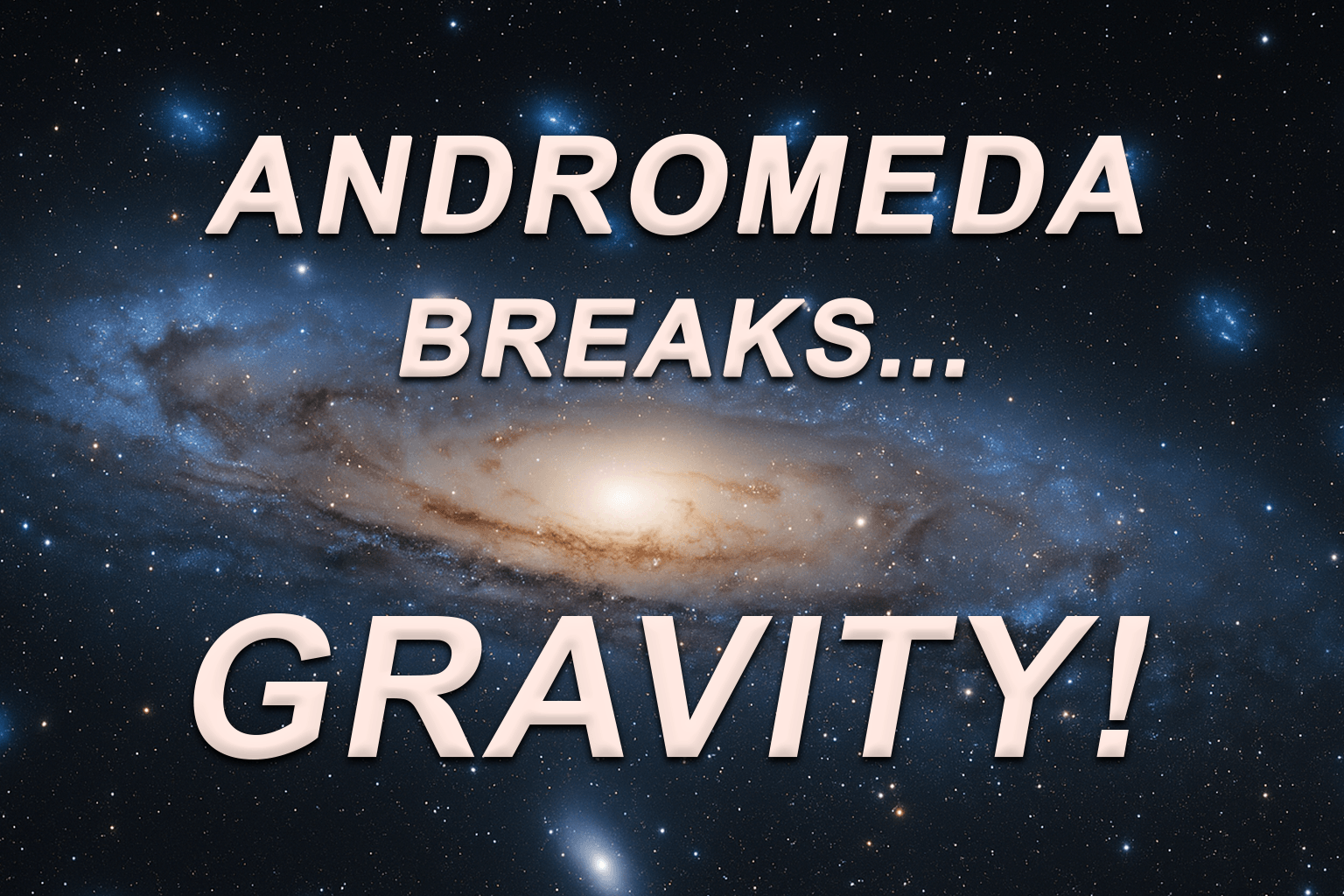
    A cosmic mystery has shaken the foundations of modern cosmology. Recent studies have revealed that 36 out of 37 of Andromeda’s satellite galaxies appear to be clustered in a directional plane pointing toward the Milky Way. This bizarre alignment isn’t just unusual—it’s statistically improbable and challenges the standard model of the universe.

    In a cosmos governed by randomness and dark matter halos, such structural precision should not exist. Yet here it is, 2.5 million light-years away, defying expectations and pointing—quite literally—at us.

    Why Is This Discovery So Alarming?

    According to the widely accepted Lambda Cold Dark Matter (ΛCDM) model, satellite galaxies should form more or less randomly around their parent galaxy, drawn in by gravity and trapped within an invisible web of dark matter. But the Andromeda anomaly exhibits a highly ordered plane of satellite galaxies, rotating coherently and clustered in one direction.

    This directional alignment is a violation of cosmological isotropy—the idea that the universe should look the same in all directions. When such a precise orientation occurs not once, but also in our own Milky Way’s satellite system, it begs the question: What underlying force is synchronizing galactic structures across millions of light-years?

    A New Theory Steps In: Acoustic Gravitic Theory

    One promising alternative comes from the emerging field of Acoustic Gravitic Theory (AGT). Rather than relying on spacetime curvature or mysterious dark matter, AGT proposes that gravity emerges from oscillating pressure waves—specifically, magnetosonic waves propagating through a plasma-filled universe.

    These waves, generated by stars and galaxies, travel through intergalactic plasma, creating standing wave structures—essentially vast cosmic resonance fields. Satellite galaxies don’t orbit by accident; they are phase-locked into nodal positions along these waves.

    In this model, the directional alignment of Andromeda’s satellites isn’t anomalous—it’s expected.

    “The universe isn’t random. It resonates,” says Louis D. Lockett, Sr., author of the Acoustic Gravitic Theory. “What we’re seeing in Andromeda is not a gravitational coincidence—it’s a wave-locked pattern in plasma. The same pattern exists around the Milky Way because both galaxies are immersed in the same standing wave cavity.”

    Magnetosonic Waves: The Real Architects of the Cosmos?

    AGT’s foundation lies in plasma physics and magnetohydrodynamics, building upon the work of scientists like Hannes Alfvén and Eugene Parker. In their view, intergalactic space is not empty, but alive with energy—ELF, ULF, Alfvén, and magnetosonic waves that shape everything from solar winds to galactic motion.

    This wave-driven view of gravity proposes that galaxies are not gravitational attractors, but resonant oscillators. Their satellite systems are not chaotic, but harmonic. The alignment toward the Milky Way is thus the result of shared phase-locking in a coupled plasma field—a concept AGT researchers refer to as “nodal entrainment.”

    Why This Changes Everything

    If Andromeda’s satellites are wave-locked and not gravity-bound, it would invalidate the need for dark matter in explaining galactic motion. Furthermore, it would imply that cosmic structure is governed by frequency, not mass.

    That opens the door to explaining other cosmic puzzles:

    • Why satellite galaxies rotate in planes
    • Why gravitational lensing could be caused by plasma refraction
    • Why redshift may relate to wave-medium coupling, not expansion

    In short, if AGT is right, the universe behaves less like a chaotic explosion and more like a resonant orchestra—structured by the physics of waves and plasma.

    Conclusion

    The directional clustering of satellite galaxies around Andromeda is not just an observational anomaly—it is a beacon pointing toward a radical shift in cosmological theory. While mainstream physics wrestles with the implications, Acoustic Gravitic Theory offers a coherent, testable, and physically grounded explanation.

    If cosmic structure is forged in wave harmonics rather than gravitational randomness, then we are not drifting in a void—we are resonating in a field.


    Scientific References

    Alfvén, H. (1981). Cosmic Plasma. D. Reidel Publishing Company.

    Ibata, R. A., Famaey, B., Lewis, G. F., Ibata, N. G., Martin, N. F., & McConnachie, A. (2013). A vast, thin plane of co-rotating dwarf galaxies orbiting the Andromeda galaxy. Nature, 493(7430), 62–65. https://doi.org/10.1038/nature11717

    Parker, E. N. (1958). Dynamics of the interplanetary gas and magnetic fields. The Astrophysical Journal, 128, 664. https://doi.org/10.1086/146579

    Sofue, Y. (2021). Dark Matter and the Rotation Curve of Galaxies. Galaxies, 9(4), 94. https://doi.org/10.3390/galaxies9040094

    Wang, J., Hammer, F., Yang, Y., Puech, M., Flores, H., & Kembhavi, A. (2013). Galaxy Pairs in Cosmological Simulations: Confronting ΛCDM with Observations. Monthly Notices of the Royal Astronomical Society, 433(1), 765–772. https://doi.org/10.1093/mnras/stt752