Gravitic Alchemy
Gravitic Alchemy Banner

Tag: Primary Bjerknes Force

  • We Are Not Stardust

    We Are Not Stardust

    How Acoustic Gravitic Theory Replaces Carl Sagan’s “Star Stuff” with a Wave‑Driven, Scripture‑Aligned Model of Creation

    We Are Not Stardust. The idea that humanity is merely the product of stardust is both scientifically and theologically flawed. It assumes that stars existed before us, that they had to die in violent explosions, and that the scattered debris eventually coalesced through gravity to form the elements of life. This narrative is not only contrary to Scripture but also dependent on a cosmological model rooted in speculation rather than causality. Acoustic Gravitic Theory presents a fundamentally different account, one that honors the biblical record, restores physical mechanism to gravity, and demonstrates how light could indeed precede stars in perfect alignment with Genesis.

    The “stardust” narrative emerges from the framework of Big Bang cosmology, an intellectual construct that begins with an uncaused explosion, introduces light billions of years after this supposed singularity, and ultimately invokes the death of stars as the source of the elements of life. This view was popularized by the late Carl Sagan, who famously declared, “We are made of star stuff,” a phrase that captured the imagination of an entire generation. While compelling as rhetoric, it represents a philosophy of existence rooted in death, randomness, and impersonal forces. Sagan’s poetic phrasing, embraced by Big Bang cosmology, helped cement a worldview that strips humanity of divine purpose and makes creation the unintended consequence of destruction.

    Acoustic Gravitic Theory rejects this inversion of cause and meaning. It replaces the imagery of cosmic funerals with the reality of wave-driven order, showing that creation did not emerge from stellar wreckage but from coherent resonance. Where Sagan saw the poetry of an accidental universe, AGT reveals the mechanics of an intentional one.

    The Failure of the Stardust Narrative

    The claim that we are made of stardust depends entirely on a reversal of the biblical creation sequence. Genesis is explicit: light came first. Stars were appointed later, and only after order had been established in creation. To insist that stars had to explode for life to exist imposes a cosmology of death before life, one in which the universe is a graveyard that gives birth. From a biblical standpoint, this is not merely incorrect; it is a denial of the very nature of God as Creator. From a scientific standpoint, it reduces all things to material accident, dismissing the existence of coherent mechanisms that establish the universe’s architecture.

    This inversion of cause and effect also collapses under scrutiny. If stars must explode to seed the elements, then life depends on catastrophic loss before it can begin. Such a view strips existence of inherent purpose and relegates creation to an accident. In contrast, Acoustic Gravitic Theory demonstrates that the medium of creation is not stellar debris but structured waves—magnetosonic, infrasonic, Langmuir, and Alfvén oscillations—driven by a coherent source. These waves propagate through plasma and atmosphere, imposing measurable gradients that shape gravity, organize matter, and establish stability. In this framework, light truly precedes stars, and gravity emerges not from mass-based attraction but from acoustic pressure applied through resonance. Creation is therefore not born from chaos but from the same ordered processes that Scripture declares.

    Gravity as Wave-Driven Pressure

    Acoustic Gravitic Theory begins with a fundamental redefinition of gravity. It is not an invisible pull acting across empty space nor a geometric deformation of spacetime. Instead, gravity is the mechanical consequence of vertical pressure gradients within a wave-filled medium. On Earth, this medium is the atmosphere. In space, it is plasma. These pressure gradients are generated by solar-driven ELF and ULF waves, which couple through Earth’s core to produce seismic oscillations. Those oscillations rise into the atmosphere as infrasonic waves, forming standing vertical pressure fields. Rigid objects immersed in this field cannot oscillate in phase, and because of this impedance mismatch, they experience asymmetric pressure that drives them downward. This is the Primary Bjerknes Force applied at planetary scale.

    This force can be expressed as:

    F = −VP

    Where
    F is the downward force in newtons
    V is the volume of the object in cubic meters
    • ∇P is the vertical pressure gradient in pascals per meter

    Using a gradient of approximately 12 pascals per meter, Acoustic Gravitic Theory reproduces the observed gravitational acceleration of 9.8 m/s2. This value is not a coincidence; it is the causal pressure field that has been misattributed to an abstract mass-based pull. The so-called “hydrostatic gradient,” traditionally treated as a derivative of gravity, is revealed in this model to be the very origin of gravitational force. Gravity is therefore not a field that curves space but the direct result of measurable wave pressure acting through a real medium.

    Light Before Stars

    This wave-based framework not only redefines gravity but also restores the biblical order of creation. Genesis records that God said, “Let there be light,” and only afterward does Scripture describe the making of the stars. In the conventional cosmological model, this sequence is inverted to suit materialistic assumptions. Light is treated as a byproduct of stellar ignition, and stars must die before anything of substance can form. Yet this is neither scriptural nor scientifically necessary. Acoustic Gravitic Theory demonstrates that light exists as a property of wave-bearing media and is not contingent upon the nuclear reactions within stars.

    Plasma—the dominant state of matter in the universe—is a resonant medium. It conducts and channels electromagnetic oscillations. Before the first star ever ignited, the medium itself could sustain luminous oscillations, carrying light without nuclear fire. Under AGT, stars are not the originators of light; they are luminous amplifiers embedded in a preexisting wave lattice. This view aligns not only with Scripture but also with the physics of plasma resonance. It allows for a creation in which light truly precedes the stars and where the order described in Genesis is physically coherent.

    From Atmosphere to Cosmos

    The implications of this model extend beyond Earth. Just as infrasonic standing waves establish gravity locally, magnetosonic and Langmuir waves organize planetary orbits in space. The Sun emits low-frequency oscillations that propagate through the heliospheric plasma at speeds of approximately 400 km/s. These waves form nested standing wave nodes. Planets do not orbit because they are falling through curved spacetime; they remain phase-locked within harmonic troughs of pressure equilibrium. Earth’s orbit at one astronomical unit corresponds precisely to the 2,244th harmonic of a solar oscillation near 0.003 Hz. This is not a coincidence; it is evidence of a wave-structured solar system.

    In this resonance-based architecture, orbits are stabilized by mechanical feedback. Phase-locked planets remain anchored within nodal structures. Mercury’s precession, instead of requiring relativistic corrections, arises from phase drift in the dense inner regions of the solar plasma. The so-called “three-body problem,” long considered chaotic in Newtonian mechanics, resolves into predictable resonance zones determined by overlapping pressure nodes. Gravity, orbital stability, and cosmic motion are unified under a single principle: wave-driven pressure fields within structured media.

    Refuting the Foundations of Stardust Cosmology

    The stardust narrative depends not only on the misplacement of light and stars but also on the acceptance of empty space as the stage for cosmic evolution. This is where it fails most completely. Space is not empty. Observations from missions such as Parker Solar Probe, Voyager, THEMIS, and IBEX confirm that the heliosphere and interstellar space are filled with plasma—ionized matter threaded with standing waves, Langmuir oscillations, and magnetosonic turbulence. These are measurable, structured phenomena. The universe is not a void; it is a resonant medium.

    This realization destroys the foundation of particle-based metaphysics. If plasma is the medium of gravity, then mass-based attraction is unnecessary, dark matter becomes redundant, and the concept of gravity as a pull through empty space collapses. In its place, Acoustic Gravitic Theory provides a fully mechanistic framework in which gravity, light, and cosmic structure are emergent properties of wave resonance. This wave-based model is not merely compatible with Scripture—it validates the order and causality that Scripture describes.

    Experimental Confirmation and Manipulation

    Acoustic Gravitic Theory is not a philosophical exercise. It proposes experiments capable of falsifying both itself and the mainstream model. The Vertical Infrasound Gradient Array (VIGA) is designed to measure the vertical infrasonic gradient predicted by AGT. If gravity truly arises from downward wave pressure, then such a gradient—on the order of 12 pascals per meter—must be measurable. Similarly, phase-cancellation experiments in controlled acoustic chambers can suppress or reverse this gradient, allowing local modulation of apparent weight. This is not theoretical speculation; it is an engineering pathway to gravity control.

    Further, AGT reinterprets time dilation as a form of resonant drag. Atomic clocks removed from the atmospheric pressure field—placed in vacuum isolation—should drift relative to identical clocks in ambient conditions. This is not because time itself is warped, but because the oscillators are decoupled from the pressure field that ordinarily entrains them. Each of these experiments represents a testable, mechanical alternative to relativistic abstractions. They ground gravity in sound and pressure rather than geometry and empty space.

    Creation as Coherent Structure

    In this view, creation ceases to be an accident. We are not the dust of dead stars scattered by ancient explosions; we are the product of a resonant universe in which light, pressure, and wave mechanics form the basis of physical law. Acoustic Gravitic Theory restores scientific integrity by replacing unobservable constructs with testable mechanisms and restores theological integrity by affirming the Genesis account as both spiritually and physically consistent. Light precedes stars. Gravity is not curvature but wave compression. Life emerges not from destruction but from coherent, purposeful order.

    When Scripture says that God “stretches out the heavens,” this is no metaphor. It is a precise description of wave-driven resonance shaping a structured cosmos. The heavens are stretched not as geometric fabric but as a dynamic field of oscillations. We are not the product of collapsed suns; we are the result of an active Creator who established a resonant universe and then declared it good.

    Conclusion

    The claim that we are stardust is the byproduct of a cosmology built on inversion, speculation, and denial of causality. Acoustic Gravitic Theory dismantles this claim by showing that gravity is measurable wave pressure, that light can indeed precede stars, and that the order of creation is both scientifically and scripturally sound. In this model, we are not the children of destruction; we are the result of design. Gravity is no longer an enigma but a tool, a phenomenon that can be understood, measured, and ultimately manipulated. Creation is no longer mythologized; it is restored as the coherent framework of existence.

    We are not stardust. We are the outcome of resonance, pressure, and light—an ordered universe spoken into being by God Himself, sustained by wave mechanics that point to His ongoing governance. Acoustic Gravitic Theory provides not only the scientific basis to reject the stardust myth but the experimental foundation for a new era of discovery, one in which physics and faith no longer stand opposed. In this wave-driven cosmos, science does not merely describe creation; it bears witness to the Creator.

    Sources and Citations

    Alfvén, H. (1986). Double layers and circuits in astrophysics. IEEE Transactions on Plasma Science, 14(6), 779–793. https://doi.org/10.1109/TPS.1986.4316607

    Parker, E. N. (2007). Conversations on electric and magnetic fields in the cosmos. Princeton University Press. https://press.princeton.edu/books/paperback/9780691128412/conversations-on-electric-and-magnetic-fields-in-the-cosmos

    NASA Goddard Space Flight Center. (2023). Parker Solar Probe data sets. Heliophysics Science Division. https://sppgway.jhuapl.edu/psp_data

    Voyager Project. (2022). Plasma wave science instrument data. NASA Jet Propulsion Laboratory. https://voyager.jpl.nasa.gov/science/data/

    Sagan, C. (1980). Cosmos. New York: Random House. https://www.penguinrandomhouse.com/books/159730/cosmos-by-carl-sagan/

    Meyer-Vernet, N., Issautier, K., & Moncuquet, M. (2017). Space plasma physics: An introduction to plasma and particle dynamics in space. Cambridge University Press. https://doi.org/10.1017/9781139027478

    Melrose, D. B. (2017). Plasma astrophysics: Part I – Basic principles. CRC Press. https://www.routledge.com/Plasma-Astrophysics-Volume-1/Melrose/p/book/9781138473184
  • The Real Engine of Gravity!

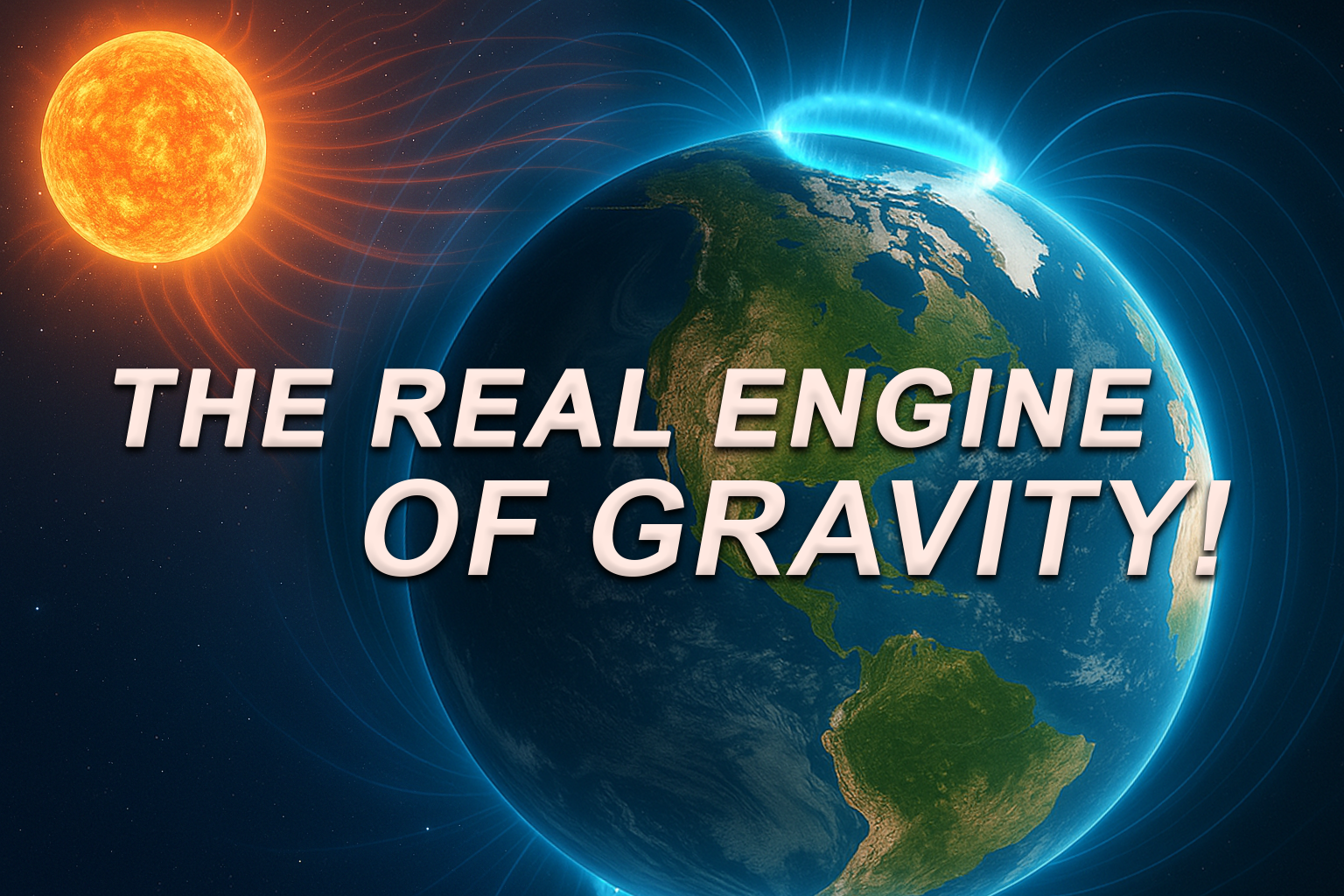
    The Real Engine of Gravity!

    3 Wave-Pressure Mechanisms That Replace Mass-Based Force

    The real engine of gravity isn’t mass. It isn’t spacetime curvature. It’s wave pressure acting through a physical medium, and the mechanism has a name, a mathematical formulation, and a documented laboratory record going back to the 19th century.

    This is what Acoustic Gravitic Theory proposes. Not that gravity is mysterious or that it needs a new set of abstract parameters. But that it’s already been explained, by wave physics, and physics simply hasn’t made the connection yet. The Primary Bjerknes Force, originally formulated by Carl Anton Bjerknes at the University of Christiania through the 1860s and 1870s and extended by his son Vilhelm Bjerknes in his 1906 Columbia University lecture series “Fields of Force,” is the engine. The medium is the atmosphere and the solar plasma. The mechanism is real, testable, and already operating.

    Let’s look at exactly how it works.


    The Problem with Traditional Gravity Models

    For well over a century, physicists have explained gravity through either Newton’s law of universal gravitation or Einstein’s geometric interpretation through General Relativity. Both frameworks treat mass as the origin of gravitational force. Neither provides a medium or a physical mechanism for how that force is transmitted.

    Newton’s formulation is honest about this gap. He famously refused to speculate on the mechanism, “Hypotheses non fingo,” meaning he frames no hypotheses about what gravity actually is. He only described what it does mathematically. Einstein’s spacetime curvature model replaced Newton’s description with geometry, which is more mathematically elegant, but the fundamental question remains unanswered. What is the physical carrier? What actually pushes or pulls? Curved geometry is a description of a path, not an explanation of what bends the path or why.

    Meanwhile, planetary orbits remain stable despite complex multi-body gravitational interactions that neither Newtonian nor relativistic models can solve analytically, a point Poincaré established definitively in his 1892 to 1899 treatise Les méthodes nouvelles de la mécanique céleste. The persistent stability of orbits across the full observed record of planetary motion, even for bodies like Venus that lack a significant magnetosphere, remains without a mechanistic explanation in the standard framework.

    AGT answers the mechanism question directly.

    RELATED: WHAT IS GRAVITY?
    https://graviticalchemy.com/what-is-gravity/


    Mechanism 1: The Primary Bjerknes Force in Earth’s Atmosphere

    On Earth, the real engine of gravity operates through a vertical pressure gradient in the atmospheric column sustained by a composite acoustic energy system.

    Secondary microseisms, generated by opposing ocean swell-train interactions and first characterized theoretically by Michael Longuet-Higgins at the University of Cambridge in his landmark 1950 paper in the Philosophical Transactions of the Royal Society, radiate continuous seismic power on the order of 10¹¹ to 10¹² watts globally into the crust at 0.1 to 0.3 Hz. Microbaroms generated by storm activity at the ocean surface deliver atmospheric infrasound reaching 0.05 pascals during major storms, monitored globally through the infrasound network of the Comprehensive Nuclear-Test-Ban Treaty Organization. Earth’s continuous seismic hum, established through the foundational 1998 paper of Naoki Suda, Kazunari Nawa, and Yoshio Fukao at the Earthquake Research Institute of the University of Tokyo, sustains the planet’s spheroidal normal modes from 0.309 millihertz through approximately 2 millihertz through infragravity wave loading of continental shelves.

    Schumann resonances inside the Earth-ionosphere cavity, sustained by roughly 100 lightning discharges per second globally, contribute coherent electromagnetic standing waves at 7.83, 14.3, and 20.8 Hz. Solar ELF and ULF oscillations carried by Birkeland currents into the polar ionosphere penetrate Earth’s conductive outer core, inducing oscillatory feedback through Faraday’s Law and Lenz’s Law and organizing the phase coherence of the composite field.

    The result is a vertically structured infrasonic standing wave field that produces a downward pressure gradient of approximately 12 Pa/m at the surface. This value matches the classical hydrostatic gradient of approximately 11.5 to 12 Pa/m from acoustic first principles, without any fitting to the observed gravitational acceleration. Solid bodies immersed in this field cannot oscillate in phase with the surrounding atmosphere because their internal impedance is several orders of magnitude higher than that of air. The asymmetric pressure across the body’s vertical extent produces a net downward force. That force is what we call weight. It’s the Primary Bjerknes Force applied to the terrestrial acoustic field, mechanical, deterministic, and continuous.

    This isn’t speculation. Acoustic levitation experiments at the Daniele Foresti group at ETH Zurich demonstrated programmable suspension and three-dimensional manipulation of objects through dynamically reconfigured standing wave fields. The mechanism is identical. The cavity is just larger.


    Mechanism 2: Orbital Phase-Locking via Solar Magnetosonic Waves

    In space, the real engine of gravity operates through the same Bjerknes principle at heliospheric scale.

    The Sun functions as a multi-frequency oscillator emitting magnetosonic waves, Alfvén waves first characterized by Hannes Alfvén in his 1942 Nature paper on electromagnetic-hydrodynamic waves, and ELF and ULF waves driven by solar rotation, coronal mass ejections, and magnetic reconnection events. These waves propagate outward through the heliospheric plasma and reflect inward from the heliopause, forming large-scale standing wave troughs at specific radial distances.

    Planetary bodies don’t orbit at arbitrary distances. They phase-lock into these troughs. Each planet acts as a nested resonant cavity, composed of atmospheric, ionospheric, and where present, magnetospheric shells, whose impedance prevents in-phase oscillation with the surrounding plasma field. The resulting pressure asymmetry across the cavity boundary produces a restoring force directed toward the trough minimum. Orbital stability is the resonant equilibrium of an impedance-defined cavity in a documented standing wave structure.

    Earth’s orbit, for example, aligns with the 2,244th harmonic of the solar oscillation frequency at the documented Alfvén wave speed across the inner heliosphere. That’s an empirical match that mass-based gravity doesn’t predict and can’t explain. It falls directly out of the wave-mechanical account.

    The Lagrange points that Joseph-Louis Lagrange identified in his 1772 essay on the three-body problem, including the L4 and L5 positions occupied by the Trojan asteroid swarms 60 degrees ahead and behind Jupiter, are within AGT specific instances of phase-aligned trough positions in the nested wave architecture. They’re not precarious gravitational balancing acts. They’re wave nodes.

    RELATED: ORBITAL MECHANICS
    https://graviticalchemy.com/orbital-mechanics/


    Mechanism 3: Birkeland Currents as Real-Time Feedback Infrastructure

    The real engine of gravity doesn’t just establish an initial structure. It maintains it actively through a continuous electromagnetic feedback circuit.

    Birkeland currents, the large-scale field-aligned electric current systems flowing along magnetic field lines between the Sun and planetary poles, complete a global energy circuit that modulates the resonant properties of the heliospheric wave field in real time. First proposed by Kristian Birkeland at the University of Christiania in the early 20th century and confirmed through satellite measurements by Adolph Ivar Fälthammar and colleagues in the 1970s, these currents carry vast electrical streams that continuously energize planetary cores and reinforce planetary magnetic fields through inductive coupling.

    Alfvén waves propagate along magnetic flux tubes, transferring momentum and energy from solar activity outward through the entire system, as Alfvén detailed in his 1981 book Cosmic Plasma. This means the heliospheric standing wave structure isn’t a static snapshot frozen in place. It’s an actively maintained resonant cavity, continuously re-energized by the Solar Induction Dynamo. When solar activity fluctuates, the Birkeland current system adjusts. When the wave field shifts, planetary cavities track their trough positions through the same impedance-mediated feedback.

    This is why the solar system maintains its stability across the full documented observational record. A purely gravitational system is conservative, energy is preserved but not replenished. Real planetary systems lose energy through tidal dissipation, radiation pressure, and other mechanisms. Something has to be doing the work of maintaining the structure, and that something is the active electromagnetic infrastructure of the Solar Induction Dynamo. Gravity, in AGT, isn’t a passive attraction. It’s an actively maintained pressure condition.

    RELATED: WAVES CARRY FORCE
    https://graviticalchemy.com/waves-carry-force/


    Why Venus and Mars Still Work

    One question comes up regularly: Venus lacks a significant global magnetosphere, and Mars has only a weak remnant field. If orbital stability depends on a planetary magnetosphere coupling to the solar wave field, how do these bodies maintain stable orbits?

    The answer is ionospheric resonance. Both planets retain ionospheres, structured plasma layers in their upper atmospheres that continue to interact with the solar plasma medium and respond to passing magnetosonic waves. The impedance contrast between the ionospheric cavity and the surrounding solar plasma is sufficient to generate the Bjerknes-type restoring force that keeps the body locked to its trough position. Magnetospheric shells amplify the coupling, but they’re not required for it to operate.

    Venus’s anomalous slow retrograde rotation, characterized through the Goldstone Solar System Radar observations of Roland Carpenter in 1962 and confirmed through the Soviet Venera missions from 1961 to 1984, fits directly into this account. Within AGT, Venus resides in a phase-inverted trough within the inner heliospheric standing wave structure, and its ionosphere is the coupling interface. The rotation isn’t a mystery requiring a special-case explanation. It’s a geometrically derivable outcome of the wave-phase relationship at Venus’s orbital position.

    This extends the real engine of gravity to every body in the solar system with any kind of plasma interaction, which includes every significant body we’ve characterized.


    Conclusion

    The real engine of gravity is a pressure mechanism operating in a real physical medium, not a geometric metaphor stretching across empty space. On Earth, it’s the Primary Bjerknes Force applied to a vertically structured infrasonic standing wave field sustained by ocean-driven acoustics, solar electromagnetic input, and Schumann resonances. In the heliosphere, it’s the same Bjerknes principle applied to magnetosonic standing wave troughs maintained by the Solar Induction Dynamo through Birkeland currents and Alfvén waves.

    This is a unified, testable, mechanistic account. It reproduces the observed gravitational acceleration at Earth’s surface from acoustic first principles without fitting parameters. It explains orbital spacing through documented wave harmonics. It accounts for anomalous planetary behavior through wave-phase geometry rather than special-case hypotheses. And it does all of this by appealing to physical processes that are already documented, already measured, and already operating.

    The standard models describe what gravity does. AGT explains what gravity is.

    The full mathematical derivation, including the complete dispersion model and energy budget, is available at graviticalchemy.com. To follow the development of AGT and join the community building this out, visit skool.graviticalchemy.com. To support the experimental validation program directly, visit buymeacoffee.com/graviticalchemy or merch.graviticalchemy.com.


    Supporting Scientific Literature

    Longuet-Higgins, M. S. (1950). A theory of the origin of microseisms. Philosophical Transactions of the Royal Society, 243(857), 1-35. https://royalsocietypublishing.org/doi/10.1098/rsta.1950.0012

    Suda, N., Nawa, K., and Fukao, Y. (1998). Earth’s background free oscillations. Science, 279(5359), 2089-2091. https://www.science.org/doi/10.1126/science.279.5359.2089

    Alfvén, H. (1942). Existence of electromagnetic-hydrodynamic waves. Nature, 150(3805), 405-406. https://www.nature.com/articles/150405d0

    Alfvén, H. (1981). Cosmic Plasma. D. Reidel Publishing Company. https://link.springer.com/book/10.1007/978-94-009-8374-8

    Bedard, A. J., and Georges, T. M. (2000). Atmospheric infrasound. Physics Today, 53(3), 32-37.
    https://doi.org/10.1063/1.883019

    Chen, F. F. (2016). Introduction to Plasma Physics and Controlled Fusion. Springer. https://link.springer.com/book/10.1007/978-3-319-22309-4

    Kelley, M. C. (2009). The Earth’s Ionosphere: Plasma Physics and Electrodynamics. Academic Press. https://www.elsevier.com/books/the-earths-ionosphere/kelley/978-0-12-088425-4

    Balogh, A., and Treumann, R. A. (2013). Physics of Collisionless Shocks: Space Plasma Shock Waves. Springer. https://link.springer.com/book/10.1007/978-1-4614-6099-2