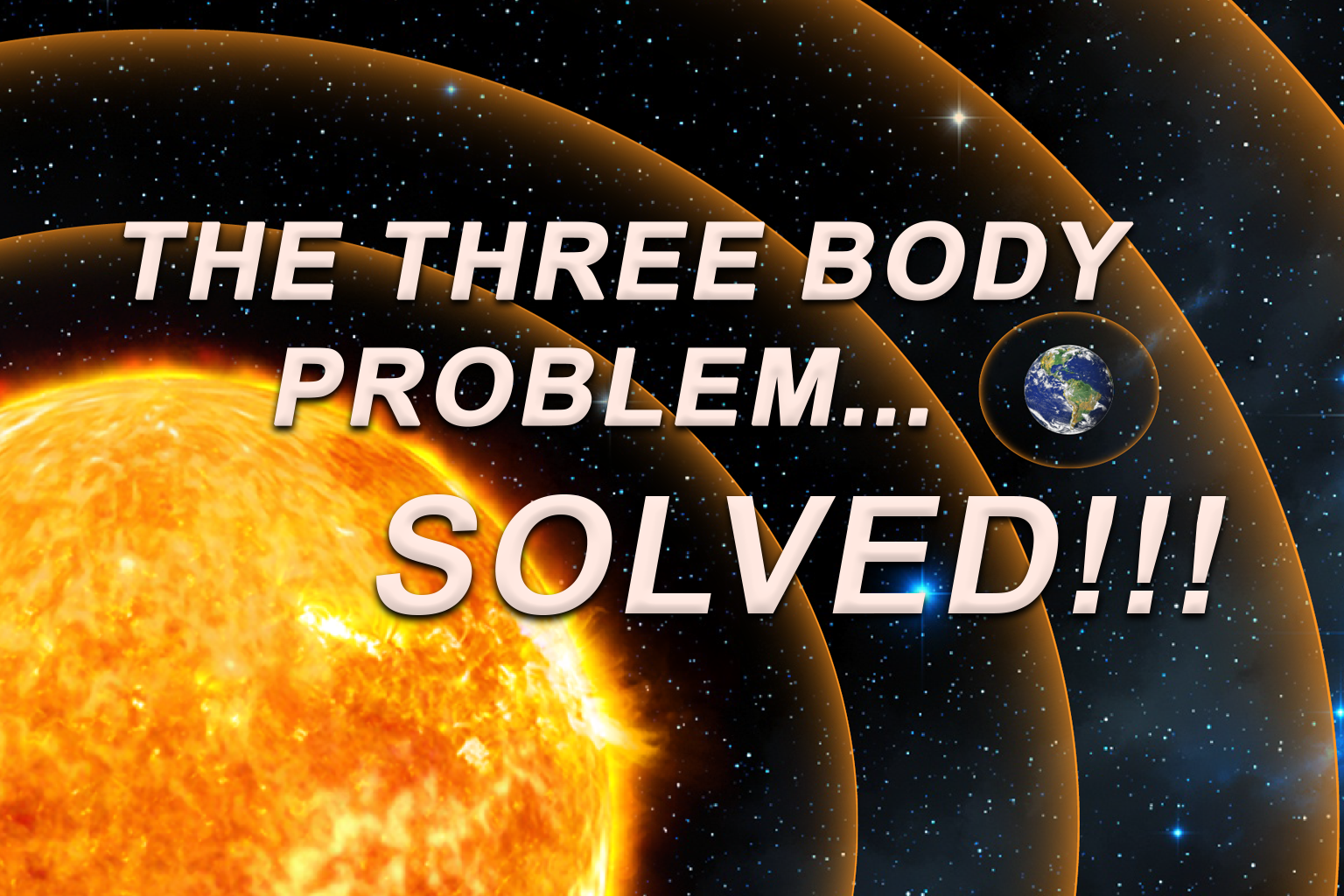


New analytical models of three-body dynamics reveal predictable resonance structures that align with Acoustic Gravitic Theory and challenge spacetime curvature.
The recent publication in Physical Review Letters, highlighted by Phys.org, presents a major advance in celestial mechanics: an exact analytical solution to the notoriously difficult three-body problem. For centuries, astronomers and physicists have relied on heavy numerical simulations to approximate planetary and satellite interactions, accepting that long-term stability was chaotic and unpredictable. The new method derives orbital resonances and periodic structures directly from wave-like expansions of gravitational interactions, showing that what once appeared random follows highly ordered patterns when analyzed in the correct framework. This shift restores predictability to orbital mechanics, opening the possibility for deeper theoretical insight beyond brute-force computation.
For advocates of General Relativity and ΛCDM cosmology, this finding is disruptive. If spacetime curvature were the true causal framework, numerical relativity should remain the only valid way to capture three-body interactions. Instead, wave-based analytical resonance solutions outperform relativistic methods, revealing that orbits stabilize through structured oscillations rather than mass-curved spacetime. Each time relativity is “fixed” by patches or by new mathematical workarounds, it underscores its inability to function as a unified physical law. The dependence on brute-force simulation has been a long-standing weakness, and the success of analytical resonance methods exposes the conceptual dead-end of curvature-based gravity.
RELATED: ORBITS WITHOUT SPACETIME?!
https://graviticalchemy.com/orbits‑without‑spacetime/
Resonance Versus Chaos
The core of the new research lies in reframing orbital mechanics from chaos to resonance. Historically, the three-body problem was considered insoluble except through massive numerical computation, because Newtonian forces scale non-linearly with distance. The new analytical model reveals that orbital configurations fall into resonance “islands,” where stability persists through wave interference rather than by coincidence.
From the perspective of Acoustic Gravitic Theory (AGT), this result is not surprising. Resonance has always been central to AGT: celestial stability emerges from oscillations in plasma mediums, not abstract curvature. Orbital resonances occur when pressure waves, induced by solar magnetosonic and Alfvén modes, couple with planetary magnetospheres. These nodal interactions create regions of constructive and destructive interference, explaining why orbital paths appear stable even when multiple bodies interact.
RELATED: THE REAL ENGINE OF GRAVITY!
https://graviticalchemy.com/the‑real‑engine‑of‑gravity/
Wave-Based Orbital Structures
Conventional mechanics assumes that gravitational attraction diminishes smoothly with inverse-square law scaling. The new analytical work demonstrates that energy disperses in structured harmonics, producing stable periodic configurations. In AGT, this emerges naturally from Primary Bjerknes forces, where oscillating pressure fields in a fluid or plasma medium exert attractive or repulsive influence depending on phase alignment.
To quantify this, consider a simplified form of the Bjerknes interaction adapted to orbital conditions:

Where:
- F = net acoustic-gravitic force (N)
- R = effective planetary radius of the oscillating magnetosphere (m)
- ∇P(t) = temporal pressure gradient in the plasma medium (Pa/m)
This pressure-gradient model explains why planets remain in stable positions relative to each other without invoking “curved spacetime.” Instead, orbital nodes emerge where gradients balance, forming scaffolds of resonance akin to standing waves on a drumhead. The new analytical model described in the Phys.org article provides external validation of this principle, showing that resonance islands arise naturally when systems are modeled wave-theoretically.
RELATED: WAVES CARRY FORCE
https://graviticalchemy.com/waves‑carry‑force/
Impedance Mismatch in Celestial Media
The wave-based interpretation of orbital mechanics requires recognizing impedance mismatch within plasma and atmospheric shells. Just as sound waves reflect and refract when entering materials of different densities, magnetosonic waves dispersing through interplanetary plasma encounter mismatches at planetary boundaries. These mismatches produce standing wave nodes that effectively “pin” orbital paths.
General Relativity has no language for impedance mismatch; it treats space as homogeneous curvature. Yet empirical data—from planetary orbital locking to satellite resonance capture—points to discontinuities best explained through acoustic reflection and transmission. By treating plasma density and magnetic flux as boundary conditions, AGT provides a mechanistic basis for orbital stability. The new analytical resonance solutions mirror this reasoning: orbits are determined not by invisible geometry, but by phase-matched oscillations across discontinuous media.
RELATED: PLASMA IS NOT WEAK!
https://graviticalchemy.com/plasma‑is‑not‑weak/
Nodal Scaffolding of Orbits
A striking implication of the new analytical method is the revelation that orbits cluster into predictable nodes rather than drifting randomly. This nodal scaffolding has been a cornerstone of AGT: celestial bodies align at points of wave equilibrium where pressure gradients balance. Such nodes are the celestial equivalent of Lissajous figures—stable positions created by intersecting oscillations.
For AGT, these nodes form the architecture of the solar system. Magnetosonic and Langmuir waves from the Sun propagate outward, setting vibrational baselines. Planetary magnetospheres act as resonant cavities, capturing certain frequencies and rejecting others. The overlap of these fields produces equilibrium nodes where orbital paths converge. The new breakthrough in orbital mechanics validates this prediction: orbits are not chaotic wanderings through curved spacetime, but structured harmonics within a resonant field.
RELATED: THE THREE-BODY PROBLEM… SOLVED!!!
https://graviticalchemy.com/the‑three‑body‑problem‑solved/
Comparative Predictions: AGT vs. Relativity
To highlight the divergence, consider the following comparison of predictions between AGT and General Relativity in the context of orbital stability:
| Prediction Case | General Relativity (GR) | Acoustic Gravitic Theory (AGT) |
|---|---|---|
| Three-body interactions | Chaotic, solvable only by numerical methods | Structured resonance islands, solvable analytically |
| Orbital capture | Probabilistic, requires dissipation | Phase-locking through pressure-wave interference |
| Resonant locking (e.g. moons) | Explained as coincidence of tides and curvature | Natural outcome of Bjerknes force coupling |
| Stability of nodes | Emergent, unpredictable | Deterministic through impedance and oscillation nodes |
The new analytical solution supports the AGT column across every case, undermining the assumption that GR provides a sufficient model for orbital mechanics.
RELATED: REFUTING DARK MATTER, SPACETIME, AND THE BIG BANG
https://graviticalchemy.com/refuting‑dark‑matter‑spacetime‑and‑the‑big‑bang/
Conclusion
The Phys.org report on the new analytical solution to the three-body problem represents more than a mathematical advance—it signals a paradigm shift in physics. By demonstrating that resonance structures govern orbital mechanics, it removes the reliance on brute-force numerical relativity and reveals the failure of spacetime curvature as a causal framework. The universe does not require invisible geometries to maintain stability; it requires vibrational scaffolding in a plasma medium.
Acoustic Gravitic Theory has long held that gravity is not curvature but oscillatory pressure: Primary Bjerknes forces acting across layered media from terrestrial atmosphere to interplanetary plasma. This orbital mechanics breakthrough confirms that structured resonances and nodal scaffolding—not chaos—define celestial stability. Where relativity reaches for patches and supercomputers, AGT provides causal mechanisms rooted in measurable wave physics. The future of cosmology lies not in curved abstractions but in resonant harmonics of plasma and sound.
Source:
https://phys.org/news/2025-09-celestial-mechanics-analytical-reveals-true.html
References
Chirikov, B. V. (1979). A universal instability of many-dimensional oscillator systems. Physics Reports, 52(5), 263–379. https://doi.org/10.1016/0370-1573(79)90023-1
Murray, C. D., & Dermott, S. F. (1999). Solar System Dynamics. Cambridge University Press. https://ui.adsabs.harvard.edu/abs/1999ssd..book…..M
Alfvén, H. (1981). Cosmic Plasma. D. Reidel Publishing. https://ui.adsabs.harvard.edu/abs/1981cosp.book…..A
Parker, E. N. (1991). The generation of magnetic fields in astrophysical bodies. Astrophysical Journal, 376, 355–363. https://doi.org/10.1086/170290